
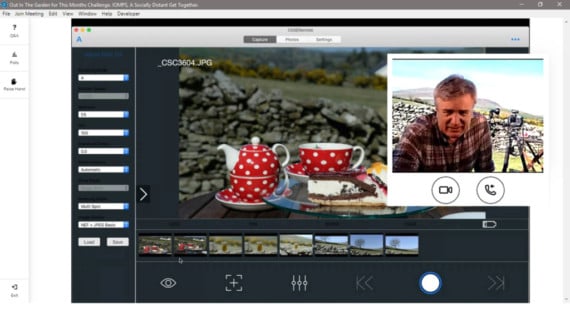
In the current absence of a regular weekly meeting due to travel restrictions, the Isle of Man Photographic Society has explored ways to engage with our members and to provide ideas for taking images during our enforced separation.
We were therefore delighted to have leading island photographer and honorary life member of the society, Andrew Barton LBIPP LMPA, arrange a "webinar" (web-based seminar) from his garden to give a tutorial on the subject of "depth of field".
This necessitated Andrew setting up a very complicated arrangement in his garden, including two cameras, his computer plus the cables to connect with the internet, thereby enabling our members to join in and ask questions or comment on the process.
It was clearly a major effort on his part to manage all this when he would usually have an assistant with him to carry some of the load.


.jpeg?width=209&height=140&crop=209:145,smart&quality=75)
It proved challenging but successful. It was a "first" for our society but a possible rehearsal for the future.
With the slopes of the North Barrule hillside visible in the background, Andrew had arranged several set-ups to demonstrate the concept of "depth of field".
It is rather technical in terms of the physical characteristics of a lens design (of which more will be described in next week’s article) but essentially depth of field is the distance between the closest and furthest objects in your image which appear sharp - anything closer or further away becoming less and less sharp and ultimately becoming totally defocussed.
It is a fundamental aspect of photography and one, when understood, can be exploited by the photographer to enhance an image.
Thus it is usually considered important that the main subject should be in focus -but it then depends on the subject (and the photographer’s vision of the intended image) as to how much of the rest of the image is in focus.
For our webinar and to tie in with our members’ monthly challenge of ’Home and Garden’, Andrew had arranged an "afternoon tea" set-up, with cups, a tea pot and a slice of cake - and showed how a wide-open lens aperture (say at f2.8) held only the cake in focus, while the smaller the aperture the more the other components came into focus until at f22 (a very small aperture) even the background was becoming clear.
But please note that each change to a smaller aperture requires a compensating adjustment with a longer speed setting.
Andrew also demonstrated a way of shooting macro images on a mobile phone with a lens costing under £5, this is an attachment that just clips on to the existing lens!
Why not try a few shots in the garden - maybe a family member sitting in a chair, using different apertures as an experiment - you’’ll soon get the hang of a quite difficult concept.
Thank you Andrew for arranging the webinar, it was well worth the effort.
However you take your images, if the result is pleasing and you like it, then good enough - your shots will provide a record of the day or the event and always be there to remind you of it.
Check out our website - www.iomps.com - for more ideas to stimulate and inspire your photography.
Chris Blyth
Comments
This article has no comments yet. Be the first to leave a comment.