
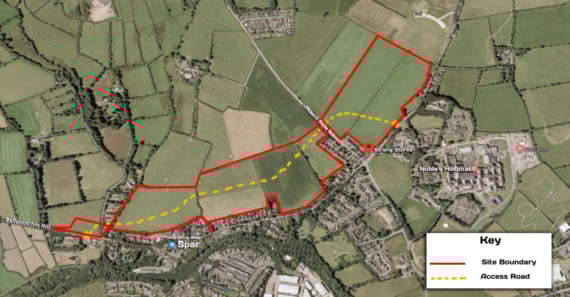
Residents in the area of Camlork have told the public inquiry into the area plan for the east it would ruin an area of natural beauty.
The inquiry heard claims that development on green fields was unnecessary, that it would increase the risk of flooding and raise problems over sewage treatment.
The residents are all members of the pressure group Save Camlork, which wants to see the island’s countryside protected and no building allowed in the area.
John Kermode began by restating previous arguments that government figures show a fall in projected population and a large number of empty properties in the island.



.jpg?width=209&height=140&crop=209:145,smart&quality=75)
He told the inquiry chairman Michael Hurley that the island has ’long had empty houses’ and that ’building new estates in the countryside will not fix the issue but make it worse’.
example
Mr Kermode gave the example of the number of brownfield sites in Douglas that could be built on to provide housing rather than greenfield sites.
He also made the inquiry aware of the prominence of the area which forms part of the ’Plains of Heaven’ in election manifestos from Middle MHKs Bill Shimmins and Chief Minister Howard Quayle and the pair’s previous commitments to oppose to development in the area.
Calum MacNeil, who is a freshwater biologist and previously worked for the Department of Environment, Food and Agriculture, said he was concerned about the risk of flooding in the area, particularly around Trollaby stream and the issue of sewage pollution.
Dr MacNeil said his property in the area has suffered from regular flooding despite it backing onto fields which should ease the problem.
He said that replacing the area with concrete and housing ’will in my opinion increase the frequency and severity of flooding’.
The Cabinet Office’s representative John Barrett QC said that modern building techniques including on site attenuation (retention of storm water on site and slowly releasing it in a controlled discharge) may actually decrease the risk of flooding.
However, Dr MacNeil said he was ’sceptical of that’.
Dr MacNeil also raised concerns about the treatment of sewage. He gave the example of the new estate at Ballaglonney Farm, which has its own temporary treatment unit which treats sewage, under licence from the Department for the Environment, Food and Agriculture, before releasing it.
He is concerned that if that were to happen, even short term with the Trollaby Stream, this would damage the stream’s current ’excellent’ water quality.
However, Mr Barrett assured him that if a treatment plan could not be devised for any development that was not ’up to scratch’ then the development could not go ahead.
Comments
This article has no comments yet. Be the first to leave a comment.