

A modern and less restrictive law on abortion moved a step closer to reality in the House of Keys this week.
MHKS voted to accept amendments made by the Legislative Council to the Abortion Reform Bill, bringing Dr Alex Allinson’s draft legislation nearer to becoming law.
Members also agreed some additional changes on Tuesday.
These new amendments were placed by Chris Robertshaw (Douglas East) and Chief Minister Howard Quayle, but were largely technical, aiming to tighten certain parts of the bill in relation to counselling services available for women after a termination, the definition of ’treatment’, which clarifies the extent of conscientious objection, and a strengthening of the position to prevent sex-selective abortions.
.jpeg?width=209&height=140&crop=209:145,smart&quality=75)


Although the latest alterations were agreed unanimously, it does mean the bill has to go back to the Legislative Council next week for agreement to the final changes.
Supporters of the Bill are hopeful this will not cause any delay, as it should still be possible to have it ready to go to the next sitting of Tynwald on November 20, when it will need to be signed off and sent for royal assent, before it can become law.
Since the Bill was first introduced to the Keys by Dr Allinson in January, the bill has undergone many amendments, while retaining its core principles of relaxing the current restrictive regime and removing criminality.
Dr Allinson said: ’We have come a long way since last January.
’I have learnt so much in the long process of drafting and refining legislation but have always been supported by the majority of people from all backgrounds and faiths who appreciate law reform is vital for our society.’
He added: ’This Bill ceased to be my private member’s Bill months ago. It is now our Bill - a piece of law crafted by all members of Tynwald which I believe we can be justly proud of.’
Once the Bill becomes law, abortion will be permitted upon request up to 14 weeks, under specified circumstances including ’serious social grounds’ during the 15-24-week period, and in certain emergency or serious situations after 24 weeks.
Provision has also been included to create ’access zones’ around medical centres to protect women and medics from harassment.
The Department of Health and Social Care has already begun preparations, in anticipation of the Bill becoming law.
Under the law as it stands, termination is legal up to 24 weeks where medical practitioners consider there is substantial risk the child will not survive birth, will die shortly afterwards or will be seriously handicapped.
Pregnancies resulting from rape, incest or sexual assault may be terminated up to 12 weeks, but women must provide an affidavit attesting to the cause of the pregnancy. Terminations on social grounds are not allowed.
Reform campaigners argued the rules were too restrictive and forced women to travel off-island for a procedure.
The debates in the House of Keys and Legislative Council have been exacting in their detail and the atmosphere has been mostly civil - even though there were moments of exasperation at what some perceived as delaying tactics by opponents of reform, who in turn were concerned at possible undue haste at the expense of other rights.
Outside of the chamber, however, it has not always been so respectful.
Abort67 outraged many with their protests, designed to shock with graphic pictures. Some more moderate opponents of reform have acknowledged those extreme tactics may have actually weakened their case.
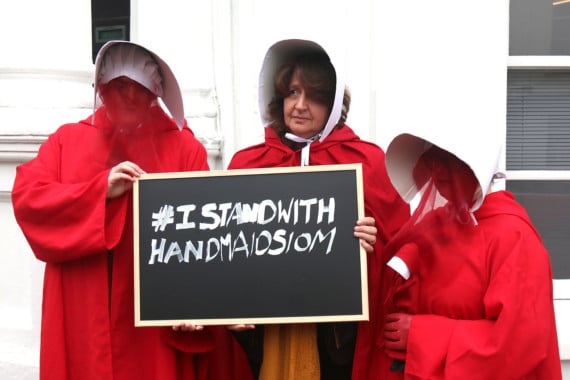
Meanwhile, some of those against reform took issue with the silent presence of Handmaids Isle of Man - the pro-choice group whose members wear the iconic veiled outfits, from Margaret Attwood’s The Handmaid’s Tale, and followed up their first memorable protest at Tynwald Day 2-2017 with more appearances this year.
Comments
This article has no comments yet. Be the first to leave a comment.