

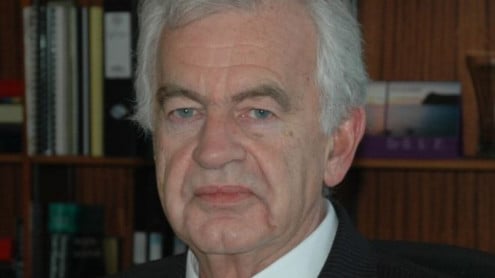
Attorney General John Quinn has warned of the risks of any fresh attempt to add sunset clauses to the Brexit Bill.
Attempts to add such a provision - which would mean that laws renewed under the Brexit Bill would have to be reaffirmed by Tynwald within five years, or they would expire - were defeated in the House of Keys.
Now the bill - formal title the European Union and Trade Bill - is before the Legislative Council and it is possible that a fresh attempt will be made.
But Mr Quinn, who is guiding the bill through the upper chamber, said: ’We need to be very careful with sunset clauses as they are not appropriate in all situations, especially where we are dealing with large volumes of legislation.’ He added: ’If large volumes of legislation expire at the same time, this in itself could cause large gaps in our statute book if there is no other legislation in place to replace it and making sure that there is appropriate legislation in place to replace such a large volume of expired legislation would be a challenging, possibly insurmountable, task.’
.jpeg?width=209&height=140&crop=209:145,smart&quality=75)
.jpeg?width=209&height=140&crop=209:145,smart&quality=75)

The impact could have a knock-on effect for other laws, he warned.
’Sunset clauses also have the potential to cause uncertainty for individuals and businesses if they are subject to or rely upon legislation which has a limited duration,’ he added.
Mr Quinn was speaking as MLCs gave a first reading to the bill. Any further proposed amendments will be debated at the clauses stage, which is due to take place today (Tuesday).
The Brexit Bill is enabling legislation that will allow the government to effectively retain EU laws after Brexit.
If action is not taken there is a risk that EU laws that were applied to the Isle of Man via its relationship under Protocol 3 will cease to exist. The risk would be heightened if there was a no-deal Brexit.
Mr Quinn said: ’The effect of all this EU legislation ceasing to be part of the law of the island would be large gaps in the island’s legal framework, particularly in relation to agriculture and fisheries and customs matters.
’One of the principal purposes of this bill is to avoid such a legal cliff edge and ensure as smooth a transition as possible from immediately before exit day to immediately after exit day.’
With growing uncertainty as to whether Theresa May will be able to obtain parliamentary approval for the exit deal she has brokered with the EU, the need for the Manx Government to plan for every eventuality has been emphasised.
Mr Quinn added: ’The only outcome under which this bill would not be needed is an outcome that nobody seriously expects to happen - that is, for Brexit to be cancelled.’
Under the bill, the Council of Ministers will be able to use secondary legislation - Tynwald orders - to keep the laws affected in place. Tynwald orders can be approved in a single sitting, unlike bills, which have to go through several stages of scrutiny.
That caused some alarm at a reduction in scrutiny.
At last week’s LegCo sitting Jane Poole-Wilson said the bill highlighted concerns about the process for scrutinising secondary legislation. Members can only vote for or against a Tynwald order, they cannot attempt to amend it.
Balance
She said: ’I hope to see sensible improvements that where possible allow for increased time for consideration of secondary legislation and that strike a better balance between expediency and scrutiny, and that move away from the current "yes" or "no" options that do not allow for amendment and improvement to the piece of legislation being considered.’
Comments
This article has no comments yet. Be the first to leave a comment.