

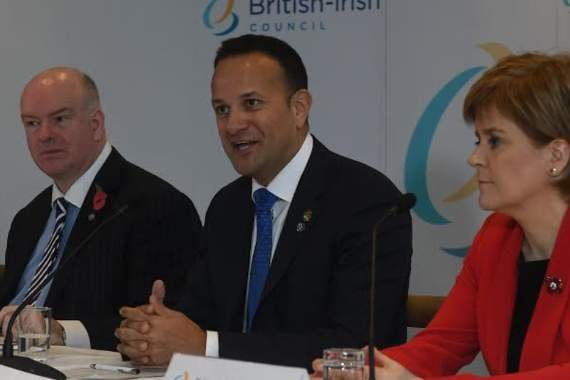
Chief Minister Howard Quayle says he is hopeful agreement on a Brexit deal is close - and the ’sooner the better’.
He was hosting the 31st summit of the British Irish Council at the Comis at Mount Murray Hotel today where British and Irish leaders suggested an agreement could be reached within weeks.
Present were Irish Taoiseach Leo Varadkar, Chancellor of the Duchy of Lancaster David Lidington MP, Scottish First Minister Nicola Sturgeon, Welsh First Minister Carwyn Jones and Jersey’s First Minister Senator John Le Fondré.
Mr Quayle said: ’The UK seems confident as much as they can be that a deal is to be agreed. All administrations want a deal to be reached.
-(1).jpeg?width=209&height=140&crop=209:145,smart&quality=75)
’We are obviously concerned but I think the sooner the better that an agreement can be reached. The definition of a good agreement we can all have views on.’
The summit came as UK Premier Theresa May faced a potential rift with the DUP over the contents of a leaked letter that appears to suggest she would sign up to a ’backstop to the backstop’ that would mean a border down the Irish Sea.
Asked whether the Northern Ireland backstop would or would not feature in any withdrawal agreement, David Lidington said: ’We don’t comment on alleged leaked documents but the position remains as it has always been. ’And the Prime Minister has always been very clear that we won’t accept something that involves carving out Northern Ireland from the rest of the UK.’
Mr Varadkar told reporters that it was more likely than not that a deal will be agreed within weeks.
He said: ’We are at a sensitive point in the negotiations. A successful outcome in not guaranteed but it is possible in the next couple of weeks.’
’I think it’s more likely than not that we will be able to agree an agreement in the next few weeks, before the end of the year. But lots of things can go wrong and even if we can agree before the end of year, bear in mind what’s agreed will have to be ratified by Westminster and also by the European parliament.
’And even when all that is done, then we begin talks on the future relationship. There’s no clean break here, this could go on for a very long time.’
Mr Lidington said: ’I think we remain very determined to getting a good deal that works for every part of the UK and which we also think will work well for the EU27.
’I think that if we get the withdrawal agreement and accompanying political declaration, which I hope that we can secure in the weeks to come, that will create a new dynamic.
’It will no longer be a question of some hypothetical outcome. There will be product on the table which all will have signed up to. It will have involved compromises, give and take on all sides.’
Nicola Sturgeon said: ’Clearly the next few days are going to be critical and we will wait to see what transpires.
’If a deal can’t be struck or perhaps more likely it is but can’t command a majority in the House of Commons, we mustn’t any of us assume, that makes crashing out of the EU next March with no deal inevitable.
’Instead in my view that should open up other options and my preferred option all along if the UK is leaving the EU, which I regret, is that it should seek to stay within the single market and customs union.’
She said she made no bones that Brexit experience had exposed ’real weaknesses’ within the devolution settlement. But she said it actually strengthened the relationship between Scotland and the other devolved administrations.
Mr Varadkar said he believed institutions like the British-Irish Council could have a new life and new purpose after Brexit.
He explained: ’At the moment because we are both members of the EU, British and Irish Ministers meet the counterparts about four times a year. After the UK leaves the EU next March that won’t happen anymore.
’We are all going to be part of the Common Travel Area. This body can become the forum to iron out any issues that may arise around that and I know the Crown Dependencies were talking today about some of the issues around financial services and financial regulation.
’And even though the UK will be out of the EU, the Crown Dependencies obviously will continue to have major involvement with European financial markets and will be interested to have some agreed influence on what decisions are made at European level.’
Comments
This article has no comments yet. Be the first to leave a comment.