
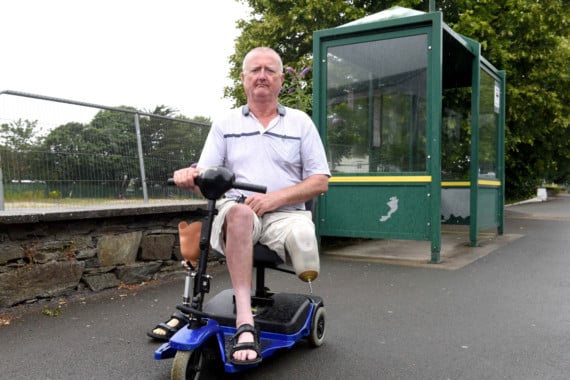
The government minister in charge of the island’s buses has insisted that mobility scooters would be welcome aboard - once safety is assured.
A bitter row has broken out between former Ramsey commissioner Eric Corkish and the Department of Infrastructure after Mr Corkish was told he could not take his mobility scooter aboard buses. Bus chiefs cited safety reasons, following a trial period during which Mr Corkish was allowed his scooter on board.
Infrastructure Minister Ray Harmer was forced to defend that decision in Tynwald last week. He said it was not possible to safely secure a mobility scooter on any of the buses in the current fleet.
’An unrestrained mobility scooter poses an unacceptable risk to anyone sitting on it or being carried on it on the bus,’ he said.
.jpeg?width=209&height=140&crop=209:145,smart&quality=75)


’We did conduct a brief trial with one passenger, who was keen to assist us. Unfortunately while the passenger could get onto the bus, the scooter did not remain still during the journey.
’In future, we can and would aim to buy buses that are fitted with suitable restraints for mobility scooters and we will certainly make this clear to the travelling public.’
There were no problems with wheelchairs, either powered or not, he said, but larger mobility scooters designed for use on roads and pavements could not be secured.
Policy
’We are in no way discriminating against those who have problems walking. Rather, we are asking those who cannot walk as far to choose their mobility aid carefully if they want to use it on the bus.
’Our policy is to carry all passengers we can safely and legally carry. Buses are designed to carry wheelchairs and prams without the need for special additional restraint and our drivers regularly carry these.’
The issue was raised by Lawrie Hooper (LibVannin, Ramsey) who rejected the argument.
’It is interesting that other jurisdictions that use the same types of buses that we use, that follow the same types of regulations that we follow, actually do have schemes in place to allow for certain types of mobility scooters to be used,’ he said.
Mr Harmer said: ’It is all about being legal and safe.’ Once buses could accommodate mobility scooters legally and safely, then the situation would change.
He said that would be borne in mind when replacement buses were being sought.
Mr Hooper changed tack to challenge Mr Harmer on whether the trial itself was legal and safe, or ’was he intentionally and deliberately putting passengers in danger during that trial?’
Mr Harmer said: ’It was clear from the trial that it was not safe. That was the point of the trial.’
But he said the trial, while well-intentioned, was premature and created an expectation ’that we could not meet until new buses were available’.
He added: ’It caused more problems than it solved.’
Comments
This article has no comments yet. Be the first to leave a comment.