

The powerful Cabinet Office has published its findings after considering a report about potential development in the east of the island.
The body - which advises the Council of Ministers and develops government policy - disagrees with the recommendations from planning inspector Michael Hurley in the key area of population.
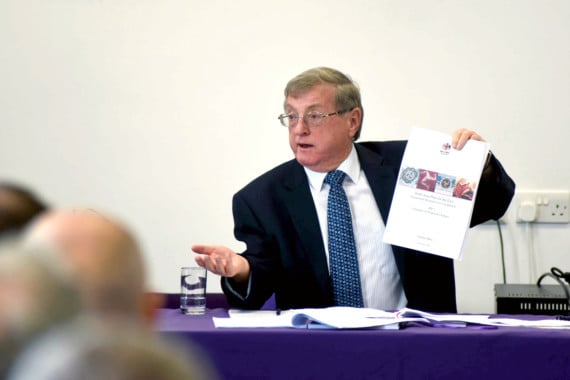
Last year, Mr Hurley conducted an inquiry into which areas in the east of the island could be earmarked for development.
He said that ’strategic reserve sites’ could be released when the population rises to 89,000.



Under current projections, that would be in 2036.
But the Cabinet Office says those areas could released 11 years earlier, in 2025.
A strategic reserve site is land considered suitable for development which will be held ’in reserve’.
Such sites will normally only be released for development if there was compelling justification to do so.
Examples of strategic reserve sites under the plan include Ballachrink, at Birch Hill Park in Onchan and land north of Coronation Terrace, Strang, near Union Mills.
Mr Hurley said that release of the sites ’should be contingent on some objective criterion, such as the island’s resident population having increased to at least 89,000 by the time of the 2021 Census’.
That figure approximates to the mid-point between the island-wide population of about 84,500, as shown in the 2011 Census, and the projected island-wide population of 93,500, on which the strategic plan housing requirement is based.
Mr Hurley said that he wanted the figure of 89,000 written into the area plan to be the point at which the sites could be released.
In its response to his report, which is available on the consult.gov.im website, the Cabinet Office said that it was not realistic ’to believe that by 2022 the resident population will be nearing 89,000’.
It’s currently about 85,000.
Using the 2016 Census as a start point, if the government’s net immigration target of 500 a year was being hit, which it hasn’t since 2011, then the island would grow to a population of 88,914 in 2031.
It would need net migration to reach 1,000 for that figure to be achieved in 2022.
However, while accepting the 89,000 figure as the trigger for releasing strategic reserve sites, the Cabinet Office has managed to create a proposed get-out clause by changing that rule to look at the number of people living in private households as well as household size.
In forming his suggestion for 89,000 release figure, Mr Hurley took the mid point between the 2011 Census and the government’s projected 2026 figure, which was set out in the strategic plan and works off the assumed 500 net migration figure.
The Cabinet Office has taken the 2011 figure or households (35,599) and the 2026 projection of 40,484 and found the mid point of 38,042, which it will use to allow the release of the reserve sites earlier than would occur if it were being down when the population hit 89,000.
The Cabinet Office’s proposed amendment to Mr Hurley’s recommendation said that the first opportunity to review the population would be the 2021 Census.
It added: ’If the 2021 Census reveals that the number of private households is likely to reach 38,000 or more by 2026, consideration will be given to their release 12 months before the end of the plan period, which is April 1 2025, in line with any other guidance set out in this plan.
’The status of strategic reserve sites and mechanism/trigger for release of any strategic reserves set out in extant area plans will be reconsidered when the Isle of Man strategic plan is next reviewed.’
However, as Mr Hurley said in his report into the area plan inquiry, the release mechanism could well prove ’redundant’.
Developers will be free to try their luck on any land as they see fit and the decision would rest with the planning committee or Minister for Environment, Food and Agriculture, be that Geoffrey Boot or his successors, and in some circumstances, with the Council of Ministers.
The recommendations on the area plan are scheduled to be discussed in July’s Tynwald and will have to be passed by members to have effect.
Comments
This article has no comments yet. Be the first to leave a comment.