
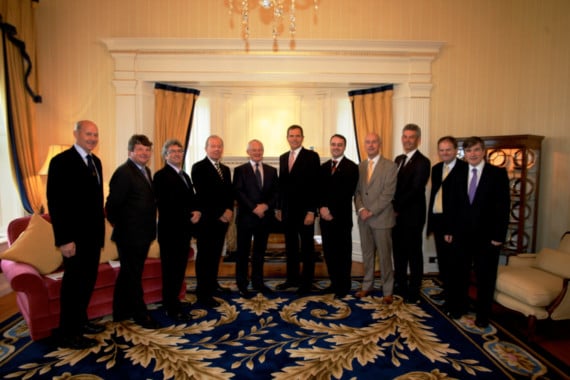
Four former government ministers are to return to the political spotlight when they are quizzed over the island’s foray into the film industry.
The public accounts committee will take evidence relating to the events that caused losses of over £26m from the government’s media development fund.
It will hear from former Chief Minister Allan Bell, former Treasury Minister Eddie Teare and former Economic Development Minister John Shimmin - who have now all retired from politics - and former Trade and Industry Minister David Cretney MLC.
The PAC, chaired by Clare Barber (nee Bettison) MHK, is currently taking evidence ahead of making a recommendation to Tynwald about whether there is a need for further investigations into the loss.
.jpeg?width=209&height=140&crop=209:145,smart&quality=75)

Millions of pounds were lost as a succession of investments flopped.
The committee was asked by Tynwald to investigate the funding after a motion by Liberal Vannin leader Kate Beecroft MHK, (pictured) who has been asking questions about the fund since she was first elected in 2011.
A decision to make investments in the film industry, which included a £24m in Pinewood Studios was called a ’calculated risk’ by then Chief Minister Allan Bell in June 2012, which saw the studio take over the management of the island’s £25m media development fund.
Before that, the fund had been managed by CinemaNX since 2007.
A report by Oxford Economics in 2012 found that the island’s film industry supported a cumulative total of £375m (2011 prices) in tax revenue for the government overwhelmingly through VAT receipts, but also National Insurance contributions, income tax and other indirectly paid taxes. This was because, before 2007, the Isle of Man was able to keep all of the output tax accrued on film-making activities that had taken place on the island.
But in 2007 the relationship changed and the VAT revenue was instead shared between the UK and the Isle of Man on the basis of the relative sizes of the two economies.
The effect of this was to substantially reduce the VAT revenue received by the Manx government, notes the report.
It also had a big impact on the number of films made.
Between 1995 and 2011, a total of 97 film and television shows were filmed here. However, only 15 of these were after the VAT changes in 2007.
Oxford Economics said the number of productions had fallen sharply ’to minimise overall risk’.
Its report found that between 1995 and 2007, the government invested over £171m in film productions through the Media Development Fund.
This enabled the fund to make investments in films equal to £195m since 1995, by reinvesting returns. When adjusted for inflation, government recouped almost £85m since 1995.
However, because of the agreement with the UK over VAT prior to 2007, the island made a healthy income from the film industry regardless of poor investment returns.
Oxford Economics estimated that, taking into account additional tax revenue, returns exceeded investment by almost £300m.
Figures released last year by Treasury Minister Alfred Cannan revealed from 2007 onwards, CinemaNX invested £39.7m in films up until 2012.
In the CinemaNX deal only £16.8m was recouped with a loss of more than £20.5m.
Of that, more than £9million was lost on the Zac Efron film ’Me and Orson Welles’, which was partially filmed in the island.
Under the Pinewood partnership, the island invested £20m and lost just under £6.2m in six years. This included £1.2m lost on the film sequel of the BBC spy drama Spooks.
After the sale of all of the Pinewood shares in 2016, the government said it had made a £10m profit on the investment.
The committee will hear evidence in public in the Legislative Council chamber in Tynwald on Monday, October 21, at 1pm.
UI
Allan Bell, John Shimmin, Eddie Teare and David Cretney
Comments
This article has no comments yet. Be the first to leave a comment.