
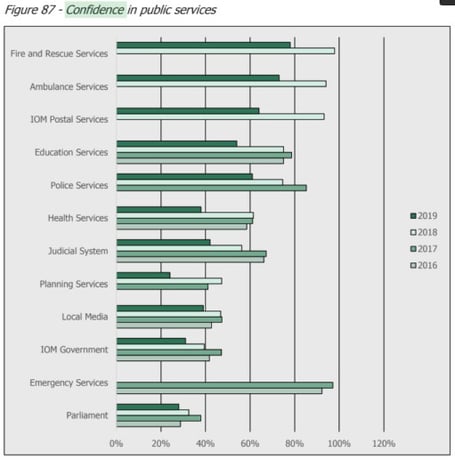
Confidence in and satisfaction with all public services fell last year, according to the island’s latest social attitudes survey.
And there is a growing view that the Manx government has no clear policies - and the number who feel those policies are having a negative impact continues to grow.
Some 562 people aged from 18 to 82 took part in the 2019 social attitudes survey, now in its fourth year.
Some 88% of respondents were born in the Isle of Man or England, but more said they were born in England (46%) than in the island (42%).


.jpg?width=209&height=140&crop=209:145,smart&quality=75)

When you add in Wales, Scotland and Northern Ireland, UK-born residents outnumber those born in the island.
A section on satisfaction with public services will make uncomfortable reading for those in government.
Once again, the fire, ambulance and postal services are the most highly regarded but all three saw a big drop last year in public satisfaction and confidence.
Indeed, all public services, including police, education, health, social care and utilities, saw a drop in satisfaction and confidence but it was planning that saw the biggest fall.
Confidence in the government and parliament also fell in 2019.
Respondents were also asked about the impact of government policy.
After a modest gain from 2016 to 2017, the proportion of those who feel the current administration has clear policies has consistently been dropping from 29% 2017 to just 20% last year.
People were asked if government policies have a direct impact on their lives, and those who responded ’yes’ were then asked if that impact was positive or negative.
The survey shows there was a slightly lower proportion indicating that government policy has no impact upon them - 15% in 2019 down from 21% in 2018.
But the number of people who said there was a negative impact has grown slightly, from 51% in 2018 to 52% last year - although the number who said there was a positive impact has also risen from 28% to 32%.
The survey has some good news for politicians.
An overwhelming - and increasing - majority of those who took part in it knew the name of their MHK, up from 79% in 2018 to 80% last year.
Fewer knew the name of their local commissioners but it was still a healthy majority of about 65%.
The biggest source of news for most were local newspapers (Courier, Examiner and Independent) either in print or online (65%) and radio (60%), followed by social media (56%) and the internet (44%).
Some 56% of those whose main source of news are newspapers were aged 50-plus.
Comments
This article has no comments yet. Be the first to leave a comment.