

The Isle of Man could establish its own constitution without changing our relationship with the UK, according to a leading academic.
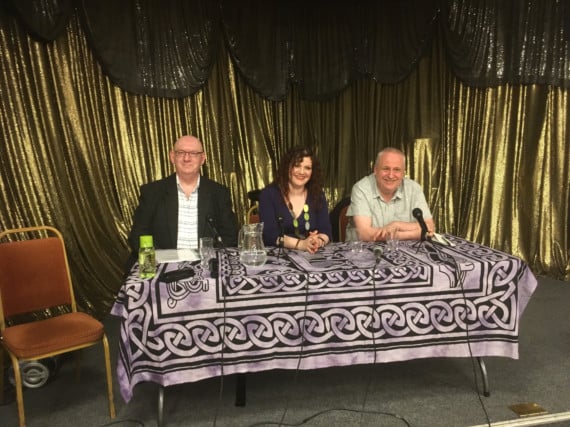
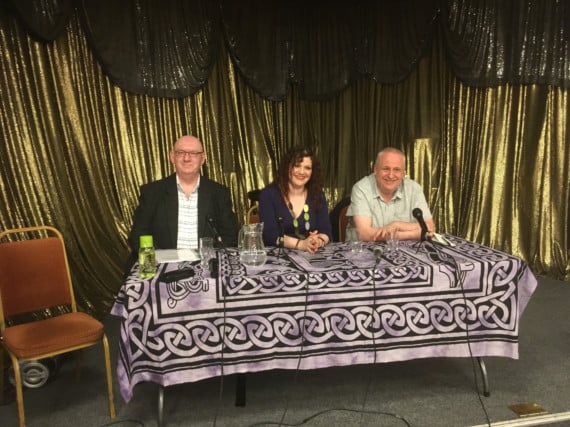
Prof Peter Edge, professor of law at Oxford Brookes University, was speaking as part of the pane at a Positive Action Group meeting on the current constitutional conundrum in the British Isles.
Prof Edge, who originally came from Ballasalla and attended Castle Rushen High School, compared the current situation of the UK’s constitution and its relationship with the Crown Dependencies as reaching the ’blue screen of death’.
The blue screen of death is a computer term used to describe what happens when a Microsoft computer system crashes.


.jpeg?width=209&height=140&crop=209:145,smart&quality=75)

Unlike the USA, the UK and the Crown Dependencies do not have a codified or physically written constitution.
Prof Edge said: ’When a constitution is working well, you don’t notice it, but when it doesn’t work, it becomes all anyone talks about’.
This has been seen since the Brexit referendum, where legally there is no reason why MPs couldn’t disregard the will of the people and stop Brexit, but constitutionally, MPs are there to represent the will of the people.
Prof Edge said that there wouldn’t be anything to restrict the island’s ability to have a constitution.
constitution
He said: ’The Isle of Man could create a written constitution and not change its relationship with the UK.
’That may seem unusual, but the Crown Dependencies’ constitutional relationship with the UK is rare, if not unique.’
The Crown Dependencies are not part of the UK and in fact never formally were.
So while former colonies such as Australia were given a constitution upon their independence from the then British Empire, this never happened with the Crown Dependencies.
Others, such as India, created a constitution in preparation for independence to be ready for the change from day one.
So, while the Isle of Man could establish a constitution for the pure purpose of defining our rights, it could also be a move towards potential independence.
If the island did go independent, it is likely that we would need to forge a single written constitution of our own anyway.
However, Prof Edge noted that, historically, codified constitutions are agreed to by the people, meaning that Tynwald approval is unlikely to satisfy the standard test for such issues, and the island would likely need to hold a referendum on any potential formal constitution.
The island does have a provision for referenda set out in the 1979 Referendum Act, but it has never been used.
However, the island’s position is slightly more clear than the Channel Islands, Prof Claire de Than from the Jersey Institute of Law told the meeting.
Prof de Than said that written constitutions for the islands were discussed but were often shot down as being seen as a move towards the creation of a federation of countries.
She said: ’There have been 103 formal suggestions for the creation of one in the past 20 years, in that time, politicians have spent about a total of a year not agreeing what to do.’
Prof de Than said that Jersey talks more of independence than Guernsey, but keeps finding ways to dodge the issue.
However she thinks that Brexit could create new difficulties and possibly make independence talks more likely.
But that doesn’t mean a federation is likely, as Guernsey has said it would want to see full independence from the UK before it would consider joining a new federation.
During his talk, MannBenham advocate Paul Beckett said that he was not making a political statement, merely stating legal fact and that the island had the legal right to choose its own destiny and suggested we may have already completed ’part of the journey’.
Part of this is due to the way the island has created what he called a ’very sophisticated’ system of principles which have become ingrained in Manx law and demonstrates that the island’s internal legislature would be ready if independence was a route the island went down.
He added: ’This isn’t an academic discussion.
’We could go out and make that decision.’
Comments
This article has no comments yet. Be the first to leave a comment.