
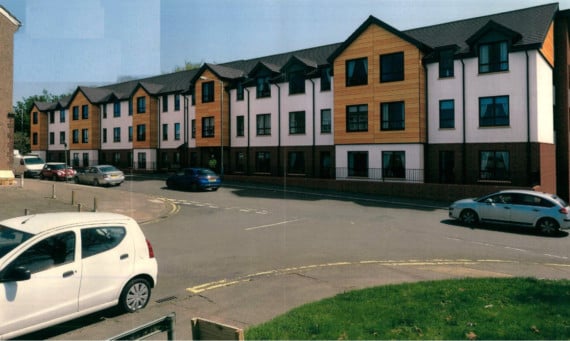
Douglas councillors have clashed with the Department of Infrastructure over plans for sheltered accommodation in Willaston.
The plans had included building 41 sheltered accommodation flats on Snaefell Road and included the site of the former Willaston police station - but now the council has backed down on the proposals.
During a meeting between senior Douglas Council members and DoI Minister Ray Harmer and staff it was confirmed that the department would not support the council’s business case for the Willaston sheltered housing complex in its current form.
The chair of Douglas Council’s housing committee, councillor Claire Wells, said: ’The council has been developing plans for sheltered accommodation in Willaston for some time, the aim being to provide local facilities for elderly residents and to free up under-occupied family homes.



.jpeg?width=209&height=140&crop=209:145,smart&quality=75)
’The council, in seeking to provide modern, flexible, sheltered accommodation, proposed that the facility should have all two-bedroom units in order to future proof its stock.
’Unfortunately agreement with the DoI on the content of the scheme was unable to be reached.’
Debate in the council chamber pointed to the problem being the plan to build two-bedroom flats and the DoI insisting that any sheltered accommodation should be built with one bedroom and the suggestion that the proposed building was too large for the site.
Council leader David Christian said he was ’disappointed’ that no agreement can be reached with the DoI.
In a strong showing of unity within the council, members spoke to share their disappointment about the DoI decision and put forward the case for Douglas to be allowed to decide its own future and housing needs.
Jon Joughin said: ’We need sheltered housing. A growing number of the population are senior citizens. We’ve got the will so why can’t we do it?’
Mrs Wells added that the outcome wasn’t ideal and joined her fellow councillors in criticising the DoI rejection and explained the housing committee’s understanding of the DoI decision and its relevance.
According to Mrs Wells, the DoI guidelines for sheltered accommodation is for 75% to be single bedroom and the remaining can be two bedrooms, however the council’s policy was to build two beds.
A spokesman for the DoI said: ’The department’s design guide for sheltered housing provides advice to housing authorities on a range of matters including the recommended mix of one and two-bedroom apartments for sheltered housing.
’This guide has been implemented with success elsewhere in the island, including most recently at Peel’s Westlands Phase A project, and the design principles have also been adopted in Ramsey where work is planned to begin on the Mayfield scheme later this year.
’The guidelines behind the model were published in 2016 when the existing standards were revisited to take into account factors including demand, accessibility and affordability. The new standards were developed in conjunction with island-based developers, local authority and sheltered housing providers and other government agencies.’
However, councillor Ian Clague said: ’It should be for Tynwald to say we can’t get the money, not the DoI but central government.
’How can it be legal for the DoI to say they won’t put our case forward? It clearly doesn’t care about local democracy, people or authorities.’
Mrs Wells, as chair of the housing committee explained: ’If the DoI doesn’t support us, then it is our understanding we can’t get the loan but I will happily go up to Tynwald and fight our case.’
She told the Examiner: ’This is extremely disappointing for Willaston residents and councillors, and has delayed redevelopment plans for the site in Snaefell Road.
It was subsequently agreed by the housing committee not to move forward with a sheltered scheme but to build general-purpose two-bedroom flats and maintain the current sheltered housing at Ballanard Court.
It was revealed in the council that there were 29 people on the sheltered accommodation list, 188 on the list for one- or two-bedroom properties and 65 on the list seeking a transfer into different sized housing.
Comments
This article has no comments yet. Be the first to leave a comment.