
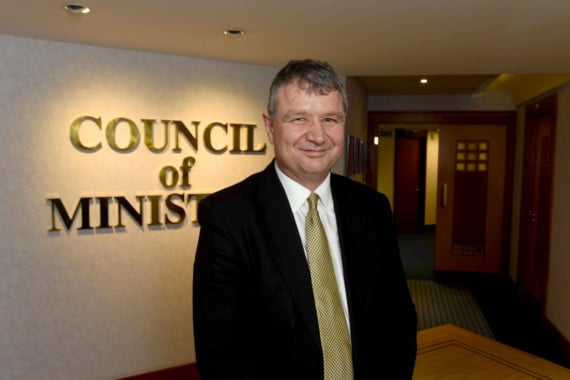
Chris Thomas is the man who has to make things happen for Howard Quayle’s government to be a success.
It has taken Mr Thomas just over three years, from first being elected to the House of Keys, to find himself the central cog in the Council of Ministers engine.
Despite, or perhaps because of, nominating Howard Quayle’s opponent Alf Cannan in the chief minister election, he was appointed Minister of Policy and Reform and, if we are to see a more joined-up government in future, much depends upon the Douglas Central MHK.
From some quarters, it appears his position is stronger than that of the other ministers. But it depends from where you are looking.



He is a fully-fledged minister, but he is the only one not in control of a department. Technically, Chief Minister Howard Quayle is the minister in charge of the Cabinet Office.
However, he has easier access to the ear of the chief minister than any of the others. A good place to be, but he insists that does not make him second in command.
’I am not the deputy chief minister,’ he says. ’We have an act that lays down that we don’t have a deputy chief minister.’
So, who would step up if Mr Quayle was indisposed for any length of time?
’It is up to the chief minister to delegate authority on an ad hoc basis.’
When the policy and reform minister position was first created in 2014, its holder, Chris Robertshaw, was dubbed the ’The Enforcer’.
Mr Thomas has a different take.
’My predecessors have contributed to defining the role, but my contribution will also help define it,’ he says.
’I think Chris Robertshaw was christened The Enforcer. My role is to be The Facilitator and bring policy together, which often involves bringing people together.’
For instance, he says, housing policy falls under the remit of several government departments and even local authorities.
How his job affects his long-term political ambitions will be interesting. If it goes well, he should get credit. But cabinet colleagues, eager for their own moment in the spotlight, may be tempted to ensure that, when their department is involved, people see them at the helm.
Conversely, if it goes wrong, then it will be easy for other ministers to brief in the lobby that it was not their fault, but down to a meddling P&R Minister.
Such thoughts might seem far-fetched in the early days of an administration, but we have recently heard of the breakdown of trust in CoMin during the last government. It only takes a few things to go wrong â?¦
Mr Thomas, however, is taking a positive approach. He is a firm advocate of consensus politics and evidence-based policy-making and wants to keep that approach.
All ministers had direct input into the Programme for Government, but the enthusiasm with which he repeatedly refers back to its key messages, and the terminology contained within, suggests that he was closely involved in its style and format.
’It is a document that binds the Council of Ministers and now, to some extent, Tynwald members. It is also a document that gives direction to public servants.’
He rejects suggestions that it is a vague wish list, arguing there are ’precise actions’ demanded and it has a 24-month legislative programme.
’We are a few days away from agreeing indicators about what would an "inclusive and caring society" look like. That, in itself, has got a political aspect to it. We won’t be changing those for at least five years.’
There are times during our conversation when it feels like I am talking to an accountant reading from a political manifesto. But, then, Mr Thomas is a masters graduate in philosophy, politics and economics.
He went to the same college at Oxford - Balliol - as three former prime ministers. One of those leaders, H. H. Asquith, described Balliol people as having ’the tranquil consciousness of an effortless superiority’. Mr Thomas does not come across as having a superiority complex. He is more self-deprecatory than anything.
When I put it to him that, on election night 2016, his self-confidence appeared greater than in the run-up to the 2013 by-election, he looks a little nonplussed. It is for others to judge, he says.
The reform part of his ministerial brief relates to government, but Mr Thomas is keeping a close eye on what happens to the parliamentary processes when the debate on the Lisvane Report starts.
That report stems from a motion Mr Thomas placed before Tynwald in the last parliament and he rejects the implied criticism from Speaker Juan Watterson that the UK peer did not appear to take time to consider the nuances of Manx politics.
’To my mind, that wasn’t his job. His job was to give an international observation about how he saw issues in that parliament. That is what I called for, an outside view. I did not call for yet another committee.’
It was Mr Thomas who helped change the rules for the election of chief minister. The primary change was that voting would take place in public but it also resulted in the Legislative Council getting to see how MHKs had voted before its members cast their vote.
When the LegCo voted en bloc for Mr Quayle after he secured 12 of the 24 Keys votes there was some criticism that the change introduced by Mr Thomas had, in fact, unintentionally almost guaranteed such an outcome.
He contends, however, that the vote proceeded exactly as he expected - although he has previously stated that it would have been preferable for Legislative Council to use a block vote only when a candidate had an absolute majority in the Keys (13).
But he is very clear on one thing and that is that MLCs should not have a say in who is chief minister. He is confident that they will not do so again, once proposals to remove them from the process return.
In 2011, Mr Thomas stood as a Liberal Vannin candidate - unsuccessfully. In 2013, he was elected - as an independent. He is careful not to be seen as critical of the party, but says the party option no longer fitted in with his approach to consensus government.
In 2011, he says, he believed ’party politics might be the way forward - but I don’t think it is, I think it is actually a programme for government approach’.
In his current job, he is better placed than most to put that to the test.
Comments
This article has no comments yet. Be the first to leave a comment.