

There is no miraculous fix to solve the spiralling legacy funding gap for public sector pensions.
Eight months after Tynwald tasked government officers to look at a range of options to tackle the issue, the court will hear most have been ruled out.
These include capping the benefits of the higher paid civil servants, moving to a career average scheme, aligning normal retirement to the state pension age and closing the current defined benefit scheme to new members.
Instead, a Cabinet Office report to this month’s Tynwald will seek support for the setting up of a defined contribution scheme to new staff - but it won’t be compulsory but voluntary.




Reforms of public sector pensions initiated by Tynwald in December 2014 have made the current schemes more sustainable and affordable by reducing benefits and increasing contributions.
But they have done nothing to resolve legacy funding gap - the shortfall between contribution income and benefit expenditure.
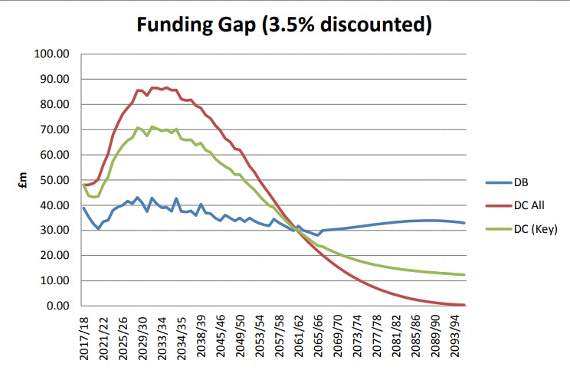
This is expected to rise from the current £36.67m to a whopping £131.21m by 2059-60.
But the report to Tynwald said in real terms, the funding gap was expected to fall over time to level off in today’s terms below £20m a year.
In a foreword, Policy and Reform Minister Chris Thomas MHK notes: ’There is no miraculous fix to resolve the legacy funding gap for public sector pensions, no "silver bullet" that can be fired to address the issue or "magic wand" that can be waved to make the liability disappear.’
Explaining the spiralling costs, the report states: ’The cash shortfall across the island’s public sector pension schemes has arisen both due to [their] unfunded nature and has also worsened due to the payment of historically higher benefits for individuals in a growing public service where the level of contributions over time has probably been too low and where those individuals are now living much longer in retirement.’
In July last year, Tynwald tasked the Public Sector Pensions Authority to explore introducing a voluntary defined contribution (DC) scheme for public servants which should become the default scheme for new staff.
It also considered capping the salary on which pension benefits are based, linking the normal pension age to the state pension age, introducing a career average scheme and the possibility of using a mirror scheme to help smooth the switch to a DC scheme.
A series of workshops were held with Tynwald members over the last eight months.
The report concludes that while the majority of these options may have a "fairness" argument, they do not significantly reduce the legacy funding gap in either the short or the long term but would involve considerable and costly design changes.
Placing all new employees automatically into a DC scheme was not considered financially prudent as there would be significant cost increase to government.
Closing current schemes to all or some new members would require raising additional funding of about £2.3 billion over the next 50 years or so. Instead, any new DC scheme should probably be voluntary, the report concludes.
It says such a scheme may be attractive to some new public servants, given its flexibility and portability - in particular those join government on short term contracts or who do not expect to remain there for all of their career.
Such a voluntary scheme would manage long term legacy costs in a ’more controllable and long term downward trajectory’, the report notes - although it doesn’t set out how much of saving it is likely to make.
The general view of capping benefits of the higher paid was that the impact was ’minimal and very long term’ - unless the cap was set below £50,000, in which case it would capture significant numbers of staff at middle management.
Raising the retirement ages to the state pension age would lead to potential industrial unrest in return for limited gain, the report suggests.
Moving to a career average scheme was unlikely to improve the legacy funding position significantly and introduce complexity, while setting up a mirror scheme was also deemed ’too complex and generally unworkable’.
Comments
This article has no comments yet. Be the first to leave a comment.