
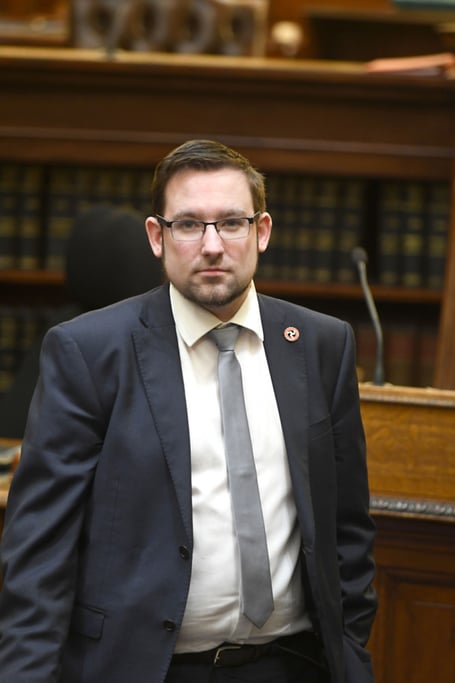
A law that could change the way broadcasters and communications providers are regulated returns to the House of Keys today - three months after its last appearance.
Consideration of the Communications Bill was put on hold after its second reading in November, to allow Tynwald to debate a select committee report on public service broadcasting to take place first.
It took Tynwald two attempts to debate that select committee report, after which most of us were none the wiser as to whether members wanted to or were going to change anything. As a general rule, when it comes to debating public service broadcasting, MHKs are very good at grandstanding and less good at actually changing direction.
Fortunately, there is a lot more than public service broadcasting to the Communications Bill, which today is at the clauses stage.
 National income falls again as GDP drops for a second year in row
 New organ donation law to come into force as island urged to ‘make informed choice’
 Department outlines new education priorities as Tynwald receives updated plan
 Peel Commissioners says LegCo measures will mitigate issues in local government bill
Under its provisions, local radio stations would continue to be licensed as they are now, but it would cover regulation of TV provided by satellite or distributed by an electronic communications network.
Department of Home Affairs chiefs have previously promised a built-in flexibility with the regulations covering both broadcasting and telecoms.
At present, telecommunications and broadcasting are covered by separate laws and the government says that, although they will be brought under one umbrella piece of legislation, they will still be treated as separate sectors.
There has been debate previously about whether the Communications Commission should have an independent head, as opposed to a political one, and a move will be made by Daphne Caine (Garff) to amend the bill so that members of the commission board cannot be Tynwald members.
Lawrie Hooper (LibVannin, Ramsey) is another planning to table an amendment, to introduce more specific rules on ’causing harm’ by sending a message via an electronic communication.
Before members even get to that stage of proceedings today, however, they will first have to deal with the clauses stage of the Highways (Amendment) Bill, which should be a quicker and more straightforward affair.
The Charities Registration and Regulation Bill’s second reading - when a piece of legislation’s principles are debated - may not be quite so simple. Policy and Reform Minister Chris Thomas’s nose was put out of joint somewhat after members blocked his move to push through with the second reading at the same sitting of the first reading, two weeks ago.
He may find more malcontent about the bill today, and not just the direction of its journey having started in Legislative Council.
The Income Tax Legislation (Amendment) Bill is down for a third reading. It has already undergone detailed scrutiny at the clauses stage and if, as expected, passes this stage, will then move on to Legislative Council for scrutiny.
In question time, the heat is back on the Department of Education, Sport and Culture. Two weeks ago, Education Minister Graham Cregeen was called on to explain why his department was not subjected to the same level of expert external scrutiny as the schools it is in charge of.
One of the reasons proffered was that other government departments do not undergo such external scrutiny and that Tynwald proved an acceptable watchdog. Unperturbed, Julie Edge (Onchan) is following that up by asking Chief Minister Howard Quayle how many external reviews of government departments have taken place in the past five years.
But in the written questions, Jason Moorhouse (Arbory, Castletown and Malew) adopts a very direct approach. Mr Cregeen will be asked if he will publish the Ofsted report into the operations of the Department of Education way back in 2002 and what recommendations were implemented - and why any of them were not implemented.
With other questions covering holiday patterns, school spending and the budget for school meals, Mr Cregeen will have to make sure he has done his homework.
Other highlights in the questions include a call for Chief Minister Howard Quayle to give a statement on the newly published gas regulatory review report, planning rules, the housing strategy and criminal justice.
The Legislative Council is back in action after a brief break while it awaited legislation to arrive from the House of Keys.
The Dormant Assets Bill, which will allow the government to put ’dormant’ money from bank accounts into a special fund for good causes, is due to arrive for a first reading. Unlike the House of Keys, where the first reading is merely a formality, debate is allowed in the upper chamber.
Comments
This article has no comments yet. Be the first to leave a comment.