
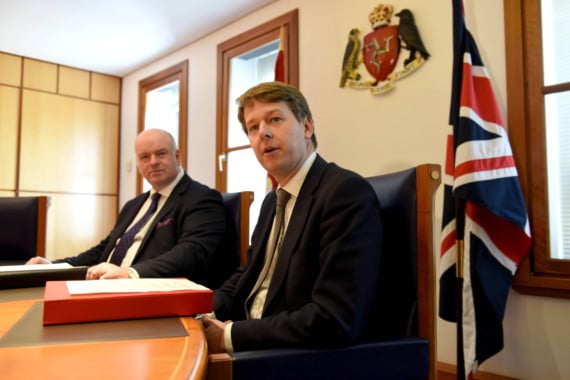
As we reflect on its performance, it is important to remember it is still relatively early days in the Howard Quayle administration.
Criticism of a lack of action - if not travel - in preparing for Brexit is harsh, considering the UK Government hasn’t appeared to know what its plan is. In truth, there has been plenty of dialogue, debate in Tynwald and representations made to Westminster.
Meanwhile, the government moved effectively on its obligations following the Moneyval report on money laundering.
Pledges for improvements to communications, including the thorny issue of broadband speeds, we must wait and see, but there is recognition of a problem that needs to be addressed.
.jpeg?width=209&height=140&crop=209:145,smart&quality=75)
On the social front, there was the largest single increase in personal income tax allowance and the first increase in child benefit for seven years. The minimum wage has gone up too.
So, a promising start in places. Perhaps the key thing to acknowledge is this Council of Ministers, appears considerably more united than its predecessor, although that would not be hard.
There is a collective belief among the ministers in what they are doing. There will be issues that put this unity to the test, not least the rumbling row over proposed changes to prescription charges - that could cause some to blink.
The Steam Packet situation also revealed there is not always agreement internally. Despite protesting - a little too much - about unity, the CoMin initially wanted to take a less conciliatory stance than that recommended by the Department of Infrastructure and later supported by Tynwald, albeit without debate.
It is actually healthy that there has been internal debate in CoMin. Grown-ups can do that and still get on with the job.
But the Council of Ministers needs to develop, collectively, a thicker skin. Some people may dare to speak against them and question their methods. It’s okay, that’s normal.
Interestingly, a chance meeting with a retired former minister, saw him remark to me that the current crop - both ministers and MHKs - were ’detached from reality’, by appearing to wish to discount some of the experience available, but also choosing to save money in areas such as free prescriptions, ahead of making savings the government machine itself.
There are many who would like to see more action to work towards making that machine smaller and more efficient.
In terms of which minister enjoyed the best year, Chris Thomas’ profile has risen rapidly with his policy and reform brief, but it is perhaps Alfred Cannan at Treasury who has done the best so far.
He avoided a full-on austerity budget and has loosened the purse strings in areas such as television licences for pensioners - although there may be a queue of politicians seeking to take credit for that.
Moreover, a previously hidden softer side seems to have come through.
Special mention for Ray Harmer, too, for finally getting a promenade scheme that Tynwald, at least, can support.
As for those who have had difficult times, there was a point this year when you could imagine Economic Development Minister Laurence Skelly patting Home Affairs Minister Bill Malarkey on the back for taking the spotlight off him, in what appeared to be a determined effort to wind-up the whole of Ramsey rather than just merely explaining what should have been a relatively straight-forward situation over the courthouse.
However, the job of health minister remains the most poisoned of chalices available in the current government system. So, it is as much a reflection of circumstance as it is of Kate Beecroft’s performance that we can judge her to have had the toughest time.
Rob Callister’s resignation from the department and the emergence of revelations that the working relationship between Mrs Beecroft and chief executive Dr Malcolm Couch was on the critical list got 2017 off to a bad start.
Then there was award of the patient transfer taxi contract to a new operator, although it could have been Nelson Mandela who was responsible for that decision and people would still have been upset.
It was followed by the row over centralising endoscopy services, which saw the political troops of Ramsey mobilised once more.
To ensure the DHSC’s position at the top of the tree of tumult, we have had the announcement of proposals to dramatically reduce the number of people who qualify for free prescriptions (followed shortly after by some fire-fighting FAQs to try to offer assurance).
No one said it was going to be easy.
The Programme for Government itself has already become a mantra for all ministers, but CoMin must work hard to ensure it does not become a weapon for opponents.
For all the worthy targets set and achieved, it will be the ones missed that get picked out and they must accept that. For instance, the document - issued in January - puts the Education Bill at the top of the list of legislation expected ’within the next 12 months’.
By the time the Delivering the Programme for Government document was published in April, a follow-up document with specific targets, the target date for an update of the 2001 Education Act was moved to June 2018. Consultation on a draft of the bill is now not expected until the new year.
It may seem churlish to point out these things, but another missed deadline, about planning reform, has already been mentioned in a Tynwald question and, if Tim Baker is going to meet the September 2017 target for the implementation of a new sea services strategy, then it presumably is going to contain a lot of ifs.
The deadlines - and the targets themselves - are welcome.
But they need to be realistic, to avoid the programme becoming a millstone around the necks of ministers and, perhaps more importantly, to avoid important issues being rushed without due consideration, for fear of political criticism.
That said, the Programme for Government is an evolutionary process and the principle behind it is a good one.
We will judge our politicians by its success, or otherwise.
Comments
This article has no comments yet. Be the first to leave a comment.