
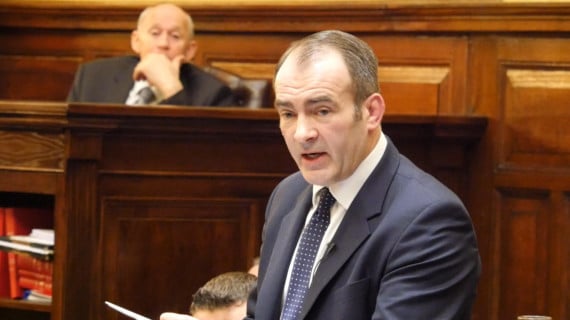
Treasury Minister Alfred Cannan today unveiled a Budget for a stronger economy and a stronger society.
Here is his Budget speech in full.
A five year plan to instil confidence in Public Finances
Mr President, over the past five budgets, Government has focused its energy and time on dealing with the aftershocks of the renegotiated VAT deal.
.jpeg?width=209&height=140&crop=209:145,smart&quality=75)
.jpeg?width=209&height=140&crop=209:145,smart&quality=75)
This may have been appropriate at one point, but we cannot continue to look backwards.
Eight years has elapsed since the shockwaves caused by that announcement but in every budget since we have focused solely on cost saving and rebalancing.
As we know, the needs for those kinds of measures remain but they cannot and indeed must not be our all-consuming purpose.
So today we put an end to that. We stop looking back and start looking forward.
Today we stop looking at the needs of the spreadsheets and start looking at the needs of our society first.
This Government has called for an inclusive and caring society, an island of enterprise and opportunity alongside a financially responsible Government and I intend to deliver in equal measure.
Today I am delivering a budget of optimism, a budget of focus, a budget of support and a budget that clearly defines and lays out the challenges ahead.
Economy
Turning to the economy I am pleased to be able to report that our economy continues to be one of the fastest growing in Europe - we are enjoying our 34th year of unbroken growth with the island’s economy growing at 5 per cent.
Our unemployment remains at 1.3 per cent.
Our job vacancies throughout 2016 were at levels not seen since 2007.
Inflation remains relatively low but there are some warning signs of some increased pressures coming forward. Already we can see increasing oil prices that are starting to impact on heating and transport costs.
The 2016 earnings survey, shows that workers’ average full-time earnings in the Isle of Man increased on average by 2.2 per cent.
There are many positive indicators for the future.
As many of you will be aware, revenue in 2015/16 from income tax was less than originally forecast for the first time in many years.
However, that is definitely not the case this year.
Increasing numbers of taxpayers and jobs are contributing to healthy growth in both ITIP and National Insurance receipts.
This is positive news - income tax receipts grew from £199 million last year to an estimated £213.5 million this year and National Insurance receipts are projected to be £186 million.
Combined, we are a total of £7.5 million above budgeted estimate.
The assessor has informed me that there are over 500 more taxpayers than this time last year and that there are also 700 more individuals in work today as compared to this time last year.
Despite this growth we know that in real terms many household incomes have fallen in the last decade and it has become increasingly more difficult for hard-working families in particular to sustain a reasonable standard of living.
This budget will bring forward measures to start dealing with these issues.
But it is crucial that economic growth is at the forefront of our thoughts and we must continue with our efforts to build our economy still further by encouraging new investment, new business and new jobs to our island.
It is essential that Government plays its part in ensuring that business has appropriate access to capital in order to allow existing island-based businesses to reach their growth potential.
We will continue to work to support this objective.
In that respect, the new £50m Enterprise Development Scheme is now up and running after being formally launched in June 2016.
This budget tops up the Fund by £2 million to meet the anticipated demand for funds in the coming year.
We are continuing to commit £4m to provide other financial assistance grants to be administered by the Department of Economic Development.
Other initiatives currently underway include:
â?¢ The new alternative banking regime which was launched on August 1, 2016; opening up the banking capabilities of the Isle of Man and offering banking solutions for a broader cross-section of businesses and individuals.
â?¢ The new crowdfunding regime which was launched in May 2016. This is a relatively new concept and it will take time to grow but we remain confident in the longer term opportunities that this regime will generate.
â?¢ And an online business ’toolkit’ which is a new resource for on-island businesses to start up, find financial assistance and useful information on how to grow their business has been launched.
Mr President, access to land and buildings remains vital.
A range of actions are now underway to assist in this respect including the review of the planning system, the launch of the Eastern Area Plan, and proposals for a new business park at Ronaldsway.
However it has become clear to me that our traditional methods of supporting regeneration of land and property are not operating as effectively as they could.
There are vacant sites visible in many of our towns and villages, with high profile sites vacant in our capital and development of these sites is long overdue.
It is my intention therefore that Treasury will work to bring a scheme to Tynwald seeking to adopt innovative approaches to enabling regeneration and leveraging our position in combination with the private sector to unlock potential development sites and injecting a confidence and vibrancy into our economy.
Mr President, good and effective legislation and regulation remain integral to many of our key sectors.
The Financial Services Authority has been working openly with industry and Government to cohesively develop the business environment and progress the island’s financial and professional services sectors.
The Treasury is also promoting important changes to the Insurance Act to ensure that the island’s legislation governing this important sector is modern and fit for purpose.
A considerable amount of industry engagement has been undertaken to get us to where we are today, but there is still more to do to ensure that the effects of any changes are proportionate and that the sector has the opportunity, where possible, to adjust accordingly.
Our registries, particularly our ship and aircraft registries, also continue to maintain their reputations for world class customer service and high regulatory standards.
Both performed well supporting local jobs in the professional sectors.
Access to skills and growing the ’economically active population’ are also critical elements to our plan and we have been successful in creating an environment that is attractive for businesses to invest and set up.
Actions are underway to encourage the relocation of workers to the island, including targeted financial assistance for export businesses and further work permit reforms.
The changes to the work permit system approved by the last administration further streamlined the process and modernised the legislation and have helped our attempts to generate economic growth.
The Department of Economic Development is seeking approval for further work permit reforms within financial and professional services to further support the growth and diversification of this vital sector, which still provides the bedrock of the island’s economy.
This will help bridge the gap in the local market for skilled workers.
The Department of Education and Children is investing more in STEM subjects (science, technology, engineering and maths) to give our young people the skills they need and this has meant young people are now better prepared than ever to make progress in a world where technology is driving innovation and change across all sectors.
This is particularly important in ensuring the success of our precision manufacturing sector typified by the Isle of Man aerospace cluster which takes in up to 18 apprentices each year.
The Department of Economic Development is also further investing more in the locate.im website which targets potential new residents and businesses through promotion of the Isle of Man’s excellent quality of life.
DED and DEC have also been working with the private sector to help market the Island to skilled workers in those sectors where we are experiencing the greatest shortages.
Working closely with industry, DED and DEC have also encouraged the development of locally-based talent and has expanded the provision of formal apprenticeship programmes into such areas as ICT, financial services and health and social care.
Both departments are also sponsoring industry and private sector links with schools such as Junior Achievement and the ACE Engineering Programme.
These programmes will create a pathway for young people to join these important sectors, gaining the knowledge and skills required to contribute to our growing economy in coming years.
DEC is also working on new vocational and FE [further educations] pathways trialling new Scottish qualifications and is planning new qualifications to support those wishing to return to work.
Marketing our island in a fiercely competitive world is arguably more important than ever.
Given the increasing appeal of ’staycation’ holidays, the Isle of Man’s tourism industry faces even greater competition from other parts of the British Isles to attract visitors to our shores.
The launch of the Isle of Man’s Destination Management Plan early in 2016 provided a clear strategy in how to develop the Isle of Man as a place to visit, but also acknowledged the vital role that tourism plays in encouraging the broader proposition in persuading people to live and work here.
Efforts to increase the marketing of the island across the UK and the wider world have increased substantially.
The UK regional events programme has grown from 60 events over the last three years and is on course for 100 this year.
The evidence shows these actions are working. Our economic fundamentals remain strong and there is real evidence for optimism.
But optimism is fine as long as you recognise the challenges that exist both at home and abroad.
Whilst there is every reason to maintain our confidence we must recognise that Brexit and other international events can and often do impact on our economic success.
We are committed to building our international relationships and maximising our opportunities but we need to be ready to respond to the challenges that this will bring.
I am therefore setting aside £1m in a new Brexit Fund to provide funding for projects and resources which may be required for issues arising from the UK’s departure from the EU.
This fund is intended to allow immediate access to where resource is required and I expect that allocations to this fund will increase in future years.
It cannot be stressed strongly enough, the Isle of Man takes its responsibilities as an international business centre very seriously.
The Moneyval report on the island’s performance against the latest international standards for anti-money laundering and countering the financing of terrorism was published at the beginning of the year.
Whilst it confirmed the high level of compliance which is present in the island’s legislation, it also highlighted that there is significant improvement required in respect of the resources available to the law enforcement authorities in order to effectively address financial crime.
Steps have already been taken through developments such as the creation of an independent Financial Intelligence Unit and a new Asset Recovery Unit.
The Government is committed to continuing to reinforce our anti-money laundering and countering of terrorism regime wherever necessary to ensure full compliance with global standards.
The Treasury will continue to play a full part in honouring the island’s international commitments in the coming year.
The Beneficial Ownership Bill, currently before the House of Keys, gives effect to the Government’s exchange of notes with the UK to create a central database of beneficial ownership by June 30, 2017.
Although time is incredibly tight for the delivery and implementation of this significant piece of legislation, the commitment will bring the Isle of Man in line with the other Crown Dependencies and Overseas Territories and gives UK law enforcement agencies an important new resource in the fight against serious and organised crime.
Capital Expenditure
Government’s continued investment in the island’s infrastructure is vital for our economy and well-being.
With an eye on longer term strategic capital investment in our island’s infrastructure, Treasury have reviewed and updated the Capital Programme for 2017-18.
I am today announcing a five year capital programme detailing £388m of investment in our public services and infrastructure.
In the next year the capital budget allocation will be £88 million .
The capital budget provides our island’s most fundamental infrastructure; the largest scheme delivered in the previous financial year was the Phase 1 regional sewerage treatment programme, costing some £11 million.
It was encouraging to note that this expenditure has fallen substantially below previous cost estimates for the development and modernisation of these facilities. £10 million has been spent providing the Henry Bloom Noble Primary School which was completed and opened in 2016.
The scheme, which includes development of a Government owned brownfield town centre site, now provides a first class modern teaching environment.
Capital investment in healthcare, housing and infrastructure all featured prominently in 2016-17 including development of the new adult psychiatric in-patient facilities at Noble’s Hospital and the acquisition of a brand new 68 bedroom care home both helping towards one of our key aims of providing an inclusive and caring society.
This focused expenditure in the local economy will continue to be the case in coming years with significant capital investment to provide a replacement high school at Castletown, the commencement of projects to replace the Department of Health and Social Care’s current facilities for adult services at Eastcliffe and care facilities at Reayrt Ny Baie in Douglas.
We are investing in the infrastructure of our ports to ensure our vital sea links are maintained with funding allocated within the programme for the acquisition of land in Liverpool and in our airport to maintain our critical air links with funding allocated for refurbishment and maintenance of the runways and improvements in landing systems to allow greater range of operation in fog situations.
We will continue to invest in our highway and public transport networks to ensure that the roads and services we use every day are fit for the future and support our economy, including improvements to estate roads away from the main highway networks.
Housing will remain a focus for local authorities and Government. The Local Authority Housing programme will provide a mix of refurbishment and new build housing and provision for elderly people.
Projects such as the refurbishment of the Willaston estate will account for an investment of some £30 million over the next 10 years.
There will also be additional new public sector housing constructed at Clagh Vane in Ballasalla in 2017-2018.
Mr President I expect to see departments linking their business plans to the capital programme to make the best use of resources and to focus expenditure in the right areas.
It is right that you should know that Treasury will challenge departmental business cases to ensure there is real demonstrable need and value for money, together with identifiable linkages to the Programme for Government at the core of each decision.
It is not uncommon for timing related expenditure variances to occur within a Tynwald approved project.
This usually relates to slippage in the capital works programme or deliberate acceleration of approved schemes.
Yet, even in cases where changes to the expenditure profile arise purely as a result of timing and remain within the overall Tynwald approved budget for the project, Treasury are required to seek Supplementary Capital Approval for expenditure which has already been approved by Tynwald.
This seems to me unnecessary and time-consuming for Tynwald and the departments concerned.
This year the Budget motion includes a measure to permit Treasury to authorise the expenditure of sums in excess of the approved year’s capital budget provided that the amounts concerned are purely in relation to timing of expenditure and that the project is otherwise within the capital expenditure budget approved by Tynwald.
This proposed measure assumes a limit of £100,000 per scheme, and if the measure proves worthwhile, we may seek to raise that level for future years.
Treasury also has established a Capital Contingency Fund and have removed client contingency budgets from capital schemes.
As a result, I am also seeking within the Budget motion this year to permit Treasury to be granted authority to agree to expenditure from the Capital Contingency Fund for project overspends without recourse to Tynwald for a Supplementary Capital Authority.
This will be subject to a maximum of 10 per cent of the approved project budget but subject to a maximum permitted limit of £100,000 in each case.
The rationale for both of these changes is to limit the number of items requiring a Supplementary Capital Approval by Tynwald to situations where an actual variation or significant project overspend has occurred.
However I would like to reassure Honourable Members that any significant overspends will still be reported to Tynwald.
Sustainable Budget
Mr President, economic success will be less than impressive if we cannot commit to careful and sustainable management of public finances.
This Budget will clearly show that an underlying deficit of £80 million is forecast for the next financial year.
We are paying for that by using almost £50 million of investment returns from our Reserve Funds and drawing the excess £30 million from the funds themselves.
It is the Public Sector Pensions Reserve that feels the key impacts from this deficit and I shall return to that subject later.
Over the next five years, this Government intends to reduce that structural deficit to £23 million through economic growth, strong cost controls and by direct savings.
We will use the interest and returns from our investments to support Government spending so that by 2020/21 we forecast that the interest and returns will exceed the structural deficit allowing for a surplus of £15 million in that year and £32 million in 2021/22.
It is undeniable that there is huge pressure on Government to continue to provide the high quality and breadth of public services that island residents have come to expect, but at the same time we have fewer resources available.
There is no better demonstration of this than the exceptional demands being placed on our Health Service.
If we are to face up to our challenges we must be realistic.
For the past two years the Department of Health and Social Care has had to come to Tynwald for a supplementary vote requesting an additional £9.9 million in 2015/16 and £11.1 million for 2016/17.
Clearly, if the department is to effectively manage its budget and continue to provide these essential services then it must have a meaningful target to manage within; this level of continued overspending does not provide that.
The department estimates that the ongoing costs pressures amount to an extra £21 million for 2017/18.
In recognition of this, but also to ensure that we impose strong cost controls where budget caps mean exactly that.
I am proposing that the DHSC’s budget is increased by £11 million, which will help to address approximately half of the cost pressure.
At the same time the department will need to deliver reductions of £10 million to meet the remainder of the ongoing cost.
Mr President, I also propose that the existing Health Inspection Fund is replaced by a Healthcare Transformation Fund, to provide upfront investment to transformational projects that support the Department of Health and Social Care’s much needed Cost Improvement Programme.
I am under no illusions as to the tough challenges facing our health and social services provision.
But this is not and cannot be just about the department - it is for all of us across society to take more responsibility both for our own well-being and for those around us.
Moving on, the establishment of a new Academic Business Planning Fund will provide a means for the Department of Education and Children to better tie in resources for the financial year with the business needs of the academic year.
There will be scope for that department to transfer unspent budget balances up to £0.5 million at year end for drawdown against specific schemes during the first six months of the new financial year.
This budget includes a significant requirement for departments to continue to drive efficiencies and cost savings.
We have built into this budget cost control and other measures that will continue to mean that department need to seek efficiencies and savings in their operational functions.
This is best exemplified by the 1 per cent pay cap. This policy is continued from the last administration and I can confirm that pay awards in excess of 1 per cent will have to be found from within the departmental budgets.
Each 1 per cent awarded for pay over the cost cap will require Government to identify further savings of £3.5 million and I urge those charged with negotiating pay awards to act responsibly.
Besides some essential expenditure of around £3 million and the increase proposed for Healthcare, no other funding increases have been included within the Budget, excluding increases in loan charges.
This means that with the DHSC’s cost improvement programme, savings already built in to terms and conditions for new starters and promotions and the Digital Strategy, cost avoidance measures amounting to £13.8 million are built into this year’s Budget.
In each of the remaining years under this plan we will need to identify ways of delivering on average £11 million in additional efficiencies, savings or revenue.
Included within this I have written into the budget £25 million of as yet unallocated savings that must be found from within departmental budgets.
To deal with this matter, I can inform you that Treasury, in conjunction with the Cabinet Office, have established a cross Government team chaired by my Honourable Friend, Mr Shimmins to identify the efficiencies and opportunities that may allow us to find the savings required.
The new SAVE Team (Securing Added Value and Efficiencies) will not only have a close eye on day to day savings and efficiencies, but are looking towards ’big ticket’ items that can contribute clearly to achieving our objectives.
So, today I have written to the Ministers and chief executives of all departments, boards and offices asking them to return to the SAVE Team a list of the top five opportunities within their area of responsibility for reductions in expenditure within six weeks.
In addition to this an online portal will be made available to all members of staff, Tynwald Members and members of the public to come forward with ideas and opportunities to deliver improvements and cost reductions.
There will be a short period of two to three weeks when these portals will be open and further information will be provided nearer the time. I strongly encourage everyone to use the opportunity make their voice heard.
It is my intention that by the end of the parliamentary year we will have clarity on what specific actions are required to meet the savings target but we are not standing still.
In addition to the measures outlined, The Invest to Save Fund is in place in order to help fund and to incentivise departments in coming forward with worthwhile projects in support of the Five Year Financial Plan.
The balance of the ICT Fund this year will be transferred into the Digital Strategy Fund, with £1.8 million retained under the pre-existing terms of reference for the old ICT Fund in order to meet the approved commitments.
This demonstrates our commitment to investing in technologies to deliver service improvements for Government.
We are not and will not stand still. I am committing Treasury not only to challenging departmental spending but also to invest in new delivery alternatives where strong business cases are presented.
We can and we will meet our commitments in this respect.
Turning now to Public Sector Pensions, the predicted growth in payments and liabilities remains our single biggest challenge to Government finances and future sustainability of public services.
Public Sector Pensions expenditure represents 10 per cent our revenue expenditure. The costs expected for 2017/18 are £99.2 million.
Whilst we are still in the process of examining solutions to this legacy issue, we have little choice but to ensure that funding is available to meet the costs in the medium term.
Today I am altering the planned employer commitment to fund public sector pensions at 20 per cent of the salary bill, instead committing the taxpayer, as the employer, to funding 15 per cent of the total salary bill by way of contribution to the liabilities.
This does not impact upon the cost envelope pension scheme proposals agreed by Tynwald in June 2016.
This will mean that any extra money that is needed over and above the 15 per cent contribution from the employer and the contributions from the employees will have to be met from the public sector pensions reserve.
The latest cost projections indicate that the fund will be depleted by the end of 2020/21.
At this point it is estimated that an additional liability of £58 million will need to be funded through revenue.
Whilst the financial plan allows for this, our ability to deliver this depends on growing income, controlling expenditure and finding the required level of savings.
I should add that any changes agreed to Public Sector Pensions through the cost envelope proposals will not alter the budgetary outcomes we are forecasting today.
But we will consider the options for the future in more detail once Tynwald has agreed the way forward for Public Sector Pensions.
As I have already set out, it is incredibly important that the Budget ensures that our financial position is understandable and the opaque manner of presenting our finances has to stop.
We have taken steps therefore to ensure that this Budget transparently sets out Government’s five year financial plan which clearly shows:
â?¢ Our projected operating and total deficit position;
â?¢ The profile of income and expenditure required to move us to a sustainable position; and
â?¢ The level of reserve income that will be required to support our ongoing operations.
Delivery of the five year plan will move us into a more sustainable position.
By 2020/21, we will be able to retain a significant portion of our reserves income to build for the future. This is a budget from a financially responsible Government.
Taxation
Direct Taxation and National Insurance
Mr President, increased tax and NI receipts, the growing number of taxpayers and individuals in work, demonstrates that the island’s economy is going in the right direction.
Across our island, day in day out thousands of our people are working hard to earn the money to support their families and themselves, to build our economy, to build our society.
Now is the time to recognise the contribution from working families and individuals who have been asked to tighten their belts over the past few years and so today I am announcing the single largest increase in the Income Tax Personal Allowance in any Budget.
I am increasing the personal allowance from £10,500 to £12,500 for an individual and from £21,000 to £25,000 for a jointly assessed couple.
As a result of this measure approximately 3,300 individuals will fall out of the tax net altogether and 44,300 individuals will be better off. No one will be worse off.
Some of the costs of this increase will be met by reducing the level of the 10 per cent tax rate band to £6,500 and by removing the Age Allowance.
No one will be worse off as a result of this measure.
In addition, and further to support families although not a tax measure, I am able to announce that Child Benefit will also be raised by 2 per cent.
This is a Government determined to help those in our society who are working hard to build the foundations of our future success.
I am not listening to the naysayers or the keyboard warriors, instead I am listening to the voices of those who contribute the most through their commitment and dedication to this island.
I want these measures to reassure you that we are on your side.
I would also like to announce the following changes to income tax deductions with effect from the 2017/18 income tax year:
I will increase the maximum deduction on nursing expenses from £9,300 to £12,500 per annum to help to alleviate some of the cost of nursing care.
I will reduce the maximum allowable deduction on mortgage and loan interest relief to £5,000 per annum.
This allowance is currently very generous and whilst many of our competitor jurisdictions are looking to remove it all together, that is not my intention.
Mr President, there has been much debate in the past on the tax cap and whether such a cap is fair.
My view is that the island’s economy can only benefit from wealthy entrepreneurs living here and anything we can do to attract them will always be worthwhile. However, there is a balance to be made and whilst I absolutely support the concept of the tax cap I do consider that it is currently too low.
The cap will therefore be increased from April 6, 2018 to £150,000, to £175k on April 6, 2019 and to £200k on April 6, 2020.
I want to be absolutely clear Mr President that taxing the wealthy will not solve our problems.
This rise is both morally and financially justifiable but let me be clear that many of our tax cappers started with nothing and it is their hard work and determination to succeed that has put them where they are today.
Instead of detracting from their achievements we should be celebrating their success, instead of ignoring them we should be learning from their success and let me say this; those who want to come and live and invest on our island are welcome and we will always seek to embrace opportunity.
Mr President in recent years cycling on the Isle of Man has become ’big business’.
Events such as the End to End and the Lighthouse Challenge have grown in popularity.
Last year saw the inaugural Cyclefest and of course we followed carefully the successes of our internationally recognised cyclists, Mark Cavendish and Peter Kennaugh.
So in celebration of the National Championship Race taking place this year and in celebration of everything achieved by our international representative cyclists, I am introducing a benefit in kind exemption for the cost of a bicycle and safety equipment for up to £1,000 per person every three years.
This exemption will only apply where the bicycle is purchased from an Isle of Man business.
Last year Mr President Treasury introduced freedoms for private pensions below £71,000 or £50,000 if a pension had already commenced or tax free lump sum taken.
These freedom
Comments
This article has no comments yet. Be the first to leave a comment.