
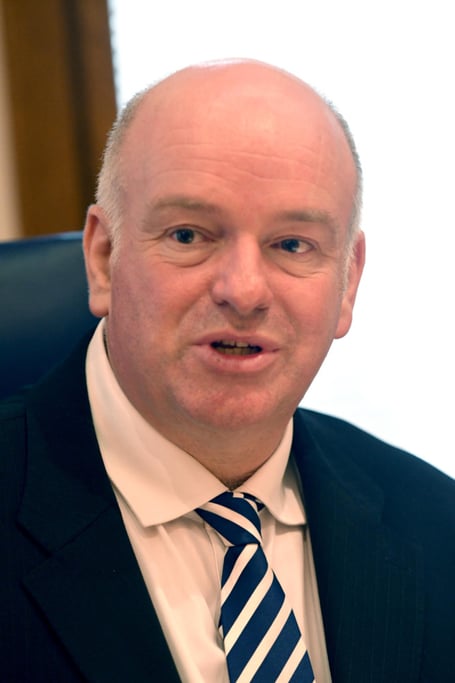
The Manx Government would have fought any attempt by Westminster to impose laws here, Chief Minister Howard Quayle has confirmed.
There was a real danger that the UK would force legislation on the island to make its register of beneficial owners public.
But an amendment to the UK’s Sanctions and Money Laundering Bill - that would have added Crown Dependencies, such as the Isle of Man, to the list of territories to which Westminster would impose legislation - was withdrawn at the last minute.
If it had been approved, it could have sparked a constitutional crisis, seeing the UK overrule the will of Tynwald.
.jpeg?width=209&height=140&crop=209:145,smart&quality=75)


In a statement to the House of Keys this week, Mr Quayle said: ’The amendment would have imposed a requirement on the Isle of Man where the UK Government and UK Parliament have no democratic legitimacy, and which would have been in direct conflict with our established constitutional position.
’The precedent this would set would leave the Isle of Man with no option other than to vigorously challenge the outcome by all means necessary.’
Mr Quayle led a delegation, ahead of the Westminster debate, to lobby against the amendment.
The amendment was ’in direct conflict with our constitutional position and basic democratic principles’.
He added: ’Furthermore, it could not be argued in this case that the UK would be intervening to hold the Isle of Man to account for its international obligations, given that we already meet or exceed all international standards in this area.’
Although the amendment calling for laws to be forced on Crown Dependencies was withdrawn, a different one, that would see the UK forcing legislation on British Overseas Territories was approved.
Constitutionally, the Crown Dependencies are not part of the UK, are not overseas territories. The basis for the relationship with the UK is the Queen as head of state,
Crown Dependencies create independent domestic legislation, although primary legislation does require royal assent.
It is acknowledged, though not recognised in law, that Westminster does not legislate for the Crown Dependencies without their consent.
The register of beneficial owners in the Isle of Man is not available to the general public but can be seen by tax and law authorities. That is the case in most jurisdictions, but not the UK, where the register is public.
Mr Quayle explained: ’The Isle of Man has consistently complied with international standards as they are promulgated by bodies such as FATCA and the OECD Global Forum.
’We already have our own robust systems in place to tackle tax evasion, money laundering and other financial crime, which meet the highest international standards including a leading position on the retention and sharing of beneficial ownership information.’
He added: ’We have an enhanced relationship for sharing information with the United Kingdom which is working well. The Isle of Man has an accurate central register of beneficial wwnership statutorily overseen by an independent authority, the Financial Services Authority, from which we can share information with tax and law enforcement authorities.’
The EU has adopted a policy seeking public registers, but Mr Quayle said this was not yet the ’international standard’.
But he added: ’The directive has only recently been agreed. While EU directives and regulations are not automatically binding on the Isle of Man, these are often considered in our policy approaches.
’Consequently, we have started to consider our policy position.’
Comments
This article has no comments yet. Be the first to leave a comment.