
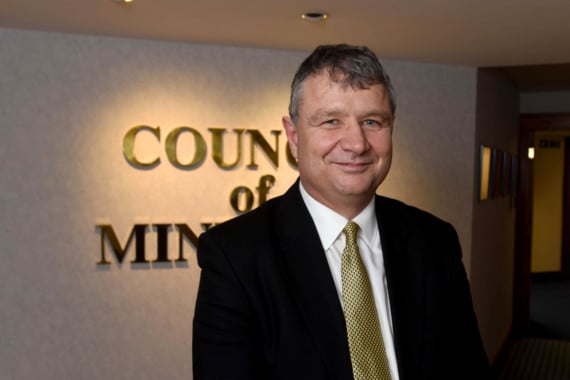
Government plans for a ’smart services framework’ are not an attempt to sneak in an identity card system, Policy and Reform Minister Chris Thomas has pledged.
He gave the assurance after being questioned on the latest developments in introducing the framework, which aims to implement a ’tell us once’ approach for information held by the government - so the right officials can access information that is held in a different section.
In December 2017 Tynwald voted to introduce the system, which would implement a single resident record, and last week Mr Thomas gave a progress report on moves towards it, following publication of a business plan.
But Daphne Caine (Garff), who has previously raised concerns about data breaches, questioned Mr Thomas over the government’s plan to reduce down to one the number of different smart cards - such as the MiCard for collecting benefits - used by the public to access services, and what the implication was
.jpeg?width=209&height=140&crop=209:145,smart&quality=75)

.jpeg?width=209&height=140&crop=209:145,smart&quality=75)

’Is that going to be an identity card by default?’ she asked.
She wanted to know if such cards would require a photograph as well as a name and whether islanders would still be able to access government services.
But Mr Thomas pledged: ’There is no intention to make any component of the smart service framework an identity card by default - that would be contrary to the principles of it.’
He added that change was not imminent.
’"Tell us once" is still some way away,’ he said. ’I do not want people to set hares running. I mean, it was dead easy for certain people to say in 2015, that we would just move straight away to "tell us once" but it is a bit harder.’
He set out what stage the process was at, saying ’appropriate underpinning legislation’ was vital.
A business case for the first stage of the implementation of the framework includes electoral registration, demographics data and jury listing.
’It is intended these stage one building blocks of the project will prove and establish a new approach for government systems and data sharing,’ he added.
’Principles are already in place governing the procurement and development of all future systems, ensuring these are compatible with the smart services framework and allowing for expedited integrations if or when requested.’
But not everyone was impressed.
Lawrie Hooper (LibVannin, Ramsey) said everything stemmed from a report in 2016, followed by a feasibility report in 2017, another report in December 2018, before the business case for the first stage this year.
’This seems to be dragging on for quite some time,’ he said.
Comments
This article has no comments yet. Be the first to leave a comment.