
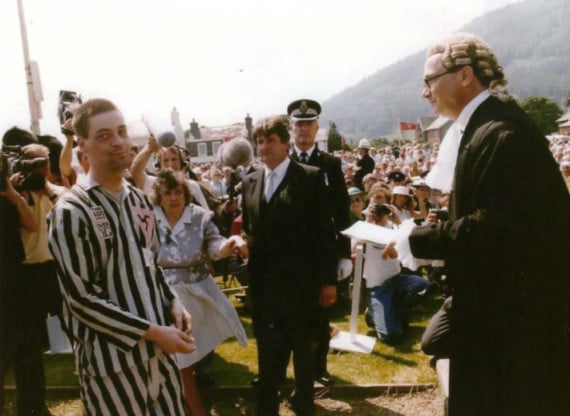
Reporter Siobhán Fletcher meets Alan Shea, who led the gay rights campaign for a change in the law 30 years ago.
This past weekend saw the island’s first ever public pride event take to the streets of Douglas in full force, as the Isle of Pride festival took over the Villa Marina gardens on June 12.
The festivities were launched by a march from Villiers Square which saw participants carry a 50-metre rainbow flag through the centre of the capital.
The march was named the ’Long Walk to Pride’, and featured specially made placards which told some of the stories of Manx LGBTQ+ history - including some never before seen photographs and quotations taken from the Manx queer archives.
-24.jpeg?width=209&height=140&crop=209:145,smart&quality=75)
One placard carried along the route featured the quote: ’The inequality can sometimes make you feel like giving up. DON’T’ above a photograph familiar to many on the island of a Tynwald Day protest that took place in 1991.
The huge gains made for LGBTQ+ equality come into stark focus when you compare the scenes of support on the Douglas waterfront last Saturday with the image of Alan Shea dressed in the striped uniform of a Nazi concentration camp victim at the foot of Tynwald Hill 30 years ago.
Mr Shea’s iconic Tynwald Day protest grabbed the attention of the entire island as he highlighted the plight of gay people suffering under the anti-homosexuality laws still in place at the time.
As a result of his Petition for Redress of Grievance to decriminalise homosexuality, and the attention his protest drew to the issue, private and consensual acts of male homosexuality on the island were decriminalised in 1992 - 25 years later than in England and Wales, and 12 years after Scotland.
The Manx Independent spoke to Alan about the gains made in the past 30 years, and the battles still to be won.
“
The costume was all about that persecution.
Alan Shea
Mr Shea said the motivations behind his protest three decades ago were always crystal clear. He wanted to send a message to the Manx people that gay men were being unfairly targeted on a daily basis.
He said: ’It was all to do with persecution, of gay men getting stopped everywhere they went. Anywhere they went they were being stopped and harassed.
’When I was campaigning, my home was being watched by the police. So basically the costume was all about that persecution.’
The uniform worn by Mr Shea consisted of a pyjama jacket and trousers, bought from Marks & Spencer in Douglas, which he then painted with grey and black stripes. He also attached a pink triangle emblazoned with the added detail of the Three Legs of Man.
The pink triangle represented the badge used in Nazi concentration camps as a marker to indicate those imprisoned because they had been identified as a gay man. It has been largely reclaimed by LGBTQ+ activists since the 1980s as a positive symbol of resistance.
Underneath the pink triangle was a label with the number 626262 (the Isle of Man Government phone number).
The concentration camp uniform is now housed at the Manx Museum.
Asked about why he picked such an evocative outfit, he explained that he knew it would draw attention to the issue, which in turn may help dispel some myths.
He said: ’What people don’t understand was that homosexuality was never against the law, only the sexual acts [were]. This is where people [were] getting confused. And the police abused their powers in those days.
’I remembered watching something about Nazi Germany, [and the treatment of gay men] and I thought the costume would be perfect for Tynwald Day, and it was.’
Three decades later, this past weekend saw thousands turn up to the island’s first pride, something which Mr Shea deemed ’amazing’.
He said: ’Pride, I thought, was absolutely brilliant. [There was such a] mixture of people. I mean all hats off to Clare Barber and the Isle of Pride committee, [they did an] absolutely brilliant job. I can’t wait for next year for the next one.’
The festival was organised by the Manx registered charity Isle of Pride, who want to promote an ethos that ’Pride Cares’.
It was originally due to take place last year, but had to be postponed because of the pandemic.
“
I still to this given day believe that the Isle of Man police should apologise for what they did.
Alan Shea
Emotions ran high on the day for many, including Mr Shea, who lamented those who died before the passing of equality laws, and firmly levelled his criticism at the police.
’I found it a bit emotional because of the people that weren’t there, because they have passed away,’ he said.
’People that should have been there, but unfortunately because of the way the police acted in those days, they are no longer here.’
He added: ’I still to this given day believe that the Isle of Man police should apologise for what they did.’
Despite the fact homosexuality was decriminalised in 1992, it took until January 2020 for the Manx Government to provide a formal apology.
As a bill which will see men convicted of consensual homosexual offences pardoned had its final reading in the House of Keys, Chief Minister Howard Quayle issued an ’unqualified apology’ to gay men convicted of same-sex offences under previous Manx laws.
The Sexual Offences and Obscene Publications Bill 2019 is yet to be fully entrenched in law, however Mr Quayle said that whilst he could not erase ’past injustice’, he hoped the new legislation would ’start to heal some of the pain’.
Mr Shea insisted the government should not be the only ones to apologise.
He said: ’We’ve had [an apology] from the Isle of Man government, but the police should apologise because they were the ones that were persecuting the gay men.
’There are people who lost their children when they were 20 years of age.
’When they were arrested by the police, they [were told] "we’re going to tell your job, we’re going to go around and tell your parents" and before they know it, the police are at their [parents’] door, saying "your son’s killed himself". That’s not nice. And that’s at the hands of the police. From [their] persecution.’
He argued that it is wrong ’for them to say that they don’t have to apologise’ and stated that past injustices cannot all be attributed to the government and outdated legislation.
When asked how he thought the police should make amends, Mr Shea said: ’I just think an apology, just for the families and everyone else they persecuted, they should get an apology.
’And as I say, it’s not this police force, but there are some members of this police force that are still there from 30 years ago believe it or not.’
Alongside a public apology from the police, Mr Shea argues more legislation needs to be passed to ensure equality and safety for all.
He said: ’There’s still more work to be done I would say.
’I think the Isle of Man needs to bring in hate crime legislation to stop [violence against gay people]’.
Although the first public pride festival on the island was undoubtedly a huge victory for LGBTQ+ campaigners, Mr Shea saw room for improvement.
He described the day as ’brilliant - without the police it’d be even better!’