

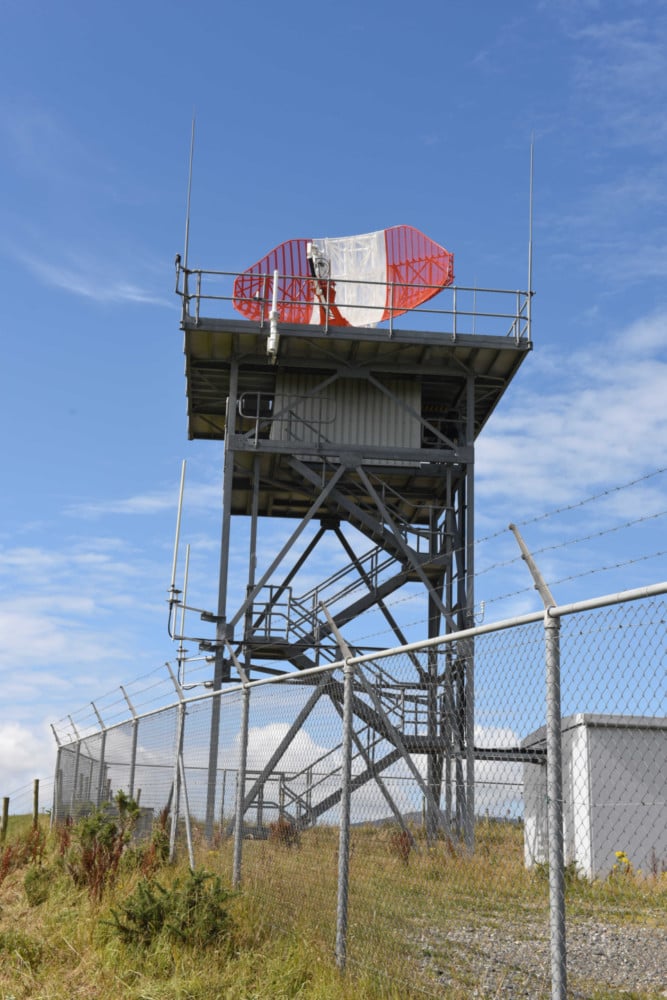
Seven years after the £3.2m project was first approved, the new radar at Ronaldsway airport will become fully operational next month.
All the approvals are now in place from the Civil Aviation Authority to allow the Leonardo surveillance system to replace the old radar.
But it will be early September before the Italian contractors can come to the island to assist with the switch-over.
The new system has been working alongside the old one for the past four to five years.


.jpeg?width=209&height=140&crop=209:145,smart&quality=75)
In Tynwald last month, Infrastructure Minister Ray Harmer MHK announced that the director of civil aviation was considering the UK CAA’s recommendation that the system is now suitable for operational use, subject to various conditions and procedures.
He said then it was expected that the new primary and secondary radars would be in use by the end of that month and that the ’old’ radars will be switched off.
There would then be a formal review of its operation, after which the initial approval will be replaced with a final licence.
’I know that members will be as pleased as I am that this significant step has been reached,’ Mr Harmer told the court.
But airport director Ann Reynolds said the switch-over would not now take place until the first week of September.
She said: ’I can confirm the Ports Division has received the relevant UK Civil Aviation Authority’s recommendation and the Isle of Man civil aviation administration’s approval to go to temporary approval and our transition/switch over is scheduled for September 2-3, when the old radars will be switched off.’
The £3.2m project, the first of its kind to be used in the British Isles, was approved by Tynwald in December 2010.
The old primary and secondary radars are located on the same tower at Derbyhaven. A failing of that system was it could not detect aircraft on the other side of the mountain.
Under the new system, the primary radar is located near Turkeylands quarry while the secondary radar has sensors all round the island so air traffic control can detect aircraft coming in from all directions.
Wide Area Multi-lateration is an alternative to conventional rotating radar and uses time-based separation methods to establish the position of the aircraft.
Sensors are spaced far enough apart to receive discrete messages from aircraft.
Each sensor will receive the message at a slightly different time, and the system uses this minute difference in time to calculate very accurately the aircraft’s position.
The position is then displayed in front of the air traffic controller in exactly the same way as conventional radar.
In May last year, the then DoI Minister Phil Gawne insisted that the government had not lost out over delays to multi-million pound airport project.
He described the new radar system at Ronaldsway as ’probably one of the best deals government has ever struck’.
Peter Karran, the then Lib Van MHK for Onchan, called on the matter to be referred to the Public Accounts Committee.
Mr Gawne replied that Ronaldsway was unique in the British Isles for having four fully functional radars.
He blamed the delay on communications problems with the Italian contractor. And he insisted government was far from losing out and substantial sums had been secured from the company for failing to deliver.
Mr Gawne told the Keys: ’We are recouping much of the cost added to which we are having our old primary and secondary radar maintained at the expense of the contractor.
’So this probably one of the best deals that government had ever struck in terms of requirements on the contract.’
Comments
This article has no comments yet. Be the first to leave a comment.