
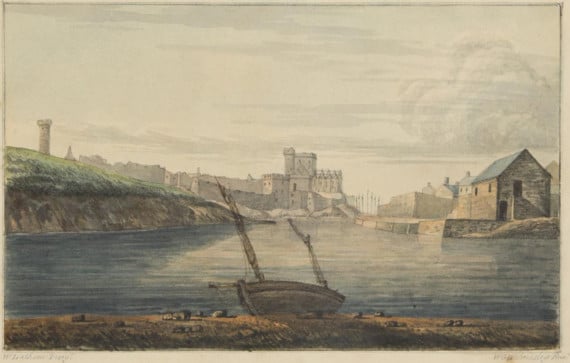
Manx Utilities has uncovered a stone quayside in Peel that’s believed to date back to the 1700s.
MU’s current work involves replacing water main and sewerage infrastructure.
Surveys and test holes have previously been carried out to understand the nature of the ground into which the new services are being placed, in particular identifying difficulties.
Manx National Heritage archaeologist and inspector of ancient monuments Andy Johnson said: ’We were aware that the modern public quayside was built in front of a series of private quays and docks, and that the ground behind was filled in to create more space for new warehouses, merchants’ houses, workshops and other industrial buildings.’




’While some of these still stand, the improvements saw the demolition of other buildings to ground level.
’Manx Utilities’ underground radar surveys and test-pits helped to identify where these structures still survive, and the course of the new pipework has been threaded through so as to minimise damage as much as possible.
’The most substantial structures are the old harbour walls, and one of these protruded so far into the excavation that it couldn’t be avoided - but it meant we got to see it for the first time in about two centuries!’
The old harbour walls are built of the red sandstone found at the end of the bay, unlike the more recent harbour works which are for the most part constructed from rock from quarries on Peel Hill.
One of these older seawalls defined land attached to No 31 Castle Street, and continued westward below the roadway along a line extending out from the south side of the alleyway between No 31 and the Leece Museum, before turning south to meet the corner of the Jade restaurant by the entrance to Keown’s Lane.
Mr Johnson added: ’From this old quayside, a ramp would have led downwards into the storage vaults below No 31, where part of the restaurant is today. I’m quite sure the partially sunken entrance was one of the reasons so many people are convinced that Peel has a maze of underground smugglers’ tunnels. We know that Castle Street was once home to several of Peel’s most powerful merchants, some of whom lived above or adjacent to a range of warehouses, vaults and yards where the source of their wealth would be stored after being unloaded from their ships.
’I shall be very interested to see if any evidence of the temporary First World War railway track appears once the project approaches Station Place - along the rest of the quay the new pipes are too far away from the sea wall - this was the track that enabled supplies brought into Peel by ship to be transferred down to the internment camp at Knockaloe.’
Comments
This article has no comments yet. Be the first to leave a comment.