

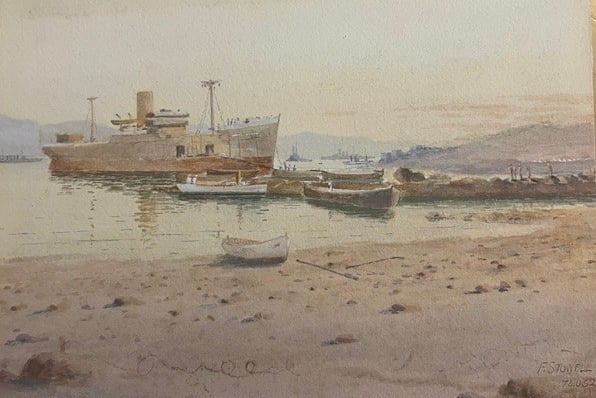
A chance visit to a charity shop on the Isle of Man has led to the rediscovery of a rare artwork linked to one of the First World War’s most tragic campaigns.
While visiting family in Onchan shortly before Christmas, David Long, a researcher with the Imperial War Museum’s War Memorials Register, called in at the local Hospice Charity Shop.
Among the items for sale was a small watercolour painting that caught his eye. A handwritten note attached to the back revealed its subject, Gallipoli, 1915.
The painting depicts the SS River Clyde, later commissioned as His Majesty’s Transport Ship.
Built in 1905 as a coal carrier, the vessel was requisitioned during WW1 and played a key role in the Gallipoli landings on 25 April 1915, where Allied troops faced heavy enemy fire and suffered severe losses.
But how did a painting created during one of the First World War’s bloodiest campaigns end up in a small charity shop in Onchan?
Closer inspection of the artwork revealed it was signed ‘F Stowell’, with a number written beneath the signature.
Mr Long recognised the number as a military service number. He purchased the painting for just £2 to investigate further.
Research confirmed the artist was Flaxney Stowell, son of the well-known Manx painter of the same name from Castletown.
The younger Stowell served with the Army Ordnance Corps at Gallipoli before later transferring to the Royal Welch Fusiliers, where he was issued the service number seen on the painting. He was later stationed in Egypt in 1916, the same year his father died.
Although the Gallipoli campaign ended in disaster, with hundreds killed during the landings, the captain of the River Clyde and four crew members were awarded the Victoria Cross for their bravery.
It is believed the painting was created after the area had been secured and turned into a supply depot, capturing a rare moment of calm after one of the war’s most harrowing events.
The artwork has attracted interest from both the Manx Museum and the Manx Aviation and Military Museum.