
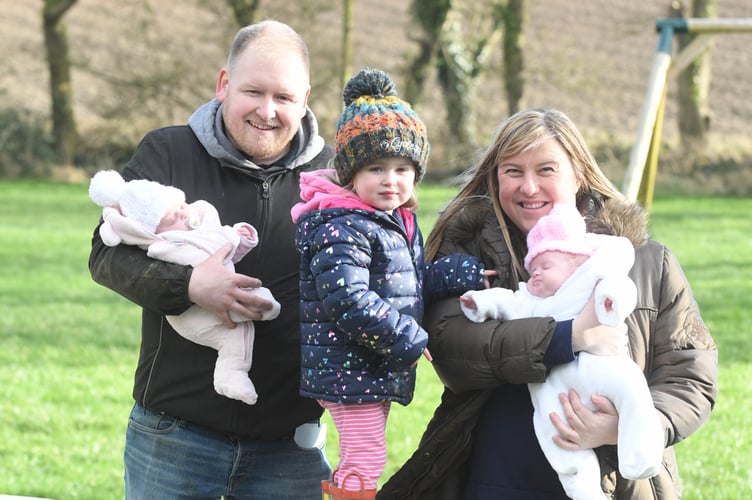
I’d never been on a farm before I met Will,’ says Robyn Duggan, wife of the Young Farmers’ president.
They met at the 21st birthday of a mutual friend and Robyn’s first invite to Ballavell, where Will and his family farm, was quite a culture shock.
Robyn recalls: ‘The first time I walked into the cow shed I was quite scared.’
Will followed up during this romantic first date with a ride on the tractor while he was spreading muck on the fields.
Despite this, they have been together ever since and Robyn soon got into the swing of farm life
‘I’ve fully embraced everything now. Because the seasons change it’s always something different isn’t it? I think that’s why I enjoy it, there’s always something else: looking forward to getting the cows out then, after the silage, you’re looking forward to a bit of routine for the winter and the cows coming in.’
She had even taken on the calf management before the arrival of their eldest daughter, Alice, two years ago. Now Jess Clague and Eva Jones who work on the farm have taken over the calves. They help out in other ways too, especially as Will and Robyn have added to their young family with the birth of twins, Faye and Lucy, on December 10.
Robyn says: ‘I think being on a farm helps massively because someone’s always around. Eva’s really good and Jess as well and Will’s mum pops round. We’d be lost without them.’
The twins’ arrival was quite dramatic. Robyn was being monitored throughout her pregnancy because of problems with high blood pressure. The day before the Young Farmers’
first Christmas Tractor run she went to the hospital for her check up and was told she had to stay in. The twins were delivered by Caesarian section the following afternoon.
Robyn says: ‘Then it was a case of whether Will should do the Tractor Run that evening or not,’
In the end Will settled for taking part on foot, with a collection bucket, but he was out on on his tractor for the second run the following night.
The twins were seven weeks premature and went into the neonatal unit after they were born. Lucy came home on Christmas Eve and Faye on Boxing Day.
Of course, childbirth is an everyday occurrence on a busy farm and Robyn had already seen a Caesarian birth at first hand, on a cow, before she underwent one herself.
Will says: ‘There was a storm on and all the electricity went out when we were halfway through, so rang Robyn and said: “Can you bring whatever torches you’ve got down in the shed?”’
Robyn adds: ‘I’d no idea what was going on then I realised it was a caesarean. It was just before I was due to give birth to Alice, and that was a bit daunting!’
Like all farmers, the Duggans are currently facing a tough year ahead with rising input costs.
As president of Isle of Man Young Farmers, Will has obviously been getting plenty of feedback on the issue.
He says: ‘Literally everyone I’ve spoken to has the same concerns: “what shall we do”, and there’s two trains of thought. One train of thought is they’re going to cut back and sow less fertiliser and produce less and the other one is going to crack on as normal and try and produce as much if not more.’
Will has decided to go with the second way. He says: ‘We’re not slowing down. With the fertiliser prices and everything, we’re not backing anything down. We plan to push as hard as ever. I think it’s all we can do.
‘I might be wrong but my attitude is, it’s more important than ever this year to produce what we can off the farm, rather than buying anything in.
‘I think next winter prices are going to be ridiculous so anything more than we can produce at home is more important so even though the prices are sky high we just have to bite the bullet.
‘I don’t think anyone knows exactly where it’s all going to end up, that’s the worst of it.’
Like all the dairy farmers who supply Isle of Man Creamery, Will’s cows are predominantly grass fed. He has committed to the Isle of Man Grass Fed Scheme which means allowing them to graze for more than 200 days a year.
This is some way above even the highest comparable schemes in the UK which are 180 days. At least 70% of their diet must be made up of fresh or dried grass throughout the year. The rest of their diet is made up of barley and silage.
Will says: ‘I’m planting about 100 acres of spring barley which will more than fulfil our requirements and then similar then with silage, about 100 acres of first cut to do and it’s more critical than ever to make that with as much protein as we can.
‘We’ve already put slurry on first cut silage ground and I think we’ll have all the slurry stores absolutely top full. We’ll do it again for second cut and, fingers crossed, maybe not need to put any fertiliser on.
‘If we can make our full first cut as normal, that will care of the milking cows for next winter, and then the second cut is only for the young cows and dry stock which we don’t need the quality for so if we can grow that from slurry....normally we’re six weeks to the day between first and second cuts but this year I think we’ll aim to let that go longer and try and cut back on fertiliser there. But certainly for the first cut and the barley crops the fertiliser is more critical than ever.’
Does the unprecedented rise in costs mean that dairy farmers will be looking for a rise in the milk prices?
‘It’s going the right way,’ says Will, ‘but it’s got a long way to go.’
As Will points out, now more than ever is the time to be supporting food production on the island.
He says: ‘I think consumers really need to look to local if they want to have any sort of sustainability.’
Comments
This article has no comments yet. Be the first to leave a comment.