
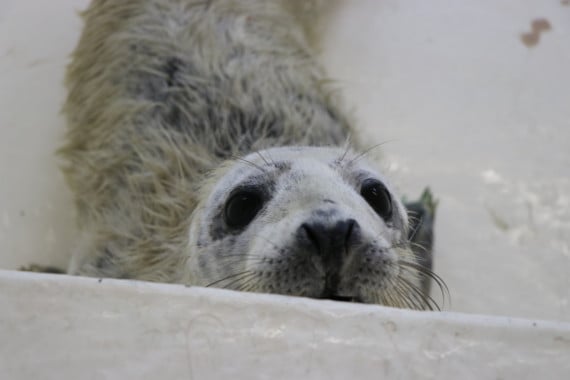
Wildlife organisations around the island received a large number of calls concerning seals that were thought to be injured by the hurricaine weather.
The Manx Wildlife Trust suspects a 48% loss of seal pups around the Calf of Man, where the organisation has been carrying out field surveys on the animals.
Manx waters are home to hundreds of Atlantic grey and common seals, which are protected species under the Wildlife Act 1990.
This time of year is critical for the species, as breeding season takes place from October to December and the mother-pup bond is vital for survival.
The trust’s marine officer, Lara Howe, is concerned about the figures but claims the population continues to thrive, despite the losses.
’Every year we’ve seen a healthy increase in numbers.
’We’re having a lot of bodies wash up because of the storms, but more pups have been born since and they’re doing well.’
Two full-time volunteers are currently stationed on the Calf of Man to follow the pup’s progress by taking identification photos and watching their behaviour.
Lara said: ’The surveys are essential, as they give an indication of how the population is doing. We’ve been taking surveys for many years and it’s great to get that continuity.’
’Other charities are also getting directly involved with the protection of the species.’
The ManxSPCA is currently monitoring two seal pups that were affected by the storms.
Rose, one pup which was found at the Point of Ayre after storm Ophelia struck, was brought in and has had her infected claws amputated.
Jane Gregory, assistant site manager at the ManxSPCA, said: ’We were concerned, as she wasn’t doing very well when we found her.
’She was very thin and we could see her neck, which is an indication that a seal is very unhealthy.’
The other pup, Sebastian, was found at Fleshwick Bay alongside two others after the second storm hit the island.
The other pups were in good health whereas Sebastian had an infected flipper and was ’looking very sorry for himself’.
Rose and Sebastian are being bottle-fed by the charity at present, to help them gain weight before being released into the wild again.
Jane said: ’Hopefully we’ll be able to see them eat fish by the end of the week. Ideally we want them to reach 20 to 25 kilos before we release them.’
With more than 10 years of experience dealing with seal pup casualties at the ManxSPCA, Michael Thompson, has been given the role as chief carer.
He said: ’It’s hard going, looking after them, but it has to be done. I feed them every four hours and we take them swimming to get their strength back up.
’It’ll take longer until they’re in the wild again because they’ve had a lot of damage.’
Michael, who has constantly monitored the rescuees since they were brought in, stresses that looking after seals is not only a full-time job, but a risky one too.
’People don’t realise how dangerous they are,’ he said. ’If you slip when feeding them, you could lose a thumb.’
Matt Creer, who works at the charity’s kennels, has lent his hand and risked his fingers during the pup’s feeding times. He said: ’It’s a real priviledge to help. They’re such wild animals and we don’t often get the chance to be close to them. Plus, they’re really cute.’
Animal trusts are warning people to stay away from seals because of their aggressive behaviour and ’nasty bite’, which could become infected.
Dogs could also contract parvovirus from bites.
The ManxSPCA has received an influx of calls regarding lone seal pups this year, most of which were found to be resting on the shore.
The charity recommends that people should watch the pups for several hours from a good distance, as the mothers may be out feeding or watching from afar.
If the mother does not return after a considerable length of time then contact the ManxSPCA on 851672.
â?¢ The ManxSPCA would welcome any donations of fresh fish for the seals.
Comments
This article has no comments yet. Be the first to leave a comment.