

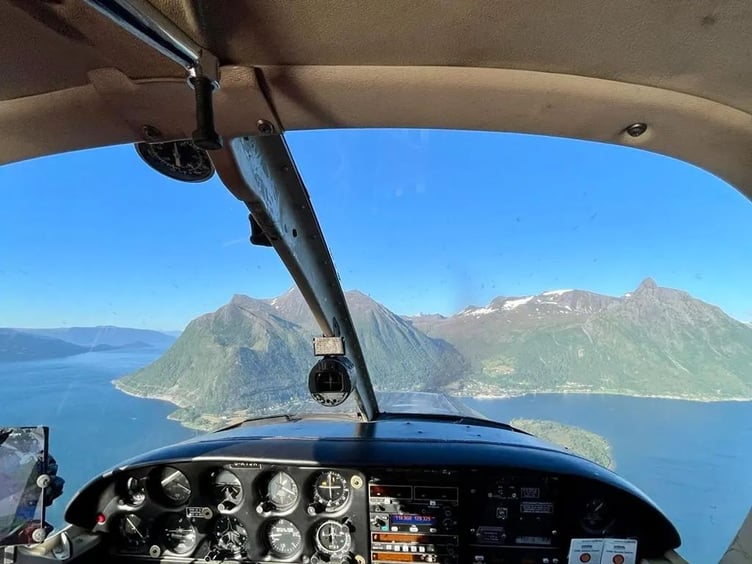
Adam Jackson, from the Isle of Man, recently came second place in an aviation competition.
The competition called ‘Dawn to Dusk’, runs annually, and its objective is for competitors to fly for at least four hours between dawn and dusk.
It was established by the late Duke of Edinburgh and the Tiger Club, a flying club in London.
Competitors are marked against five criteria which are: planning including originality, research and flight planning; airmanship, difficulty, distance and airborne time; safety, error management and appropriate equipment on board; presentation, completeness and accuracy; and pilot / crew experience, disability and health and the machine used.



Adam moved away from the island for university, and since, has worked on the engineering side of the aerospace field, including working in Formula One.
He always wanted to learn how to fly, and in 2017, he joined a flying club, having lessons and getting a license.
He was looking for a project to reinvigorate his passion for flying, as due to the pandemic he hadn’t flown much.
Adam planned a trip to Greenland but came up against some obstacles, when he found an email for the Dawn to Dusk competition.
He came up with the entry, ‘Defying Dawn to Dusk’ which had three objectives for the competition.
The first was to depart the UK for Norway and fly far enough north to avoid dusk until the return to the UK.
His second objective was to fly around the North Cape, and his third objective was to fly at local midnight, under the midnight sun.
Adam, along with one passenger, Martina Petkov, flew a total of 46.5 hours which was a distance of 3,668 nautical miles, this was achieved over the duration of two weeks, having made 15 stops.
Before the competition, Adam had flown for a total of 92 hours as the pilot in command, that is without an instructor.
Embarking on such a big trip, meant that Adam came up against some challenges.
He explained: ‘Legally I am not allowed to fly in cloud, I do not have an instrument rating, which is a qualification needed to fly in cloud.
‘That makes flying long distances across the North Sea and in Norway tricky, even in summer.
‘The weather is changeable at best.’
This meant that there were days where he was unable to fly, with him and his passenger using camping equipment.
In addition, he had to be precise with his stops, as there were limited airfields with suitable fuel for the aircraft he was flying.
He said that it was difficult fitting everything into the plane.
The plane he was flying can lift around 200kg, he said: ‘Once you account for two people, there is not much room for anything else.’
A final challenge that he faced was finding an airfield that was open at midnight, so that he could complete his flight under the midnight sun.
He said: ‘Porsangerfjorden towards the North Cape felt fairly remote, big cliffs, lots of sea, and it was late at night, with dramatic light thanks to the low sun, peaking through gaps in the dark clouds.
‘Once we got to the North Cape I was initially surprised to see lots of tourists and camper vans on the 307m cliffs.
‘It was about 11.30pm local time, so everyone had gathered to see the midnight sun.
‘Hopefully they were equally as surprised to see me in a little Cherokee bumbling past.’
During this flight, he also saw humpback whales.
There were 11 competitors, and at the awards ceremony which took place two weeks ago at the Royal Air Force club in London, Adam’s entry ‘Defying Dawn to Dusk’ was awarded second place.
First place was awarded to a team who went through the Devon and Cornwall Lighthouses, and third place was the most airfields visited by a light aircraft in 24 hours.
Another entry saw competitors draw a portrait of the Queen through its GPS trail.
Adam said that he had the least experience of all of the competitors.
Although Adam has since moved to Canada for work, he comes back to the island frequently, to visit his parents in Greeba.
He describes the experience as an ‘epic adventure’.
Comments
This article has no comments yet. Be the first to leave a comment.