
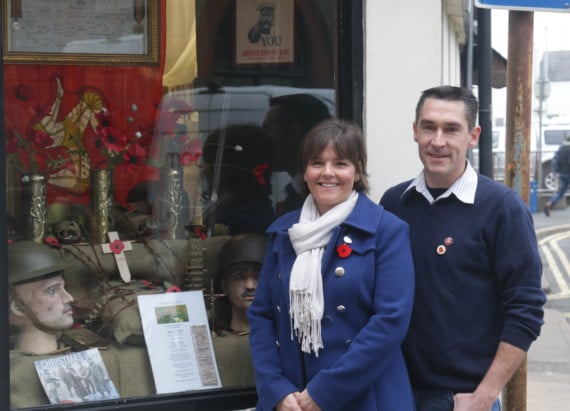
If you walk past The Curtain Shop, in Market Hill, Douglas, you may find yourself doing a double take, writes Julie Blackburn. Because one of its windows is full, not of soft furnishings but First World War memorablia.
Shop owner, Mark Hibbert, 43, has been collecting items from both World Wars for most of his life.
He decided to make a window display from some of the things in his collection to commemorate the 100th anniversary of Armistice Day, the end of the First World War, on November 11.
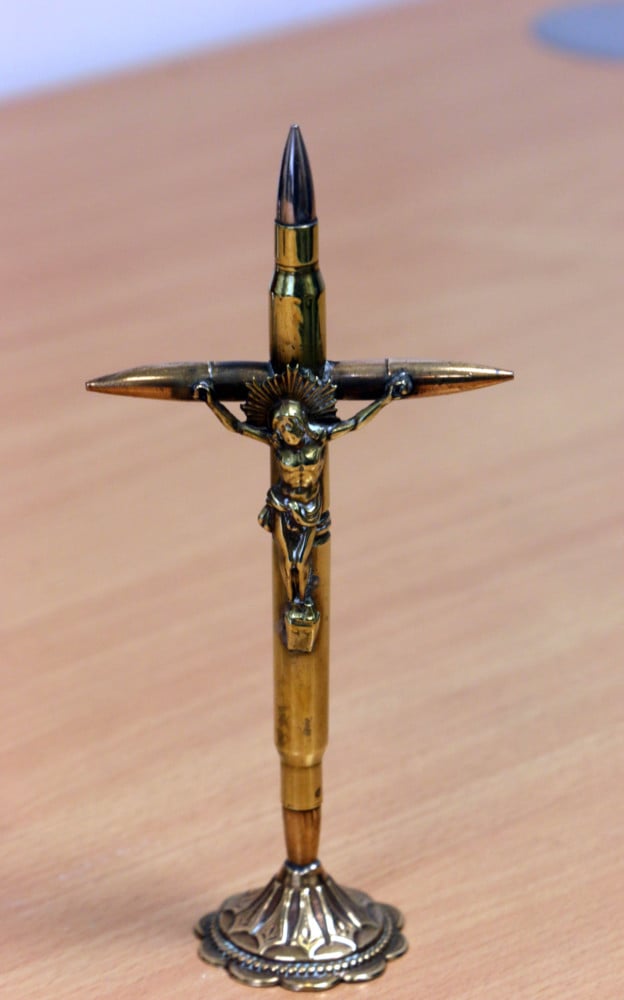
He explained how his collection got started: ’There’s a cross in the window made out of bullets that was given to me by an old boy who was my auntie’s neighbour in the UK when I was five years old.’
.jpeg?width=209&height=140&crop=209:145,smart&quality=75)



The crucifix is a beautiful piece of craftsmanship and Mark went on the explain that this was a fine example of ’trench art’, something a soldier would have made during the long periods between battles, to stave off boredom.
There are also three vases in the window which have been fashioned from spent brass shells.
It’s estimated that four and a quarter million shells were fired on the opening day of the Battle of Passchendaele and a further two million a week after that for as long as the battle went on so there would have been plenty lying around afterwards.
Mark also has a couple of empty 18-pound brass shells in the window.
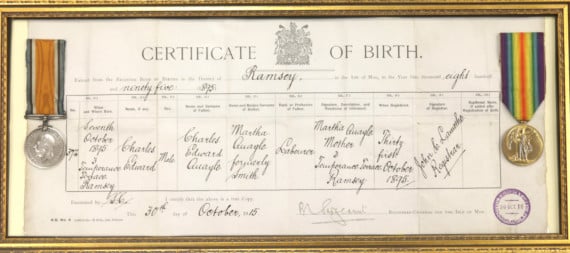
Another piece with an interesting story is the copy birth certificate of one Charles Edward Quayle, from Ramsey. It is stamped with the date it was taken out of the registry, October 30, 1915, presumably for young Mr Quayle to prove that he was old enough to enlist. However the birth certificate was discovered along with a couple of medals that which were engraved with the the name Quayle but with different initials.
This has led Mark to speculate that Charles Quayle may have borrowed an elder brother’s birth certificate because he was, in reality, below the age at which he would have been old enough to fight.
One especially poignant item is the bookmark, made in the memory of a Signaller Nield, from Devon, who was shot by a German sniper when he was just 19. Because the writing on the bookmark had become faded and difficult to read, Mark’s girlfriend, Nicki Park, offered to type it out and laminate it for the window display. They were both stopped in their tracks when she came to print it what she had typed and realised the date was October 20, the same day on which Signaller Nield had died, a century earlier.
’The hairs on the back of my neck stood up,’ said Mark.
Another piece in the display is a battered brass tin: Princess Mary gave one of these to all the British and Commonwealth soldiers at Christmas 1914. Inside would have been a picture of the Princess, some tobacco, chocolate and a lighter. Troops from India who did not smoke would have found spices instead of tobacco in their tins.
Mark also showed me a small engraved coin not included in the window display.
He explained that in those days soldiers’ dog tags were made of leather which would perish, which was why so many men could never be identified.
So the soldiers took matters into their own hands and would engrave on a coin their name, religion and army regiment, placing the coin inside their boot to be found if they were killed.
The coin Mark has was engraved with the name A. Shannon, from New Zealand.
Mark has not yet had a chance to visit any of the First World War battle sites: ’It’s on my bucket list,’ he said.
And he remains fascinated by these amazing historic wartime items that have such a vivid tale to tell about the people who once owned them.
He said: ’The more you read about it, the more you ask questions.’
Comments
This article has no comments yet. Be the first to leave a comment.