
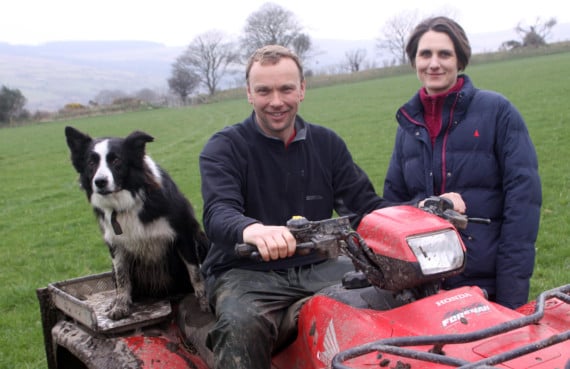
Drivers are being urged to slow down on roads adjacent to land where hill sheep are being kept, to cut down on accidents involving livestock.
Michael Rafferty, who has lived on the Tholt-y-Will Road for just over two years, highlighted the problem in a Facebook post.
He said: ’For the second time in a week I’ve had to scoop up a badly injured lamb from the Tholt-y-Will road and take it to the vet.
’On both occasions the animal had to be put to sleep.
.jpeg?width=209&height=140&crop=209:145,smart&quality=75)

’Also on both occasions the incident wasn’t reported to the police.’
The first thing to understand is that these are not animals which have ’got out’ or ’escaped’ from their fields.
These large land holdings on the hills run right over the roads that cross them: the road was actually included as part of the hill on the old tenancy maps.
Farmer Anna Kerruish runs hill sheep in the area. She said: ’Fortunately the only open road section we have is the Gooseneck Road which is single track and extremely potholed so cars are slower and collisions very rare.
’The unfenced sections generally work in with a block of hill ground so it would be a challenge to gather hill flocks with roadside fences cutting through the area.’
Ean Parsons has hill sheep on around 300 acres of land bordering and crossing the Tholt-y-Will Road.
Ean went on to explain: ’What happens with hill sheep is that a ewe will leave her lamb tucked away somewhere safe while she will go off and forage for a long distance, sometimes up to half a mile if she’s looking for water.
’Sometimes the sheep will end up on one side of the road and the lamb on the other. It will run to mum and that’s when it gets hit by a car.’
Ean added that speed is definitely a factor: accidents with livestock seldom happen in poor weather conditions when drivers are taking more care.
He said: ’The speed traffic goes up and down there is very fast.
’A few years ago I approached the Highways Board to see if they could put a speed limit on the road.
’It was really noticeable with the increase in traffic when they were building the prison in Jurby: it was horrific then.’
Ean has around 1,000 animals on the hills and, when it comes to the number of animals killed, he said: ’It’s probably in the region of 25 a year, both sheep and lambs.’
When an accident does occur, Mr Rafferty stressed the importance of reporting it to the police.
He said: ’This doesn’t automatically mean that the person will be in trouble, but it does mean the local shepherd will be notified and will be able to get the sheep/lamb to a vet.
’Also, the police and DoI will record this as a collision.
’I’ve been in touch with the DoI to see if anything can be done about the crazy driving on that road and have been told they can only go on statistics, and according to their figures the Tholty road is relatively safe - which it is not.’
Isle of Man Constabulary Roads Policing Unit posted a response on their Facebook page which clarifies the legal position for drivers on any road: ’If you kill or injure an animal whilst driving a motor vehicle, you must report the incident in accordance with section 20 of the Road Traffic Act 1985.
’An animal is defined by the act as horse, cattle, ass, mule, sheep, pig, goat or dog.’
Mr Rafferty added: ’Until you’ve seen a sheep shouting for its dead lamb, or witnessed a lamb standing over its dead mother wondering why it’s not being fed, then you may not fully appreciate the possible consequences of driving too fast on that road.
’That’s without even mentioning the risk to human life.
’Please, please spread the word.’
Comments
This article has no comments yet. Be the first to leave a comment.