
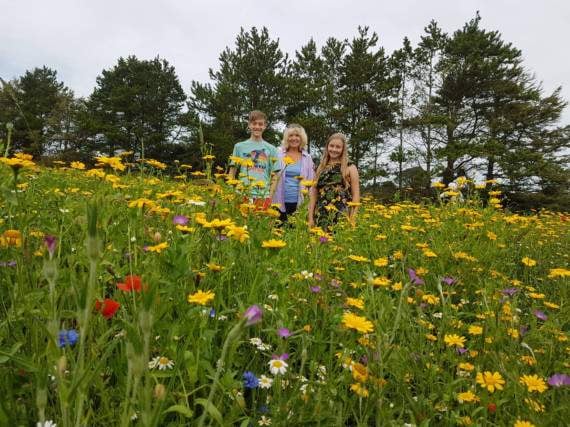
A wonderful splash of colour in a field in Colby is attracting a lot of attention - and a lot of pollinators.
The wildflower meadow has been planted on an acre of land near the top of the Ballacriy Park estate, by Paul Costain and his family from Moorhouse Farm.
Paul says: ’I just thought it would be a good idea if we could get more wild flower seed out there for the pollinators, the bees and the butterflies, so we can increase that population.’
’Everybody’s guilty of chopping wildflowers down before they’ve reached their full potential. In the springtime dandelions are one of the first plants that come up and flower and that’s a vital source for the bees - it’s the first nectar that the bees can get.’

Many farms in the UK are now leaving broader headlands around the fields, planted with wildflowers, as so-called ’wildlife corridors’ but, as Paul points out, the average field size in the UK is 20 acres but in the island it’s only three: ’We try and farm to the bottom of the hedge: we can’t go leaving a border on three acres or there’d be nothing left.’
As time has gone on it’s becoming clear that our abundance of hedgerows is actually a good thing as farmers and conservationists in the UK are now looking again at all the hedges that have been ripped out there to increase field size and efficiency.
Paul says: ’We’ve been backward on the island but now we’ve become fashionable: it all goes in cycles.’
Earlier this year Paul sourced a wildflower meadow seed mix, ploughed and worked the field and planted it in early June.
The seed cost nearly £400 so it was a significant investment but he hopes to harvest the wildflower seeds when they have finished flowering and spread some more around the parish next year.
He says: ’It’d be great if we could have more Manx wildflowers: if more and more people were collecting the seed heads once the plant has flowered and the petals have dropped they could be scattering them around.’
There is actually a machine designed to harvest wildflower seed but Paul says if they can’t borrow or hire one he also has a ’plan B’.
He reckons they can cut the plants and let them dry in the field before baling them and taking them back to the farm where the bales would be scattered out onto the barn floor and left to dry some more before sweeping up the seeds that drop off.
Paul and his partner Sally-Ann have already been collecting wild poppy seeds which they intend to store in a warm dry place until it’s time to plant them next year: ’It’s not hard too do,’ he says.
As he points out, on the island’s hills, wildflower seeds are spread naturally by grazing sheep and cattle: ’They pick the seeds up and it passes through their bodies and then their hooves trample it back into the ground.’
Paul’s sister, Kirrie Jenkins, and her family have also been involved in the project and I went to meet Kirrie, her son, Nick, and daughter, Breesha, at the wildflower meadow.
Even in a summer when the weather hasn’t been ideal - heavy driving rain has flattened the flowers in a few small areas and planting was late because of wet ground - it’s still a wonderful, colourful sight. The flowers include poppies, cornflowers and corn marigolds, the latter being on the amber endangered list of plant species.
’It’s what the traditional cornfields used to be,’ says Kirree and she goes on: ’It’s been a test. That was the main reason for doing it, and to get the birds and the bees back.’
They have certainly been rewarded already: one day she counted 17 grasshoppers in one small area of the field. It’s been many years since grasshoppers have been spotted there. There has been so much interest from neighbouring properties and passers-by that they have installed a collection box to raise money for the Port Erin branch of the Isle of Man Anti-Cancer Association.
Paul says: ’It’s trying to add a splash of colour. I love what Port St Mary Commissioners have done on the headland and Braddan Commissioners up by the Horse and Plough.
’It seems to make sense, instead of growing grass and then cutting it, to grow some wildflowers and let the pollinators take over and provide nectar to the butterflies and bees.’