
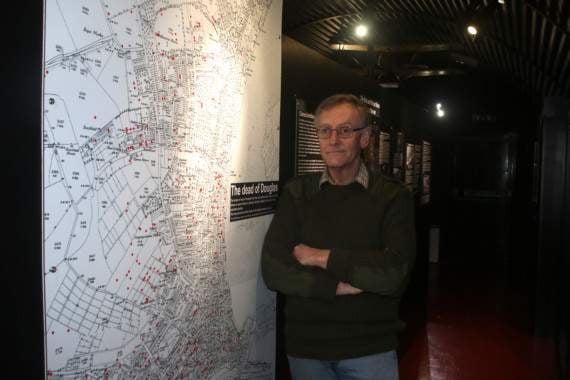
The tragic stories of Manx men lost fighting in the First World War are featured in a new exhibition at the Manx Aviation and Military Museum.
Mel Wright spoke to museum director Ivor Ramsden to find out more.
here were up to around 1,300 deaths in the four-year conflict.
The number is uncertain not least because of the hazy definition of what was ’Manx’; some war memorials feature men whose ancestors were Manx but had never even visited the island.
.png?width=209&height=140&crop=209:145,smart&quality=75)

.jpeg?width=209&height=140&crop=209:145,smart&quality=75)

But there is no uncertainty over the catastrophic impact of the dreadful war and the focus on personal stories has moved visitors to tears.
’I started work on this project at Christmas 2012 with the intention of opening the exhibition in August 2014 to coincide with the centenary of the start of the war,’ Ivor said.
’As my research went on, and publicity for the project brought in masses of objects for use, I quickly realised that it was going to take a very long time to put it together because everything that came in had to be meticulously identified and researched.
’Each object has a story to tell and I’ve tried very hard to find every possible scrap of information surrounding the objects and the people who they belonged to.
’At times the information has been very sad and the emotions have run very high.
’It’s impossible to do this work without developing a strong empathy with the people who were involved.’
He added: ’In the museum I have always tried to include some humour into the displays where appropriate but I’m afraid that the unimaginable slaughter of the First World War isn’t a subject for humour.
’In fact I shall be surprised if anybody leaves the exhibition without a tear in their eye.
’It’s not a place to learn about the big picture of the war; for that you will need to read the history books.
’Just like in the rest of the museum, it tells the personal stories of the people who were involved. At the very start of the project I decided that I would use every item that was given or loaned and I’m pleased to say that I’ve more or less achieved this.
’There’s an awful lot more than medals here but, just looking at medals, every single one that we’ve been given is on display along with information about the man who received it.
’A lot of museums have display cases full of medals but in my opinion there has got to be a story with them, otherwise they are just pieces of shiny metal which don’t mean very much.
’In this exhibition we’ve got a story for every medal; it has proved very difficult to find information about a few of the people whose names are on the medals so in those cases the stories are brief and I should be delighted to receive any additional details about anything or anybody which features in the exhibition. Whilst the exhibition is a permanent one, I can easily make changes to it.’
Ivor attempted to broaden the scope of the exhibition and capture the impact on family at home and the lives of injured survivors.
But he said there is very little recorded in newspapers or anywhere else, the subject was wrapped in a ’collective silence’ he said, ’it was taboo’.
The display has been costly to assemble and he thanked Culture Vannin and the Gough Ritchie Charitable Trust for funding some items for the exhibition which are of considerable historic significance and were at risk of being sold off the island.
Ivor and his team of volunteers have given hundreds of hours to this project and he is gratified by the positive reaction of the public.
Comments have included: ’The best First World War exhibition I’ve seen’, ’very moving’, ’fabulous’ and ’a superb exhibition, we haven’t stopped talking about it.’
Ivor said the display is ’a worthy tribute to those who did not come home and a worthy tribute to those who did’.
â?¢ The museum is open at weekends, 10am to 4.30pm.
Comments
This article has no comments yet. Be the first to leave a comment.