.JPG?width=94&height=94&crop=1:1,smart&quality=75)

In the first of a moving two-part account, Isle of Man Today deputy editor and father-of-three Andy Dalrymple from Douglas writes about the moment his five-year-old son Hector’s unexplained illness took a devastating turn...
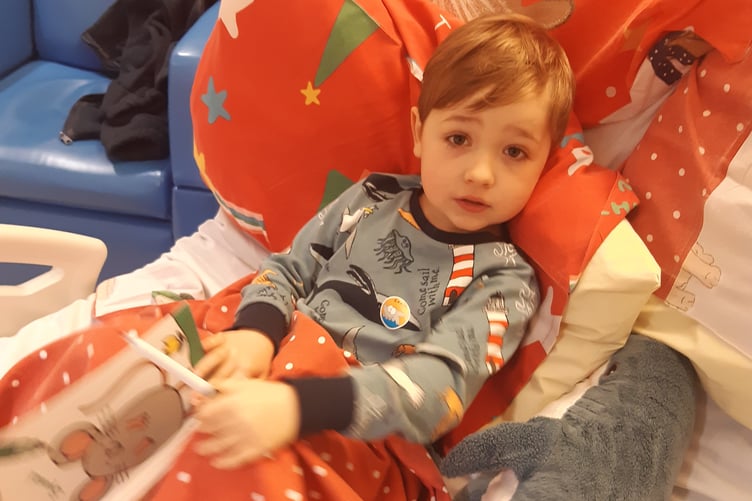
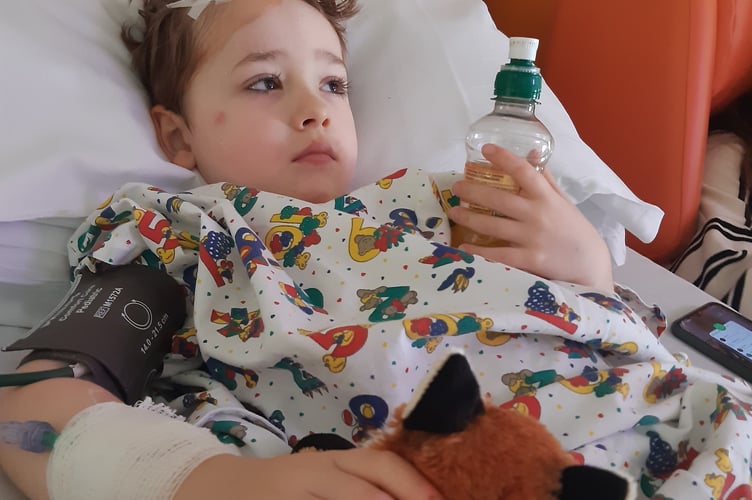
This photo (main) of my son Hector was taken in November 2024 only hours before we found out he had a brain tumour.
The months since have been an emotional rollercoaster, to say the least, as we have navigated a journey that, as I type, is not yet over.
Hector’s story is not a particularly unique one, but one I have nevertheless decided to tell for several reasons.

.jpeg?width=209&height=140&crop=209:145,smart&quality=75)

One is to hopefully show parents of children with serious illness that what can seem like a very lonely path has been trodden before.
Another is to highlight the symptoms of his condition, craniopharyngioma, and raise awareness of it.
Lastly, I wanted, in some small way, to thank the countless people who have helped us over the last 18 months, particularly the incredible staff working in the NHS, whether that be at Noble’s, Alder Hey or The Christie.
All have played significant parts in Hector’s care and treatment.
If we rewind to the start of the story at the back end of 2024, Hector had been a ‘normal’ five-year-old, albeit with an above-average knowledge of dinosaurs and animals.
He had started primary school in September and was settling in well, progressing with his academic work and generally really enjoying the move to ‘big school’, especially the lunchtime jacket potatoes.
One weekend in mid-November he started complaining of headaches that on occasion woke him from his sleep.
These also brought on bouts of vomiting. If you take one thing from Hector’s story, please let it be this: if your child is woken from their sleep by a headache, please get it checked out by your GP.
I dismissed it at first as another winter illness, but my wife Bek was insistent that it was something we should be worried about, as he showed no other symptoms of a typical winter illness.
Bek is rarely wrong, especially where our three kids are concerned. Never doubt a mother’s intuition.
Nevertheless, Hector’s vomiting stopped and the headaches settled down and, after two days of not being sick, he happily went back to school.
That weekend, Hector went to a friend’s birthday at the famed Douglas soft play facility Dragon’s Castle.
After about 40 minutes he came over, found me and said he was tired.
In hindsight, this was, if not a red flag, then a very dark pink one. Hector loves Dragon Castle.
I have lost count of the number of times I have had to scramble up the three floors of rope pulls, slides and assorted obstacles to drag him or his little sister Dottie out of there.
I put his lethargy down to the fact he had been sick that week and that he was ‘out of sorts’.
He had also not really eaten much over the last 10 days or so, saying food tasted different to what he was expecting, which, again, was another dark pink flag for those of you counting.
The following night he woke up around 1am saying he felt ‘poorly’, had a headache and ultimately came into us, which is most unusual for him as he loves his bed nearly as much as Dragon’s Castle and dinosaurs.
He was visibly uncomfortable with pain, and I gave him some Calpol. After a few hours he was sick again, the first time he had vomited in nearly a week.
After that, though, he seemed better and settled down to sleep.
Having been sick, he could not go to school that day, but again he generally seemed quite bright.
Bek rang the GP surgery they had visited the week before and they said it was not uncommon for the virus he was suspected of having to return, even after it had seemingly run its course.
That night Hector woke up again with a headache. This time he was crying out in pain. Again, we gave him Calpol and ibuprofen, but neither seemed to dent his discomfort. He eventually fell asleep after what seemed like an age, but in reality was three or four hours.
Bek again phoned the GPs, hoping, if nothing else, to get something that could at least manage his pain more effectively until the headaches passed. At her insistence, the GPs offered an emergency appointment, where again the likelihood of it being a virus was discussed.
This time, though, the doctor recommended a precautionary secondary opinion and Hector was referred to the children’s ward at Noble’s Hospital.
By the time I arrived there, he seemed in relatively good spirits.
Hector, although not what I would describe as an overly sickly child, had been admitted to Noble’s a couple of times before, usually when viruses had triggered the ‘chronic wheeze’ (think asthma for young children) that temporarily labours his breathing and lowers the oxygen levels in his blood.
He usually bounces back in a day or two, so was not overly phased about a trip to hospital, as he knows it usually ends with him being allowed to watch TV in the daytime and a stash of stickers and presents to reward his ‘bravery’.
The first afternoon in Noble’s seemed to be going to plan, with initial examinations ruling out things like meningitis.
Bloods were taken and again came back as normal.
A CT scan and MRI were booked for the next day to rule out various conditions.
One was dependent on the other: if something showed up in the former, the second would be required to provide a clearer picture.
Remarkably, Hector sat long enough for them to get a strong CT image.
This was enough for them to see that Hector had a foreign body in his brain and one that would need further investigation.
This was also the first time the dreaded ‘T’ word was used by the doctors.
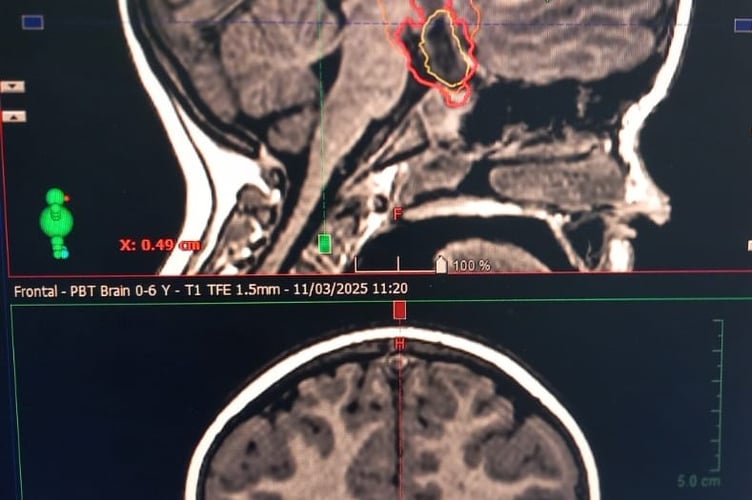
When we were asked to leave Hector playing with a healthcare assistant and accompany the consultant into another room, you know the news is not going to be great.
People say when you hear something like that you almost feel like you have been punched or that you are going to be sick, but I just felt numb.
It is like you have heard the words but cannot process them quickly enough. ‘Tumour’ is a word that has such immediately negative connotations.
I like to think that I am usually quite a calm, rational and pragmatic person, but in all the blur you go straight to the worst-case scenario when a word like that is used.
Thankfully, the staff at Noble’s are trained to deal with this and keep things as simple and clear as they can as they aim to cut through the fog that has now enveloped your thoughts.
It became clear that Hector would need specialist treatment and the MRI that was planned for Noble’s would take place in Alder Hey, with both the Liverpool hospital and the air ambulance to get him there already instructed.
The walk back to his room, where he was happily playing, was even harder for me than when the CT scan results were broken to us.
He was just sitting there, oblivious to what was unfolding around him.
I struggled to hide the tears from him, but luckily my wonderfully inquisitive little man, at his request, was whisked away to see a picture of his brain ‘that had grown a little bit too much’.
I sobbed at that point, while trying my best to pull it back together for both him and Bek until they made their way to the ambulance. It was easier said than done.
While Bek left to pack a bag, I stayed with Hector and tried to keep things as normal as possible in the most un-normal of situations.
I kept catching my mind wandering to a place that usually led to tears, but equally then had to refocus and remain as upbeat for Hector as I could so as not to raise his anxiety or worry.
He fell asleep, which at the time was a blessed relief, until they tried to wake him again to transfer him to the ambulance and onward.
At this point he turned into some sort of Tasmanian devil, a reaction that sparks a cavalcade of emotions including upset, empathy and I am ashamed to say, embarrassment.
That afternoon after they left was even more of a blur. I booked flights to follow on that evening. It was only after I received my electronic boarding card I realised I had booked it in the wrong name, my middle name somehow ending up as my surname.
Luckily, I spotted it before I got to the airport and managed to get it changed.
Bek had given me a list of things to sort in the house and pack for our two other children, who would be farmed out to other relatives in a hurry.
I only had a couple of hours to try and get everything sorted before my flight, but the first hour was a write-off.
I wandered into rooms to get things and then forgot why I had gone there, hampering the process somewhat.
Luckily my eldest son Hugo was a bit more lucid than I was and managed to help me out no end.
My trip to Liverpool that night was a strange one. Travelling alone, my mind began to wander again.
I knew Hector and Bek had arrived safely, but all sorts of scenarios began playing through my head like a really depressing collection of social media reels. I also, bizarrely, began resenting other people having fun.
That is right - I was judging people completely unrelated to me, who knew nothing of my situation, for laughing or joking on what for many was the start of a holiday or break away.
I know how irrational this sounds, and even knew it at the time, but it did not stop me feeling it. I apologise now to the family of four jetting off somewhere nice for a pre-Christmas break that I kept scowling at, or the flight attendant who probably wondered why I was blubbering when she offered me a caramel teacake.
One of the main motivations for writing this was to hopefully show others in a similar situation that they are not alone. The seemingly overwhelming and unfathomable situation you are facing has happened before to others, and the gamut of emotions you are feeling is nothing unusual.
I know it sounds incredibly clichéd, but this always seemed like something that happened to ‘other people’.
When you become one of those ‘other people’, you begin a journey that sees you hit with an array of emotions that I can only describe as like being in a wave pool.
There are moments, or waves, that you are prepared for, ones that catch you completely off guard and leave you floundering, and brief moments of calm and tranquillity when you wonder if you really are in the wave pool at all.
Alder Hey Hospital did its best to provide more of the latter, but those first few days there provided waves that would have forecasters at Ronaldsway penning a weather warning for coastal overtopping.
I arrived late that first night to be greeted by a quiet and almost serene hospital whose vast reception area was filled with an impressive Christmas tree and lights.
I had to check I was in the right place as it was more like a shopping centre than a hospital.
The wards were also very impressive, with the neurology ward we were on containing private rooms with ensuite facilities and views over Liverpool. With
Hector still well himself, there were brief moments you had to remind yourself why you were there. He even got to see Santa in the hospital’s special grotto.
This issue, however, was not just going to go away. It had not been, even as much as I wished for it, a mistake with his CT scan. Hector still had something in his brain that should not be there.
An MRI scan was required to get a more detailed look at the monster that lay beneath.
If you have ever had an MRI, you will know they require you to be very still while you are in them to get an accurate image. For older children there are headphones and videos to help keep you still for the up to 45 minutes it can take to get the scan done.
Hector was five, and although obedient, there was little chance he was going to manage this in a quiet, claustrophobic setting without his parents present.
This scan would shape what happened next, so it was decided that, to get the best possible imagery, Hector would have a general anaesthetic.
Another set of detailed blood tests was also required to look for cancer markers and hormone levels.
Hector had had bloods taken the previous day at Noble’s, but his veins had picked an inopportune moment for a game of hide and seek.
The staff there had struggled to find one for a cannula and, although they eventually succeeded, Hector found the whole process painful.
When blood tests were mentioned again, I could see him instantly recoil.
Part two of Hector’s story will be published in the Manx Independent, out on Thursday, April 16.