

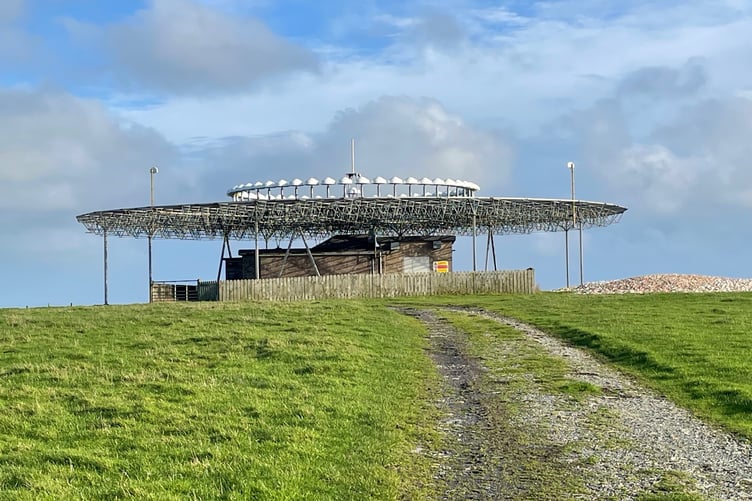
A distinctive structure overlooking Cregneash has long captured the imagination of passers-by, with its ‘flying saucer’ appearance sparking curiosity and speculation for generations.
Perched above the fields near the Sound, the circular metal structure has prompted fanciful ideas of alien visitors and distant planets, particularly among children travelling through the area. Its isolated setting and unusual design only add to the mystery as it looms into view.
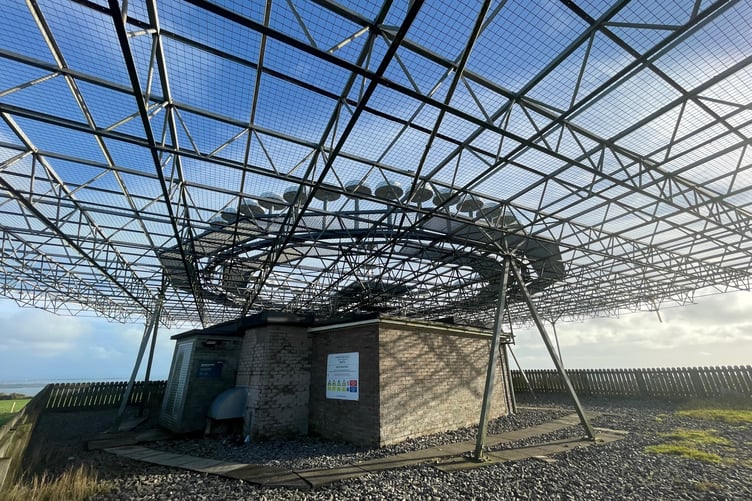
What initially looks like a substantial building reveals itself to be a metal framework wrapped in mesh, standing above a low brick base.
While it may resemble something out of science fiction, the structure serves a very practical purpose.
.jpeg?width=209&height=140&crop=209:145,smart&quality=75)
.jpeg?width=209&height=140&crop=209:145,smart&quality=75)


Tony Kirkbright, head of air traffic services at the Isle of Man Airport, explained that the ‘flying saucer’ is in fact a radio navigation beacon known as a VOR/DME.
He said: ‘The flying saucer is a radio navigation beacon called a VOR/DME. It combines two types of beacons, a VHF Omnidirectional Range, or VOR, and Distance Measuring Equipment, known as DME.
Although the technology may sound complex, the system has been a reliable part of aviation navigation for decades.
Mr Kirkbright said: ‘VOR technology dates back to the 1930s, and DME evolved from World War Two military navigation systems. Both became widely used in civil aviation in the 1960s.
‘The VOR/DME on the Isle of Man, which has the three-letter identifier “IOM”, is operated by NATS, the UK air traffic control operator, and became operational in its original form in July 1961.’
He explained that early airways relied on networks of ground-based beacons to guide aircraft safely between destinations.
‘An airways system first came into use in the late 1920s,’ he said. ‘Aircraft would effectively “join the dots” between beacons to reach their destination.
‘The IOM beacon was very important as it provided an accurate position update halfway between the UK and Ireland.’
While modern aircraft now make extensive use of satellite-based navigation systems, ground-based aids such as VOR and DME continue to play an important role.
‘Satellites are widely used by aircraft to obtain accurate position information and follow routes in the sky,’ Mr Kirkbright said. ‘However, satellite systems can be jammed or spoofed, where false information is received by aircraft, and they can also be affected by space weather.
‘VOR and DME provide a reliable alternative navigation aid.’
Although many VOR and DME installations across the British Isles have been decommissioned in recent years, the Isle of Man beacon has remained operational.
Mr Kirkbright added: ‘The IOM remains an important facility because of its unique location. Increasing use of space-based navigation is unlikely to lead to the complete removal of ground-based navigation aids, and the geography of the British Isles means the IOM is likely to be with us for many years to come.’
For now, the familiar ‘flying saucer’ above Cregneash looks set to remain a permanent and quietly essential part of the Manx landscape.