
Manx Gaelic teacher, musician and composer Annie Kissack is the fifth to hold the title of Manx Bard.
Each month she shares one of her poems with us, and explains what led her to write it.
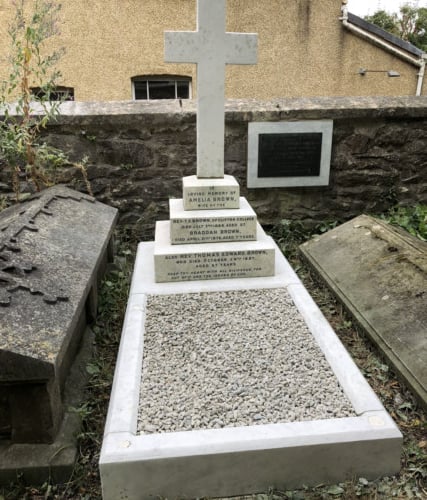
Recently I visited the grave of the great Manx poet, T.E. Brown, in Redlands Cemetery in Bristol.
Brown taught at nearby Clifton College for nearly thirty years and died while on a return visit there in 1897.
~2-(1).jpeg?width=209&height=140&crop=209:145,smart&quality=75)
-(1).jpeg?width=209&height=140&crop=209:145,smart&quality=75)


The family grave has been restored recently, thanks to the joint efforts of Manx National Heritage and Culture Vannin.
Thanks to the efforts of Dollin Kelly and John Qualtrough, and with the assistance of Manx National Heritage and Culture Vannin, it was restored last year by a local stonemason, Simon Ashwell.
Some of T.E. Brown’s poetry is too full of learned references for my taste.
But his Fo’c’s’le Yarns, a series of Manx dialect poems preserving the speech and ways of a people at a time of great change, has always spoken truly to me.
Like many Manx people of my parents’ generation, my uncle and cousin both left the island before the Second World War.
Former pupils of Onchan School, they knew their T.E. Brown by heart.
One became a college lecturer, the other a porter in London. Both absorbed the speech and ways of their new homes.
On separate visits back to the island, I heard each quietly and tearfully recite Jus’ the Shy. ’Comin’ home from the North Sea fishin’ we wereâ?¦’, word perfect after 60 years and not a shred of the old speech lost when it came to it.
And it is for that reason that I, too, shed a few tears at the grave of T.E. Brown; for him, for them, and for all who can only dream of home.
At the Grave of T.E. Brown
We walk through silent avenues of tall houses,
eyes to the sky for the rain to come.
Japonica, jasmine and the small-jewelled crocus wait and stare
as we pass through gates high and grand to a place where
stillness holds within itself so many stillnesses.
Here is your grave then, white among the polished holly and the stark magnolia.
Thomas Edward Brown, Manxman, poet.
Do you belong? I think you may though
it wouldn’t take you long to stride around here,
the way you’d walk the hills at home in the sharp early spring,
but a man must lie somewhere when he’s tired I suppose
and this as well as any.
But it is not Braddan.
A braggart robin sings his song of public schools and privilege and…
Yes, your bards’s been with us now some years, it would appear.
Beyond the wall, the solemn villas built on blood all nod.
Aged academia nods.
All agree there was a man of note,
a mid-to-late Victorian, respected in his time
but never great.
Saturday morning and the end of school.
The pupils surge into the surrounding streets,
the girls in knee-length kilts and smart,
the boys spectacled and serious, at least for now.
If they too bear exile, they bear it cheerfully enough.
So this is Clifton, your pierced screen, your Saxon shore,
where you lived those years, industrious and kind,
and dazzled lesser minds, but all the time your own
was somewhere else: quiet among the cows,
or down at the shore…
In two minds then, two places, and two voices,
one riotous as gorse, one refined,
but each defines the other.
Only over the sea in a rough little place
does the anxious hawthorn shiver.
Annie Kissack
March 2019
by Annie [email protected]
twitter:@iomnewspapers
Comments
This article has no comments yet. Be the first to leave a comment.