
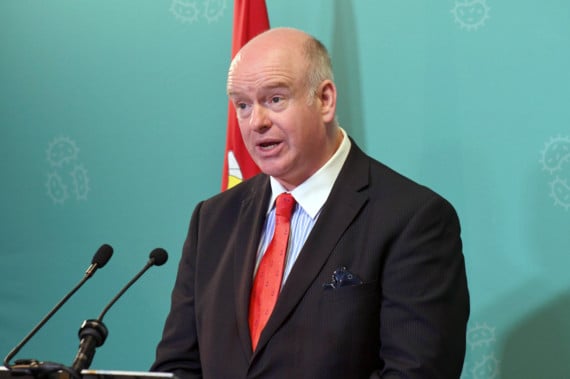
Chief Minister Howard Quayle has outlined the next ’step forward’ in the easing of the island’s Covid-19 border restrictions in a press briefing on Thursday.
The full unlocking of the borders (unrestricted travel on June 28), as planned under the exit framework, was replaced with a ’revised approach’ in light of the increase of Delta (Indian) variant cases in England, and in particular the North West.
Instead of completely unrestricted travel for everyone from this date, both residents and non-residents will be able to travel freely (without tests or isolation) on the condition that they have had two vaccine doses administered in the British Isles, with the last dose having been at least two weeks prior to arrival.
Mr Quayle described this as a ’two-plus-two’ approach, and a move closer to unrestricted travel.

.jpeg?width=209&height=140&crop=209:145,smart&quality=75)


Fully vaccinated non-residents will therefore no longer have to apply for exemptions to enter the island, but everyone coming to the island will still need to complete an arrival form.
However, even if they have been fully vaccinated, anyone who has travelled outside of the Common Travel Area (the UK, Ireland and the Channel Islands) in the previous 10 days before arrival will still face restrictions.
Those who have visited what the UK defines as an amber list country will follow the isolation and testing pathway either here or in the UK, and those who have been to a red list country will not be permitted to enter the island directly, but instead first complete their quarantine in the UK.
Procedures for checks of vaccination status will be put in place, and there will be more police and customs operations around ports.
Arrival testing will remain a requirement for children travelling to the island (with only over 18s currently being offered vaccinations) with a release from isolation after a negative test.
However, the testing and isolation requirement for children aged under five will be removed.
He also outlined the targeted testing of children of school age, in order to prevent the outbreak in island schools, with this to be reviewed again towards end of term.
Fully vaccinated people on island will also no longer be required to isolate if they are identified as a close contact of someone who has tested positive, with Mr Quayle citing the protection offered by two vaccine doses.
Another change is that people living in Ireland, either fully vaccinated or not, will be able to apply for an exemption to travel to the island if they have immediate family in the island, own property here or have a contract of employment for at least three months,
Further describing the change in approach, the Chief Minister said: ’We must accept that the restrictions at our borders are not a normal situation.
’We all have families and friends who have not been able to see us for many months, and it is very clear that we have areas in our economy that are under real pressure from the continued border restrictions.
’Our ambition - the return of a free flow of people between the island and our neighbours - is only possible because of our vaccination programme - a game changer in how we can now approach the pandemic.’
He explained that it had enabled the government to ’pivot away’ from seeking to eliminate the virus from the island, and pursue the new approach of learning to live in a world with Covid-19.
Mr Quayle also outlined the current vaccination statistics, which stands at 63,000 first doses given, and almost 30,000 having received a second.
He added that the focus now is on getting through 32,000 second doses that have been booked in over the coming weeks.
Mr Quayle continued: ’Focus is shifting away from raw case numbers - with levels of serious illness from Covid-19 and the capacity in our hospitals now the key factors.
’That is where risk will lie. When the next outbreak occurs this is where our focus must be - and we must all be prepared for another outbreak.
’It is a matter of when, not if. But thanks to vaccinations, our response to a future oubreak is likely to be different.
’It will be proportionate, taking in account the high level of vaccinations amongst our population and the benefits this brings in reducing spread, reducing serious illness, and reducing fatalities.’
Mr Quayle concluded that though the one dose of the vaccines seem to be less effective against the Delta variant, the ’good news’ is that vaccines provide ’broadly’ the same level of protection against the Delta variant after two doses, with good protection against serious illness after only one dose.