
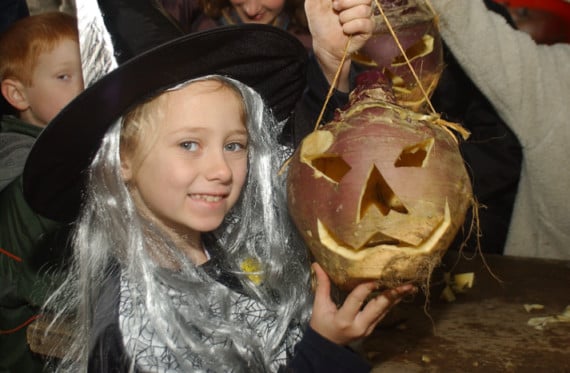
Hop tu Naa is more than just ’the Manx version of Halloween’.
It is the Isle of Man’s oldest continuously-existing tradition, with a history much older and more interesting than pumpkins and trick-or-treat.
It is believed at the Manx celebration for the end of October goes back beyond written history, to the era before Christianity had arrived on the Isle of Man.
The Manx at this time lived by a different calendar, dividing the year into two main halves: Summer (Sourey in Manx Gaelic) and Winter (Geurey).
-(1).jpeg?width=209&height=140&crop=209:145,smart&quality=75)



This explains why one of the earliest records of the hop-tu-naa song (in around 1790) is given as starting with the words: ’Tonight is New Year’s Night, Oh-*-naa. The Moon shines fair and bright, Trol-la-la.’
In a way not dissimilar to today’s Christmas and New Year period, the Celtic celebrations around the start of their year, at the end of October, brought with it both its serious and frivolous sides.
At the transition point between the two halves of the Celtic year, the spiritual world was at its strongest. Because of this, you had to be at your most vigilant.
At the Celtic New Year, you would also be most open to jeeyl (mischief or harm) which might be done to you by evil-wishers or the ever-ominous Manx fairies.
One of the most important protections against this was fire.
It was believed that fire, or its smoke, had the power to drive off evil from your land, ensuring that there was nothing left to do you any jeeyl, and maintaining good fortune for the season ahead.
The link between this and carrying turnip lanterns around the community should be obvious.
The more playful side of the new year celebrations would include much jough (drink), singing, dancing and general good fun.
It lived on in the Manx tradition with the Kegeesh Ommidjagh (or Foolish Fortnight), dedicated to having much fun as possible during the New Year period.
Part of this included singing, dancing, and general foolishness, such as going around the neighbourhood singing almost-meaningless, nonsense songs.
Although there are many ideas about the hop-tu-naa song and its meanings, the earliest versions of the songs have no reference to a witch. ’Jinny Squinney’ or ’Jinny the Whinney’ are how she appears in these versions.
Here she is just someone beating a mouse with sticks, amidst a song about baking bonnags and a trip to Scotland. The earliest mention of Jinny the Witch comes only in 1900.
So, without this ’spooky’ element, the song was perhaps originally just a bit of foolishness to have fun with.
The precise words did not matter; it was just the occasion and the spirit in which it was sung.
Which perhaps happily explains the varied and changing versions of our modern Jinny the Witch song as much more ’traditional’ than we might first have thought!
So, by carving a turnip and taking it to sing songs around the community, you are taking part in the Isle of Man’s oldest continuously-existing tradition, warding in a good future for the community, and having some fun.
It’s a tradition that is well worth celebrating!
by James Franklin
twitter:@iomnewspapers
Comments
This article has no comments yet. Be the first to leave a comment.