
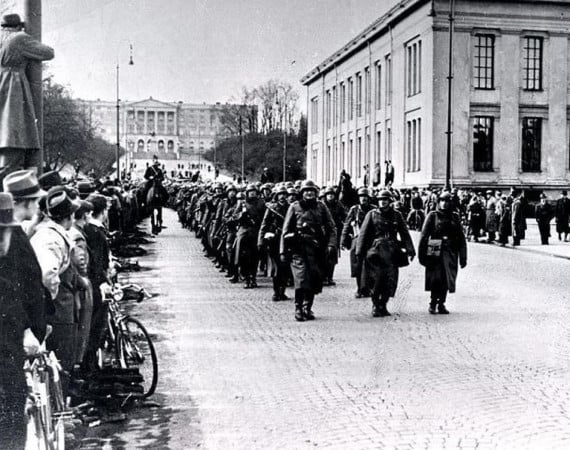
University College Isle of Man’s history and heritage lecture series continues on Wednesday, June 14, with a lecture by Dr Sue Nicol on the island’s role in Norway’s liberation struggle during the Second World War.
The link between the Isle of Man and Norway during the Viking era is a well-studied and familiar story. Even today it is highlighted via heritage sites familiar to locals and visitors alike. But far less well known is the link between the two countries through the dark years of the Second World War.
Between 1940 and 1945 Norwegians on both sides of that bitter conflict, both Nazi sympathisers and would-be freedom fighters, found themselves detained on the Isle of Man.
It is part of an almost forgotten history, where only the occasional fragment of a record has survived to help us piece the tale together.


It’s a somewhat strange and complex story. After all, we normally think of internment as a strategy for people then considered to be enemy aliens, such as Germans and Italians.
But Norway was not at war with the Allies.
So how did some Norwegians come to be categorised as enemy aliens and detained here? And if other Norwegians were seeking to join the Allied Forces, why were they also being kept behind barbed wire on the island?
It’s also worth remembering that the majority of people interned in the island were in Britain when war was declared with their respective countries.
Many of them, particularly the Italians, had been living and working in Britain for many years. It was a very different matter with the Norwegians, almost all of whom were in either Norway or neutral Sweden before being brought to the island.
Making sense of this involves making sense of how Norwegians dealt with the sudden and brazen invasion of their country on April 9, 1940, by the combined air, naval and ground forces of the Third Reich.
The Norwegians refused to capitulate, and even when their modest and ill-prepared defence forces were vanquished in June 1940, they refused to acquiesce.
Many continued to engage in civil disobedience, facing ever more cruel and petty restrictions (even wearing a red woolly hat became a criminal offence, as did refusing to sit next to a German on a bus).
Some became active in the resistance, either as SOE-trained saboteurs or in Milorg, the militant wing of the Norwegian Home Front.
Most Norwegians faced hunger and privation, as food supplies were diverted for the ever-growing German forces (up to 350,000).
Many experienced reprisals, for acts of sabotage or as punishment for fleeing family members. Homes were burned, farms and fishing boats destroyed, men were taken to prison camps in both Norway and in Germany (and not all survived to come home).
Norwegians were often shot in reprisal for German deaths. For some Norwegians (though not many) this was too high a price to pay, particularly when Norwegians were being killed as a result of Allied bombings. Some therefore took the decision to join the quasi-nazi Norwegian Unity (Nasjonal Samling) party.
It is now possible to track how some of NS members were picked up in Allied raids, particularly in the Lofotens, and in Maloy. And we can pick up their trail as a number of them were brought to the island, to sit out the war until they were repatriated and put on trial as collaborators. It’s worth bearing in mind that in some cases they were able to clear their names, and others went to their grave still protesting their innocence.
Even more extraordinary is the story of how those young men who escaped Norway in the hopes of fighting for their country made their journey here. Their escape was made possible by one of the great aviation heroes of the 20th century Bernt Balchen.
Balchen had been with Amundsen in the attempt at flight over the North Pole, he had flown Byrd on the first ever flight over the South Pole, and he was the man who found a way of flying young Norwegian men across enemy territory to Britain in order to join the Allied forces.
All of these young men faced a preliminary week or two of debriefing and interrogation, and for many of them, that took place here in the Isle of Man.
In September 1944, the Island played host to the exiled Crown Prince Olav who visited the Norwegians who were here awaiting security clearance to join the Free Norwegian forces in the UK.
The Norwegian government in exile in London was shaped by the indefatigable efforts of King Haakon.
Both the King and the Crown Prince worked tirelessly to bolster courage, to support the resistance, and to keep the faith that Norway would one day be free.
That day of freedom came in May 8th, 1945, when the German forces surrendered to the Norwegian Home Front. And the Isle of Man indeed played its own small part in helping that day come.
’Fear, Flight and Freedom: The Island’s Part in Norway’s Liberation Struggle’ takes place in Elmwood House (behind the St John Ambulance Centre, off Glencrutchery Road) at 6pm on Wednesday, June 14. All are welcome, and no booking is required.
Further details about the history and heritage lecture series, together with videos of previous lectures, can be found online at http://catrionamackie.net/lectures/.
Comments
This article has no comments yet. Be the first to leave a comment.