
Our predominant memories of 2020 will be of Covid-19 but we have also had weather conditions for planting and harvesting that we’d probably prefer to forget.
We’ve had it all this year in the island: a very wet winter and early spring with one of the wettest Februarys ever recorded made it hard to get crops into the ground.
This was followed by a glorious few months of continuous sunshine when everything dried out, affecting germination, and then the wettest July since 1987.
It’s been no better in the UK where the wheat harvest is predicted to be down by a third, possibly the lowest in 30 years.
.jpeg?width=209&height=140&crop=209:145,smart&quality=75)

Everywhere this year’s harvest has been a struggle.
The Food and Farming page spoke to some local farmers an asked then how they had got on.
l Will McMillin farms in the north of the island, at The Lhen.
In 2016 he started growing rye as an experimental crop for Laxey Glen Mill.
It was a success and he has carried on - it is used by Noa Bakehouse in their award-winning rye loaves, saving them from having to import rye flour.
This year, Will sowed another 12 acres.
He was also growing milling wheat for Laxey Mill, along with barley, oilseed rape, peas and beans, linseed and oats.
The oilseed rape is exported unprocessed along with some of the oats with the remainder being kept for feed for his own livestock.
When we spoke to him last week he had just finished getting his harvest in the day before.
He said: ’It was a poor year all round, because of the weather. The bad weather coming at harvest time made it even worse.’
l At the other end of the island, Will Duggan, in Grenaby, had also finished getting his crops in.
He said: ’It was a bit of a struggle [this year] but we got there in the end.
’We had 80 acres of spring barley which we combine ourselves. We predominantly grow it for ourselves and anything surplus we sell.
’We haven’t decided yet whether to put in any winter crops.’
l Paul Costain in Colby grows crops to feed his beef cattle and sheep.
He has a couple of weeks to go before he finishes, with some protein beans still to harvest.
He planted 35 acres of barley in his fields at Earystane which was whole cropped. He said: ’We do this because it means we can get a second crop in’.
That second crop, oilseed rape, has already been planted and is doing well.
In fields at Ballakilpheric he had planted barley and kale.
He said: ’We just took the grains off the barley, leaving the straw, and there is some regrowth to provide food for the birds over the winter while the kale provides ground cover for them and fodder for livestock.’
Paul added that changing weather patterns are not all bad. He said: ’The winters are becoming milder and we can keep the cattle out longer.’
l Chris Kneale of the Rural Business Consultancy advises many farmers around the island.
He said: ’This year’s harvest has been generally mixed across the board.
’The south doesn’t seem to have been as badly affected as the north.
’It’s certainly been below average for grain and therefore straw.
’For those drilling now hopefully the weather will be kind to us and we’ll get it in and well established.’
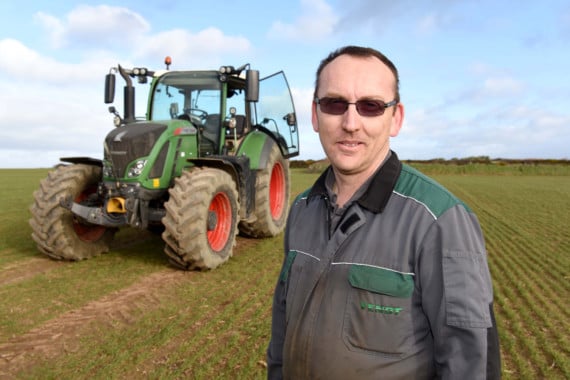
l Tom Kermode (pictured below), in Ballasalla, told us: ’This year’s harvest was a tough one and we spent the majority of it dodging showers and catching the odd dry afternoon/night in between.
’The first part of harvest yielded very well under the circumstances and, considering the amount of rain we had the previous week, it somehow stood sturdy.
’In the end we managed a quite impressive 4.2 tonnes/acre of that particular block.
’Unfortunately the same couldn’t be said for the remaining crops which bore the brunt of the heavy rain we endured in the following week and yields were substantially lower with a lot of heads of corn being missed by the harvester as the crop lay flat to floor because of the weathering it sustained from the rain.
’We battled on into the night as the weather windows were tight and with more damp weather forecast for the following days ahead it was a case of now or never.
’Thankfully the rain and poor weather abated, allowing the land we had down to spring barley to be cleared of straw bales and ploughed. We are currently working to get most of it sown back down to either grass, which will be grazed with new born lambs and their mothers in the spring, or put back into a winter cereal crop which will enable us to harvest a little earlier next year (hopefully in better weather).
’All in all we managed to secure enough feed barley and straw to hopefully see us through to spring.
’I would imagine straw and feed barley will be very scarce this winter which is always a worry for any farmer, but it’s something we are all in together and as always I’m sure we will come out the other side optimistic for the year ahead.’
Comments
This article has no comments yet. Be the first to leave a comment.