
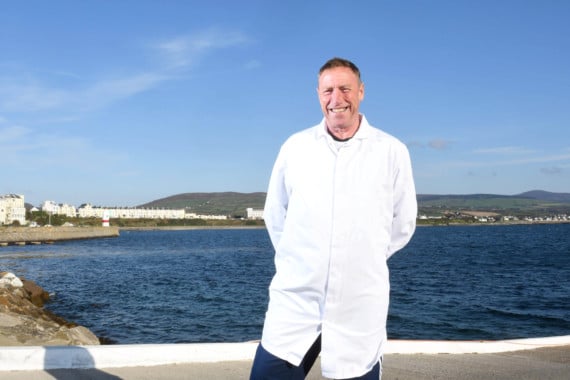
It’s a good industry but the only things that ever appear in the media are negative.
’The only time the fishing industry ever gets highlighted is when there’s reductions in quotas or somebody gets prosecuted,’ says Tim Croft.
Tim speaks with authority - he knows the fisheries inside out.
He’s been involved since he left school and worked on fishing boats, trying to learn all the different aspect of the industry: ’In order to appreciate what a fisherman does you have to have been one. It’s a hard job, there’s no two ways about it,’ he says.


.jpeg?width=209&height=140&crop=209:145,smart&quality=75)
.jpeg?width=209&height=140&crop=209:145,smart&quality=75)
His father, Terry, was in the seafood business, having come into it almost by accident, as Tim explains: ’Dad was an electrician in Birkenhead. He came over to fit a fridge for a seafood company in Port St Mary.
’The scallop fishery was very much in its infancy at the time and they were looking for people to invest.
’Dad fell in love with the island, fell in love with the industry and invested, and we all moved over.’
Tim started up on his own in 1991, opening a processing business called Island Seafare.
Ten years ago he took on Nick Pledger as a partner and the business is still going strong despite all the problems 2020 has brought.
In a normal year, the king scallop season runs from November until May and the queen scallop season from July to October.
Some of the queenies would be sold fresh but the factories usually retain an element for processing through the winter months
’It’s frozen straight off the boats in absolutely prime state: it’s very hard to actually tell the difference between that and fresh,’ Tim says.
The seafood industry on the island is primarily export-focussed, with more than 90% of their products going to France, Italy, Spain and the UK, and Tim’s business is no exception.
His major market for queenies is northern Italy, in particular Venice, as he explains: ’The vast amounts of tourism they get means the Venetian lagoon would never yield enough to feed them so there are always imports but they were imports of products that would have been typical to the area.
’On the Adriatic coast there is a similar species of queen scallops [to the island], so we prepare the product in the half shell for that area and it finds very good favour, as it does in Galicia.’
When Covid-19 hit in March it came at what was already a bad time for the industry. Tim says: ’The processing and cash side had been faced with about two and half months of seriously bad weather: there was hardly any fishing in January and February so everybody had been struggling anyway.
’Then Covid-19 came and immediately our main markets, which would probably absorb about 95% of what we do, completely locked down.
’We had no choice but for the fleet to tie up and all the factories close. So basically it was a complete shutdown.’
Tim, who employs 14 people, has nothing but praise for the support the fishing industry has received from government. He says: ’They’ve been excellent, right from the start.
’The Salary Support Scheme, instead of the furlough scheme they had in the UK, has worked so much better generally for the island’s economy because it meant that people could work. It has worked out extremely well.’
He also praises the local fishermen who discovered their entrepreneurial side during lockdown, selling fresh fish off the boats at harbours around the island.
He says: ’It was fantastic, even us as a processor endorsed that completely, that they were going to go and catch and sell, because it meant that more people ultimately were going to eat fish.
’We watched it and we didn’t react at the time because we didn’t want to compete with what the fishermen were doing. We felt it was good that they should have an understanding of what’s involved in selling and an understanding of what the consumer wants. They can actually now go to sea understanding what the consumer requires.
’Boats have tried things that they never would have done - fishing for prawns for example.
And without lockdown we wouldn’t have started Crofters.’
He is referring to the new click and collect service he and Nick set up recently, offering a range of seafood including queenies, whole dressed lobsters and crab meat.
Customers place their order online and pick it up from the factory on Port St Mary harbour.
Another major issue that came out of Covid-19 was that the lack of demand for seafood products in the major markets meant that everything the processors had stored in their freezers was completely devalued.
Tim says: ’That was the first thing that became very apparent, that whatever we had in stock, 40% of its value was going to be wiped out.
’Scallops were being bought and sold cheaper than I’d known all the time I’d been in business.
’And that’s something that’s never recovered. So the support packages, as good as they were, have only really helped us recover losses on product you’d already bought the previous year so that was difficult.’
Ironically, though, it also helped in one major export market, as he goes on to explain: ’About five years ago prices went too high and took our products outside of the level which fitted with French retailers, like Cafors, so with the prices all coming down by 40% it allowed us to resurrect that business.’
Now, he adds, the focus is on selling fresh ’get it out the door, don’t put anything in stock because we don’t know what value it’s going to be when it comes out’.
Because fresh fish counters have been closed in French supermarkets, they have been packing products like queenies in smaller, wrapped packs to go straight onto the shelves.
There was another positive that came out of Covid-19, Tim says: ’When lockdown happened the wheels stopped so it gave us a chance to actually look and analyse ourselves and our industry and try and work out how we were going to be able to do the job better.
’We sat down together with Producers’ Organisation and other processors and analysed where our downfalls were.
’It’s a good industry but when we’re trying to recruit all that they have ever read or see is a totally negative picture, so why would that encourage anybody to go into the job?
’Our factory is recruiting because what we believe is that, because our margin has been shot completely, we have to raise our volume to compensate and produce our way out it. Luckily now fisheries is open to immigration so we can actually bring people in to be crew, to work in the factories, to allow us to increase our production.’
Of course all this has to be done within quotas and bearing in mind that it’s not just Manx boats fishing in our waters.
Boats from other parts of Britain can fish if they are granted a permit.
Tim says: ’At the moment we probably only process around 50% of the Total Allowable Catch on island. Instead of complaining that it isn’t enough, let’s first of all increase the percentage that we’re taking of it.
’Our total ambition is to respect the quota but to increase the percentage that the Isle of Man handles: our aim is to take that to 70%.’
And he insists: ’We’re going to do things differently. We’re going to make the job more attractive: we’re going to make it stand better in people’s minds that the seafood industry is an industry that the Isle of Man can be proud of.’
Comments
This article has no comments yet. Be the first to leave a comment.