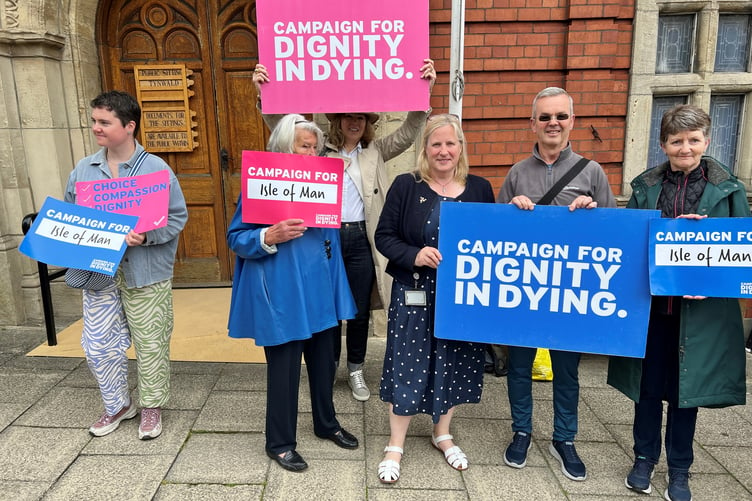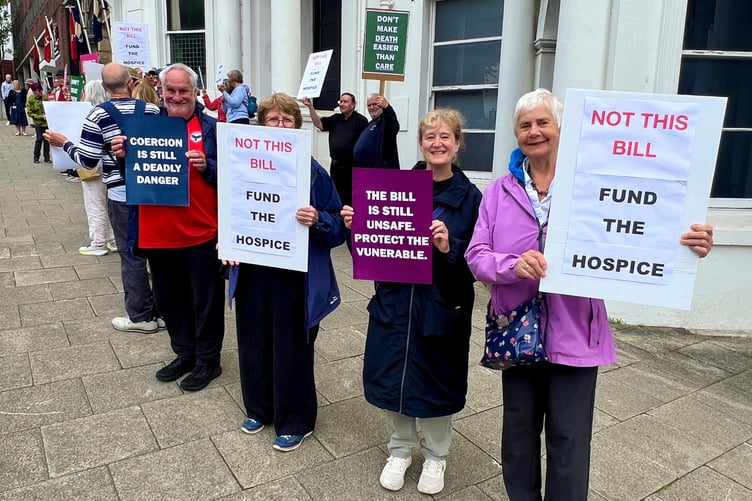
Tynwald has voted to approve a series of amendments to the island’s Assisted Dying Bill in a final push to secure it Royal Assent.
A large crowd of campaigners from both sides of the right to die debate gathered outside the Tynwald building ahead of the sitting.
The Isle of Man made history in March last year when it became the first jurisdiction in the British Isles to legalise assisted dying.
But a year after Dr Alex Allinson’s private member’s bill completed its passage through the branches of Tynwald, the UK’s Ministry of Justice confirmed it would not be able to recommend it for Royal Assent, citing concerns over compatibility with the European Convention on Human Rights.
.jpeg?width=209&height=140&crop=209:145,smart&quality=75)
.jpeg?width=209&height=140&crop=209:145,smart&quality=75)

Those concerns relate to a 2022 judgment by the European Court of Human Rights in Strasbourg.
Dr Allinson had tabled 14 amendments drafted to address the MoJ’s concerns.
He told Tynwald: ‘These amendments collectively strengthen compliance with Articles 2 and 8 of the European Convention on Human Rights by reinforcing the legislative framework through explicit duties to protect vulnerable persons, ensuring decisions are free and informed and introducing enhanced safeguards in what are perceived as possibly high risk cases.’
One of the amendments guarantees a person’s right to withdraw their request at any time and by any means.
Dr Allinson said this would prevent 'coercion crystalising into an irreversible outcome'.
‘These amendments taken as a whole will address the issues identified by the MoJ who have not raised any further inquiries,’ Dr Allinson said.
He added: ‘As a parliamentarian proud to be a member of Tynwald for10 years I ask that we uphold the intrinsic strength of our cherished democratic system.’
Gary Cluit MLC pointed out that the principle of introducing a right to die law had already been settled.
Addressing the issue of coercion, he acknowledged there was a fear that a frail, seriously ill person could be pushed towards an early death ‘by a tired relative, by a sense of being a burden or by the cold arithmetic of inheritance’. But he said the amendments directly addressed this.
Central Douglas MHK and Treasury Minister Chris Thomas said the amendments were a move in the right direction.
But he queried whether there would be other amendments that would better address the concerns of the MoJ. He said Dr Allison had assured members that his bill was compliant with human rights but it had turned out it wasn’t.
Mr Thomas said that even if it was given Royal Assent, implementation was still ‘years away’. He pointed out that there was nothing in the bill that set out who is going to provide an assisting dying service or how it is going to be financed.
Attorney General Walter Wannenburgh said the amendments were ‘likely to be sufficient’ to address the concerns raised by the Lord Chancellor’s Office.
He said the delay in securing Royal Assent could not be categorised as ‘some kind of constitutional crisis’.
Lord Biship Patricia Hillas and Chief Minister Alfred Cannan both urged caution.
Onchan MHK Julie Edge called on the UK government to ‘check this carefully’ over the impact the bill could have on the island’s most vulnerable.
She pointed out: ‘None of us know the cost of this service when we are debating an already huge overspend in the health service’.
Claire Christian, insisting she was speaking personally not as Health Minister, said: ‘It’s not safe enough in my eyes.’ ‘Do we vote it to make it safer or do we vote it down because we don’t agree with the overall bill?’ she asked.
She said a policy direction paper outlining the support her department should provide the hospice would be brought forward within the current administration and if extra funding was needed this would be brought through Treasury.
Tynwald supported the amendments by 16 votes to six in the House of Keys and by five votes to one in the Legislative Council.