
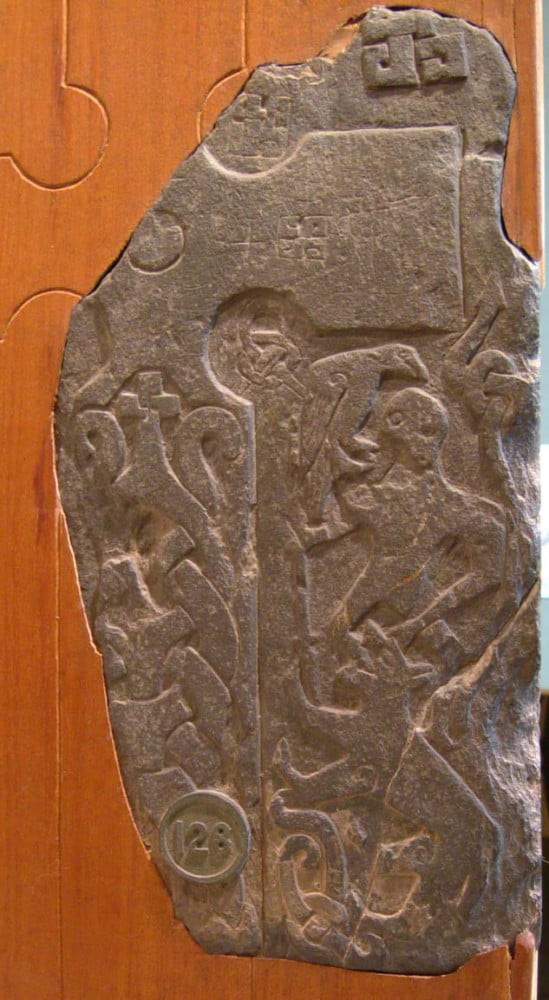
In a free public lecture at University College Isle of Man, on Wednesday, February 21, Viking expert, Professor Sir David Wilson, will outline what is known about the Scandinavian settlers of the Isle of Man in the light of recent research on the ornament and inscriptions on the Manx crosses.
Combining the evidence of the crosses with that provided by graves, written sources and coin hoards, he will demonstrate how, in the first quarter of the tenth century, the Scandinavian settlement of the island began.
Here can be seen the earliest traces of the ’Kingdom of Man and the Isles’, which ultimately stretched along the west coast of Scotland to the Calf of Man.
Originally dependent on, and having allegiance to, the crown of Norway, the kingdom ultimately collapsed with the Scottish King Alexander III’s victory over the Norwegians at the Battle of Largs in the Firth of Clyde, in 1263. The death of the last Norse King of Man, Magnús, in 1265, led in 1266 to a treaty between Scotland and Norway, by which the kingdom passed to the Scottish crown.


.png?width=209&height=140&crop=209:145,smart&quality=75)

The lecture will tell of the Scandinavian presence in the island in the 150 years before the first recognisable King of Man and the Isles, Guþrøþr Crovan (King Orry), claimed the kingdom in about 1079.
The first appearance of the Vikings in the Isle of Man has not been recorded, but in the early tenth century men and women of Scandinavian origin began to settle in the island.
The story of these early settlers is complicated, but can be traced in the archaeological record, particularly by examining their grave-goods and the remarkable series of carved stone memorial crosses. These crosses were of a type unknown in the incomers’ homeland and were based on the design of memorials carved in the eighth and ninth centuries by the native Manx population.
Sculptors employed by the settlers used not only the simpler ornament of the native series, but also their own ornamental motifs, and adapted powerful images derived from their northern homelands to embellish their own monuments in the newly-taken island. The images and runic memorial inscriptions carved on the monuments are internationally important and have been seen as such for centuries.
Since the 17th century they have been pored over by scholars, both British and Scandinavian, as they attempted to transliterate and translate the inscriptions and tried desperately to identify the mythological and other scenes delineated in the sculptures.
The Scandinavians first arrived in the Irish Sea, presumably from Norway and the Northern Isles of Scotland, in the early ninth century.
They established fortified trading stations at Dublin and other Irish sites in the south-east of Ireland, which served as bases for plundering the rich monasteries and petty kingdoms of Ireland.
The slaves and portable wealth they obtained enabled them to trade (and raid) along the coastline of England and France.
They returned, with wealth and luxury goods such as wine and fine cloth, along the main trade route, through the Western Isles to Norway. Here, they reloaded their ships with products of the North, including walrus ivory, rough cloth, and specialist stone products. After wintering on their native farms, they returned to the Irish Sea bases, sometimes settling with their womenfolk in and around the trading centres, which gradually grew into thriving towns and international markets.
These merchants/pirates do not seem to have bothered the island greatly until the early tenth century; evidence for their presence here in the ninth century is almost non-existent.
The Scandinavians of Dublin, and presumably those in other Irish settlements, were expelled from their bases and camped or settled along the coasts of north-west Wales and north-west England, as well as Dumfries and Galloway.
In 917 many of them returned to Ireland, establishing a kingdom in Dublin, and rebuilding and strengthening their earlier trading activities.
Some of the exiles seem to have remained in the new lands, and it was probably during this period that they started to settle in the Isle of Man.
The evidence for settlement on the eastern shores of the Irish Sea is slight, based largely on burial sites, some sculpture, and a number of rich hoards of silver.
Information concerning the presence of Scandinavians in the island is more coherent, but is largely drawn from pagan burials with their associated grave-goods (particularly the weapons buried with their dead) and from the fine series of Scandinavian influenced Christian stone sculpture.
With the help of these stones it is possible to indicate the probable course and sequence of the first century of the Norse history of the island, to identify the incomers’ ethnicity, and consider their relationship with the local people. We can also examine their religion at a time of conversion, as well as the economic status of the island.
Sir David Wilson (pictured) lives in Castletown and is an internationally renowned specialist in the art and archaeology of the Viking Age.
The author of several books, his volume on early Manx sculptures is published by Manx National Heritage. His lecture on ’Manx crosses of the tenth-century Scandinavian settlement’ will take place at 6pm on Wednesday, February 21, in the main hall at University College Isle of Man, Homefield Road, Douglas.
All are welcome, and no booking is required. The lecture will be recorded and made available online at a later date.
Further details about the history and heritage lecture series, together with videos of last year’s lectures, can be found at http://catrionamackie.net/lectures/
Comments
This article has no comments yet. Be the first to leave a comment.