
Peat cutting for domestic fuel has long been a traditional activity in the uplands of the Isle of Man.
The practice only ended two years ago and now work is well underway to repair the damage and restore this precious environmental resource.
’Areas like this are an incredibly stable carbon store. When woodlands reach maturity they end up emitting as much carbon as they sequester: functioning peatlands continually sequester atmospheric carbon as partially decayed plant matter slowly forms peat.
’If you thought planting trees was something for your grandchildren, this is something for your great grandchildren,’ says Shaun Gelling, peatland project officer at DEFA.

.png?width=209&height=140&crop=209:145,smart&quality=75)

.jpeg?width=209&height=140&crop=209:145,smart&quality=75)
A ’turbary’ is the official name for an area of land where peat can be cut by rights owners, to supply heating fuel.
Sarah Hickey, conservation officer at Manx Wildlife Trust, says: ’The cutting of peat was one of the causes of degradation of peat habitats and the loss of some of the island’s blanket bog.
’Restoration of peatlands is recognised as an important way to reduce carbon emissions, retain the large amount of carbon stored in the peat and improve peatland habitats.’
The conservation charity is currently carrying out a project to map the depth and extent of peat throughout the Manx uplands.
The stretches of land we are looking at, on either side of the Beinn-y-Phott Road, held the majority of the former upland turbaries.
They are the only areas in the last 50 years where peat has been legally cut and removed for domestic heating. This has led to steep ’steps’ being carved out of the hillside which, from a distance, can be seen on the hillsides looking like a series of dark scars.
The stepping becomes eroded with the bare peat below the vegetation drying out, which then releases to stored carbon back into the atmosphere. Sheep are attracted to such areas for shelter and, as they rub their fleeces against the peat, they can add to the erosion.
The whole of the DEFA upland estate of more than 20,000 acres is grazed by sheep and, to a lesser extent, and their grazing, helps to maintain the moorland habitats which are of global significance. Our upland habitats are home to the highest density of wintering and breeding hen harriers in Britain and other species of high-conservation concern such as curlew. DEFA’s upland tenants’ knowledge and experience of managing the uplands is invaluable.
Shaun picks out a handful of the dry peat, which runs easily through his fingers. When peat is in good condition it’s more the consistency of clay and you should be able to squeeze water out of it.
Shaun says: ’As the peat erodes it releases the stored carbon so we have to re-profile it to a shallower angle. This involves excavating to peel back the vegetation, making the angle shallower and stretching the vegetation to fit back over the reprofiled slope. In a few areas where the vegetation could not be stretched enough, a biodegradable coir matting has been laid over heather brash to cover areas of bare peat whilst it naturally revegetates.’
The DEFA-led project to restore 1,000 acres of upland peat habitats acknowledges the importance of nature based solutions to modern day problems.
Shaun says: ’It’s not just about carbon and climate change mitigation. Upland habitat restoration delivers multiple benefits such as improved raw water quality, natural flood risk management, wildfire resilience and the protection and enhancement of valuable habitats.
’In addition to addressing eroding peat features we will also be blocking historic man-made drains and creating shallow pools know as wet scrapes that will help to rehydrate areas of dry peat.’
Doing nothing is not an option. ’It won’t recover by itself,’ says Shaun.
The ’step’ of exposed peat we are looking at is about one metre high and it will have taken 1,000 years to form.
All avid watchers of Gardeners’ World will know that we should never buy peat-based compost because of the vital role peatlands play in capturing and storing carbon.
The project that DEFA and the Manx Wildlife Trust are currently engaged upon, involving the restoration of 1,000 acres of peatland is the largest land-based conservation project ever undertaken on the island.
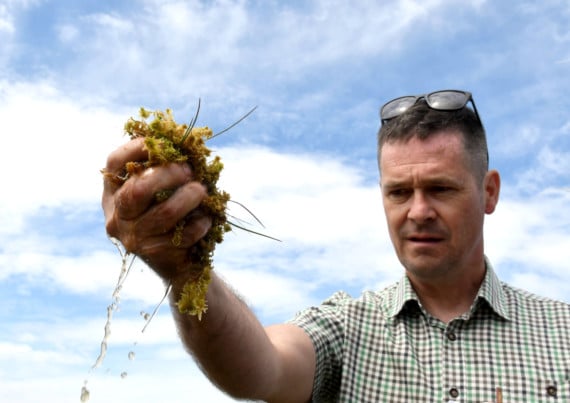
Peatlands are also excellent at storing water in the uplands, which can help to mitigate flood risk on land lower down. This is partly due to the sphagnum mosses which grow freely on peatland. This little plant can typically hold 20 times its own weight in water. You can squeeze it out with your hands, and sheep and cattle will drink through the moss.
On level areas sphagnum can grow in continuous carpets, but on slopes it can also form hummocks amongst the grasses and heather. Either way it manages to hold onto water, even in droughts and helps to ’slow the flow’ during heavy rain, which can help to take the sting out of rain storms, reducing downstream flooding.
It’s also a wonderful habitat for rare wildlife and plants. The sundew plant, which is a carnivorous plant, traps insects on its sticky leaves in order to absorb nutrients. Other plants such as cotton grass, heather, blaeberry and marsh orchids also thrive in such habitats. The wet bogs and shallow pools support numerous types of insects which in turn provide a food source for our upland birds.
’Skylarks, meadow pipits, red grouse and curlews, all of which nest in the uplands, rely on wet, damp areas because their chicks only eat invertebrates for the first few days,’ explains Shaun.
Glen Jeeves, project officer with the government climate change team, says: ’For me it’s not just about carbon capture, it’s about biodiversity. We have to acknowledge that there’s a global biodiversity crisis.’
Comments
This article has no comments yet. Be the first to leave a comment.