
Do cats really have nine lives?
Well, scientifically, of course they only have one life. So where does the belief that they have nine come from?
Historically, in ancient Egypt cats were revered as divine creatures and the idea of them having multiple lives may have its origins in this association.
Culturally, the number nine is seen as an auspicious one in many parts of the world.


.jpeg?width=209&height=140&crop=209:145,smart&quality=75)
.jpeg?width=209&height=140&crop=209:145,smart&quality=75)
But the most probable origin of the ‘nine lives’ notion is that cats have a ‘righting reflex’ which allows them to twist and turn when they are falling through the air from a height, enabling them (more often than not) to land on their feet.
A new study by scientists in Japan has shed fresh light on how cats seem to defy the laws of physics, and in particular the rule known as the conservation of angular momentum.
This states that if an object is not spinning to begin with it cannot start spinning unless something pushes on it from the outside.
The answer, broadly speaking, is that a cat is not a rigid object – it can bend its body, and twist different parts of it, to keep its overall level of spin at zero whilst still managing to reorientate itself. But despite the first scientific paper on falling cats being published in 1700, the precise movements of the cat have never been conclusively established.
The Japanese scientists measured how many different parts of a cat’s spine respond to twisting forces, using cadaver specimens to test strength, stiffness and range of motion.
They also filmed two live cats falling from a short height and tracked how their bodies moved. They concluded that the front portion of a cat’s spine is incredibly flexible and capable of twisting through more than 45 degrees, whereas the back portion is much stiffer and heavier.
The filming showed that the cats did not twist everything at once, with the lighter front half of the body moving first and the heavier rear a fraction of a second later.
This enables the cat to get its head facing down first so that is able it to see the ground as quickly as possible. Additionally, the momentum generated by the upper body rotation impacts on the lower body and helps the whole body to turn over.
This research, however, does not close the case entirely, and scientists need to undertake a scaled up version of their studies to investigate whether every cat falls in the same way, or whether some use more of a ‘tuck and turn’ technique. We can only hope that the research is carried out with no harm done to the cats involved.
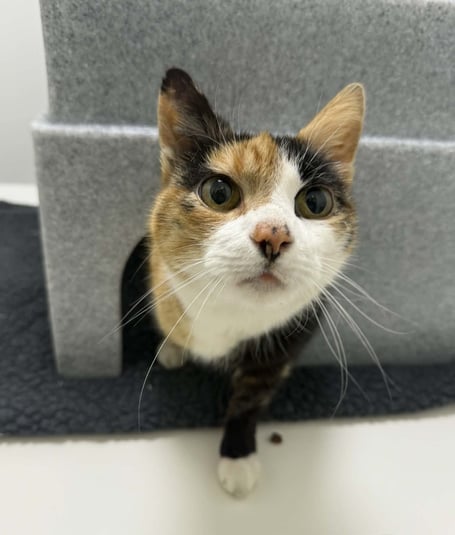
Our ‘cat of the week’ is an elderly girl called Maisey, who walks with a limp and so it’s probable that she’s used up a good many of her nine lives.
She didn’t get on with the other two cats in her previous home, and used to wander the streets of Peel looking for attention and somewhere to sleep.
She’s a well know ‘girl about town’ (or should that be ‘city’?) and popular with people in Peel, but the time has come to make sure she’s safe and well-cared for in her own retirement home.
Ideally Maisey’s new home should have no other pets in it, or boisterous children, and she will need to be well away from Peel lest she try to go back to her old stomping ground.
She will need access to the outdoors, preferably a leafy back garden where she can sunbathe to her heart’s content, and potter about when the mood takes her.
Maisey is a very affectionate cat, and although she’s in her twilight years at 14, she’s in good health and it’s highly likely that she will bring her new owner two or three years, maybe more, of good company and companionship.