
.jpg?trim=41,0,42,0&width=752&height=501&crop=752:501)
Last week’s article explored how a single cat is often a happy cat, and how introducing another cat into a household can be very stressful for all concerned. It has long been assumed that cats who are bonded, or at least ones who quite like each other, will display social behaviours such as sleeping together, touching noses, and mutual grooming (known as ‘allogrooming’).
But a new study (published in the Applied Animal Behaviour Science journal) suggests that the last of these behaviours may have less to do with affection and that it could be a subtle form of passive-aggressive cat bullying. Researchers in Belgium analysed more than a hundred cats by asking owners of cats living in pairs to film everyday interactions. They reviewed 23 different aspects of the cats’ behaviours, and concluded that while licking can strengthen a social bond it is also frequently deployed to annoy or intimidate another cat to obtain an advantage.
Allogrooming can be observed in many species and it is usually associated with hygiene, relaxation and the formation of social bonds (even sexual ones). But amongst cats this behaviour may not always be of a friendly nature.
The researchers found that cats usually groom areas of the companion’s body that were difficult to reach alone, and nearly 90 per cent of the time this involved the head, neck and ears. In friendly encounters the cats tended to sit or lie close together, often touching and adopting similar positions. They often remained huddled together, and sometimes fell asleep beside each other.
However, in more strained encounters one cat might stand or lean over the other, while the cat being groomed might turn its ears back, shake its head, lick its lips, swipe at the other cat, or try to bite it.
The researchers concluded that allogrooming, far from being a sign of affection, may be a subtle way of asserting dominance, and a covert method of resolving conflict. They further concluded that their findings underline how little we still know about cat behaviour, despite having lived alongside felines for thousands of years. Cat research is about 20 years behind dog research, and there are still plenty of questions to be answered.
Answering questions, and helping owners with their pets, is something the ManxSPCA cattery team are happy to do, using their years of experience and qualifications. This is not usually the case when you purchase a pet online from a ‘backstreet breeder’. In the last ten weeks we have noticed a worrying rise in the number of kittens being sold on Facebook – even though selling animals is, technically, prohibited on the platform.
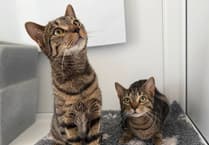
If you are interested in offering a home to a cat or kitten(s), then please do so in a way that gives you the best chance of a happy outcome. We have several pairs of kittens in our cattery at the moment, including two-month-old sisters Fawn (pink nose) and Flora (brown nose). They were born in shed in Maughold and brought to us for hand rearing (their mother has not been caught as yet). They are still quite shy, but given they’re so young they have plenty of development time to become more confident and outgoing.
As well as back up and support from an experienced team, when you adopt a cat or kitten from the ManxSPCA you take home an animal that is vaccinated, wormed, microchipped and either already neutered or spayed, or with a future procedure ‘booked in’ with our vet – all for an adoption fee of £200 for a pair of kittens (less for adult cats). This is economically beneficial,
and in the case of Fawn and Flora their spays would cost upwards of £500 in the commercial veterinary world.


.jpeg?width=209&height=140&crop=209:145,smart&quality=75)
Fawn and Flora’s names seem to be more ‘normal’ than ones you have may seen in the past, but rest assured that the cattery team’s naming creativity still knows no bounds and we also have kittens called Morganna and Guinevere, Wolf Castle and Szyslak, and Agnes and Duff!
Comments
This article has no comments yet. Be the first to leave a comment.