
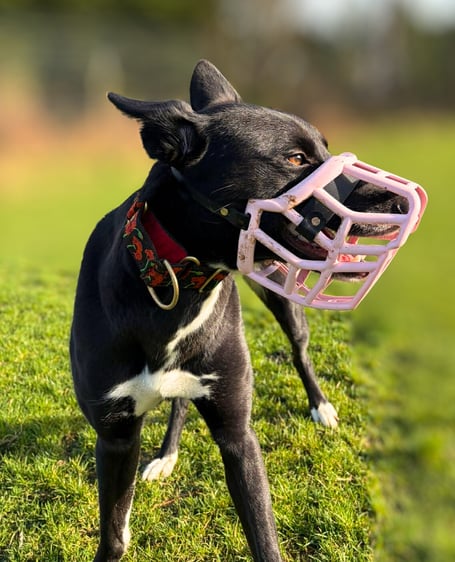
Join the MSPCA for ‘Muzzle March’, a month when we will be promoting the use of muzzles and helping dog owners to find the most appropriate design for their canine companions.
Every dog should be able to accept a muzzle in case of an emergency, even if they don’t routinely need to wear one.
Dog owners should practice putting on a muzzle from time to time in readiness for those occasions when it might be required – the most likely one being when the dog is in pain and needs to be treated by a veterinarian.
There are two main types of muzzle – the basket and the soft. The basket muzzle looks exactly as you would expect – like a basket strapped to a dog’s nose and mouth.
.jpg?width=209&height=140&crop=209:145,smart&quality=75)


.jpeg?width=209&height=140&crop=209:145,smart&quality=75)
They can be made of leather, plastic or rubber and can be bought in the appropriate size to fit your dog from a pet shop, or made-to-measure by a specialist firm such as ‘The Muzzle Movement’. We also have a selection for sale in the MSPCA’s reception area.
The ‘prison bar’ appearance of basket muzzles makes them look like the least humane choice, but the opposite is true.
In fact, many dogs seem more comfortable in basket muzzles than in soft ones because their mouth isn’t being held closed, and most basket muzzles allow dogs to open their mouths to eat, drink and pant.
Soft muzzles are made from bendy fabric such as nylon or leather, and they wrap around a dog’s mouth and hold it closed.
They prevent a dog from panting which is the most effective way he or she has of dispersing heat, and so soft muzzles should never be used in hot weather.
Because a dog can’t open their mouth with a soft muzzle they should only be used for very short periods of time, and for a very specific purpose. Also, if they are used as part of a training programme, it means that you can’t reward your dog with a treat.
Some dogs readily accept a muzzle being placed on them, but others need a lot more gentle persuasion. The first time you put a muzzle on a dog should not be the first time you need to put a muzzle on them, and most dogs will accept a muzzle if they are introduced to it in a low-stress situation.
Over a period of several days, there are a series of steps you can take to gently introduce your dog to a muzzle:
- Let them sniff the muzzle, give them a treat, and repeat a few times
- Touch their nose with the muzzle. Treat and repeat.
- Hold the treat at the end of the muzzle so that your dog has to place their nose into it to get the treat. And repeat.
- Gently slip the muzzle onto their nose, and then remove it immediately. As with all these remaining stages, keep treating and repeating a few times.
- Put on the muzzle and fasten the buckle, then remove.
- Keep doing this, and gradually increase the length of time the muzzle is left on for.
Muzzles are not a sign of a ‘bad dog’ – they are a positive choice for safety and training made by responsible owners. They can even be a fashion statement if pink or orange are your dog’s thing!
We’ll be rounding off ‘Muzzle March’ with a celebratory on-lead dog walk along Douglas Promenade on Saturday, March 28 at 11am (meeting in the Bottleneck car park).
The MSPCA team will be on hand to provide advice about muzzle types and fitting.
If beautiful Athena is still in our rescue kennels at the end of March, she will be showing off her favourite Muzzle Movement bespoke muzzle and joining in the walk.
Athena is an 18-month-old greyhound cross husky who has lots of energy and enthusiasm, and who needs to be with an active owner who can keep up with her.
We think she would be best suited to a home with another young dog, in an environment that can meet both her physical and emotional needs.