
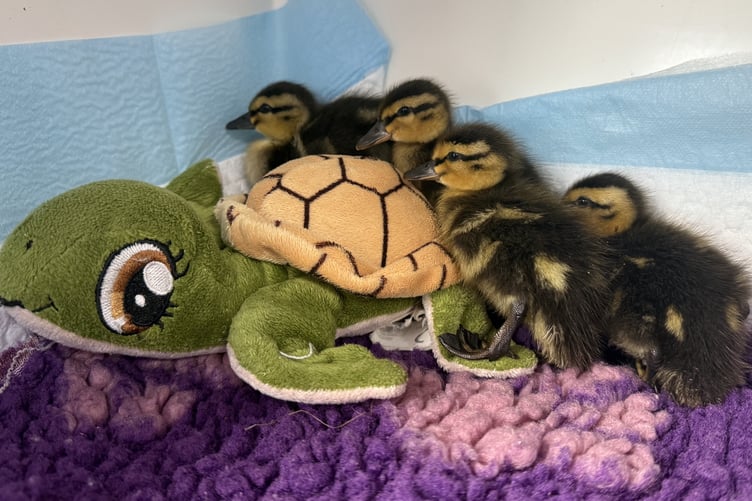
Baby bird season is well and truly underway, and in addition to the adult birds we currently have in our aviary, we now have 32 ducklings, 17 young rooks and nine herring gull chicks.
At least one of the groups of ducklings came to us as a result of their mother being scared away from them by passers-by.
You may encounter a mallard mother escorting her brood along the side of a road, or trying to cross it. If you think she and her offspring are in danger of being run over, and if it’s safe to do so, do what you can to alert oncoming traffic until the birds have reached safe ground. But take great care not to frighten the mother lest she panic, fly off and then not return.
And if you encounter a duckling or group of ducklings and assume they have been abandoned, apply the ‘watch and wait’ principle.
-(1).jpeg?width=209&height=140&crop=209:145,smart&quality=75)

.jpeg?width=209&height=140&crop=209:145,smart&quality=75)

Try to observe the young birds for at least an hour, from a reasonable distance - it is more likely than not that a parent will appear.
If there is immediate danger from a predatory cat or passing vehicles, carefully place the young birds in a safe place as close as possible to where they were found so that the parents can see and hear their offspring.
The ducklings that are brought in to our aviary spend their first few days in heated incubators (co-incidentally, the collective noun for ducklings is an ‘incubation’), and although they can swim from day one of hatching they are at risk of drowning and so they have to be supervised when they are in water. For this reason their drinking water is provided in very shallow bowls and specialist containers.
When they are old enough, the ducklings transition into heated indoor pens, then unheated indoor pens, and then into an outdoor pen where they can develop their swimming skills in large water troughs.
At about eight weeks of age, the ducklings are released back into the wild in various locations across the island – these locations mainly comprise privately-owned gardens or estates with large ponds.
Moving onto the rooks in our care, it is most likely that all of them needed to be rescued because once they have fallen out of their nests and landed on the ground their parents will no longer feed them.
Adult rooks want their fledglings to ‘branch’ (climb up a tree) and the rookery will call out loudly to youngsters to encourage them to do this.
Once on the ground a young rook will either starve to death, since they can’t feed themselves for at least a month after they fledge, or be predated.
However, a very young herring gull (i.e. a small, fluffy one) on the ground does not necessarily need to be rescued. It is likely to have fallen off a roof, and if it’s safe to do so it should be placed back on or near its nest, and its parents will continue to feed and protect it.
A young gull that is bigger than a human fist and has shed its downy feathers probably doesn’t need to be rescued. It may seem helpless and be shouting for its parents, but it needs to be on the ground for a few days in order to develop its flight feathers. Its parents will be close by, and so the ‘watch and wait’ policy applies here too.
The majority of queries we receive at this time of year relate to young gulls and their protective (interpreted by some people as ‘aggressive’) parents, with callers complaining that they are being dive-bombed, or that their dog can’t go into their back garden without being attacked.
Our response is always that this activity only lasts for a few days; that the herring gull is an endangered species; and that to disrupt the feeding (or otherwise harm) a gull is illegal. They are protected under the Wildlife Act 1990, as are their nests and eggs.