
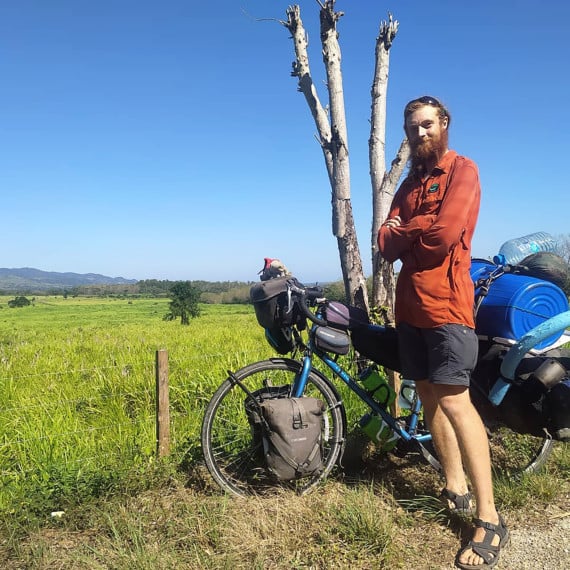
Colin Bankes-Jones has just reached Guatemala as he marks two years into his solo bicycle tour across the American continents.
So far, he has travelled almost 12,427 miles.
The former Queen Elizabeth II High School pupil set off from Manchester Airport in March 2019, landing in wintry Toronto, Canada.
Colin, who lives in Foxdale, started the trip after graduating with a degree in physics from Aberdeen University, with the aim being to ’explore the world, experience its cultures and to discover what I want to do with my life’.
.jpeg?width=209&height=140&crop=209:145,smart&quality=75)

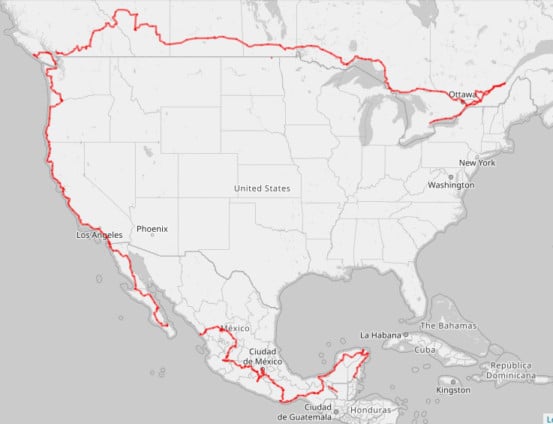
The first leg of his transcontinental journey involved venturing eastward to reach Quebec, before turning around and riding across the width of Canada until he arrived in Vancouver in July 2020.
The cycling through the Canadian mountains ranged from being able to attain downhill speeds of 50mph on its expansive highways, to avoiding cougars in narrow rocky passes.
Along the way Colin would either stay with hosts arranged via the online hospitality services of ’couchsurfing’ or ’warmshowers’, or would pitch his hammock in the wild and sleep under the stars.
However, he said he generally sticks to the rule of not stopping for longer than a week, as this results in a loss of muscle density in his legs that can make it feel ’like starting from day one’ when he gets back going again.
A keen guitarist, Colin did make an exception of stopping for the Winnipeg Folk Festival, and he carries with him a collapsible travel guitar for busking along the way.
From Vancouver Colin travelled down the U.S. west coast, and he told us that the highlight of this stretch was seeing the giant Sequoia trees in the national parks of California and Oregon.
This was followed by another standout in terms of scenery, the Baja Peninsula of Mexico.
It was here where Colin’s first real break from the road came about because of the pandemic, being forced to stop for three months in the Baja California region of Vincente Guerrero, as the Mexican federal government placed the country into lockdown. He said that once he got going again the restrictiveness of Covid-19 measures varied widely from state to state and that he was fortunate to have avoided ending up in some states before they were fully locked down.
Colin said that the most difficult part of the journey was a section of road in Mexico which was ’usually problematic for travellers, because the locals close it off and they want fees and bribes’.
’So to combat this we [as he was cycling with a fellow traveller at the time] tried to take an alternate route, which worked perfectly until maybe about 30 to 40km from the end of the route, where it turned to dirt and went to about a 10 to 15% gradient [of steepness].
’So it was getting off the bike and pushing it on loose gravel, up switchbacks [zig-zagging trail].’
He likened this to a similar experience in the U.S., the ’lost coast’ in California, which had sections of 20% gradient - resulting in him needing to walk the bike for up to 18 miles.
Colin has also suffered numerous mechanical problems, some being so serious that he needed to walk the bike 31 miles up and down Mexican hills until he could hitchhike to a nearby town to access the tools to fix it.
’Not the most enjoyable day, but manageable,’ he said. Having previously worked as a bike mechanic, he can fix most technical issues on the spot as he carries most of the necessary tools and parts with him, which he said ’makes the bike heavier but it’s worth it, especially in some of the more remote place’.
He added that he goes through parts like brake pads and chains ’like nobody’s business’.
Other challenges included the changes to a hotter climate in Mexico, causing muscle cramps which require him to go through lots of water, rehydration sachets to replenish salts, and ’eat tons of bananas and apples’.
For navigation, he either uses direct, main roads, or cycling trails - using an app on his phone for these, although they ’sometimes finish in dead ends , or rivers’.
However, he said he has not ventured too far into the wild as his bike is not equipped to handle high gradients of steepness, particularly with its weight, and the fact it is fitted with road tyres.
His bike is also laden down with pannier bags for supplies - and now that he is in the hotter climates - large plastic containers of water.
Colin said that he has met many interesting individuals along the way - most recently a group of people who were running a charity project which aims to get disabled people up and down ancient Mexican pyramids.
He continued: ’When Covid started I didn’t have many places to go [In Mexico] and I was taken in by a family who were incredibly kind, and I ended up staying there for about three months waiting for the end of the quarantine - and they were very helpful, courteous, very welcoming, to the point that they are family to me, or not far off.’
Asked about whether he gets homesick, Colin said: ’Yeah I do get bouts of it every so often,
’When Covid started and I had to pause my trip I did get homesick.
’I think that whilst I’m on the bike my body is producing a lot of endorphins, so when I stop my mood slopes a little bit - these moments are when I think of home, and I think that I could be back there on the sofa eating chips or whatever.
’But [those moments] are few and far between, and though Covid has certainly inspired a lot more of them - to some degree now I have come to accept the bike as home, so homesick has a different definition for me now.’
Colin’s travel blog on Facebook is named ’The Cicloviakingo’ - the ’cycling viking’, because this is what people in Mexico had taken to calling him because of his long, red hair.
The complex situation with Covid-19 border restrictions in South America has added uncertainty to his plans, though he is currently able to travel freely from Guatemala, through El Salvador, Honduras and Nicaragua. His ultimate goal is to reach the southernmost city of South America - Ushuaia, in Argentina.
He expects this will take him another 1.5 years of travelling, but says that he is ’looking forward to experiencing every second of it’.
Comments
This article has no comments yet. Be the first to leave a comment.