

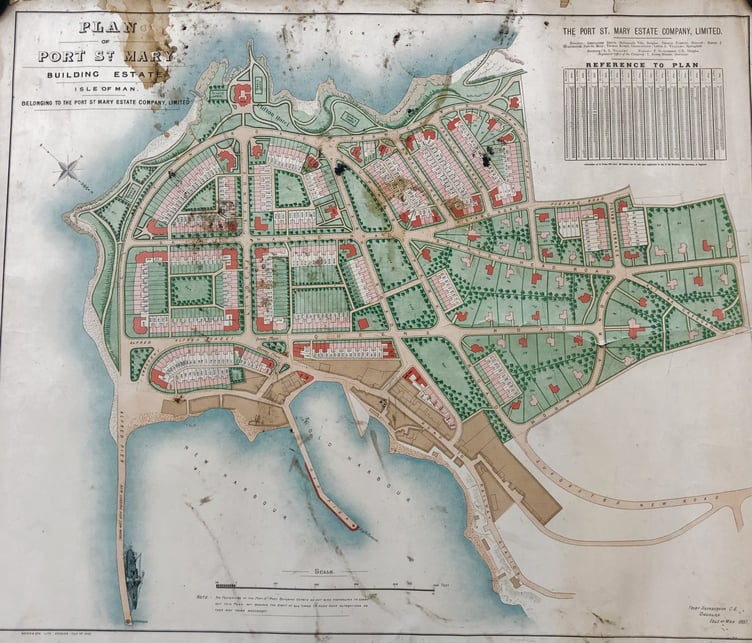
With its wide tree-lined avenues and neat rows of houses set around communal green spaces this is a vision of what might have been for Port St Mary.
The village would look very different today if this proposal, for many years displayed on a boardroom wall at the town hall but now held at the Public Records Office, had come to fruition.
The impressive plans were drawn up in 1887 for the Port St Mary Estate Company Ltd by noted civil engineer Frederick Saunderson, who went on to design and build the Manx Electric Railway.
In total there were to be 507 building plots on land which now forms the golf links.
 Woman found guilty of ASBO breach claimed she had pulled over to read her Kindle
 Road closed as repairs carried out to building's storm-damaged window
 Storm Bram brought one of the island’s strongest gusts in a decade, forecasters say
 New organ donation law to come into force as island urged to ‘make informed choice’
On the map you will find never to be built Armada Street and Spanish Head Road, Upper Park Road and Mount Vernon, accessed it was suggested by a new road running along the eastern slopes of the Cronk.
But other documents held at the Public Records Office chart how the Port St Mary Estate Company’s grand plan ultimately fell apart.
It was certainly an ambitious project as the memorandum of association from March 20, 1888, makes clear.
The aim of the company was ‘to purchase, or otherwise acquire, the estate of Port St Mary Farm and any land at or near Port St Mary and Perwick Bay and to construct and maintain roads, tramways, streets, gasworks, waterworks and sewers for the improvement of Port St Mary as a health and leisure resort’.
It was to sell, lease, exchange and grant concessions for plots in the estate for cash, rent or shares and ‘to erect or employ others in the erecting, dwelling houses, villas and residential properties, hotels and other buildings upon the land so acquired’.
Tramways would be constructed of any gauge wherever it may be thought advisable and these were to be moved by ‘horse, steam, electricity or any other applied power’.
At the first meeting of the company’s directors on June 18, 1888, it was resolved to form Queen’s Place, Alfred Street, Clifton Road and Park Road ‘at once’.
It was requested that two horses, carts and harness were purchased and Mr Saunderson directed to engage labourers to carry out the work.
Offers on plots 336 and 386 were accepted with the condition that not more than two houses be built on each plot and work started within two years.
By the second board meeting, on October 9 that year, the purchase of the Port St Mary Farm estate had been completed.
Shares in the company were allocated, plots 387 to 405 offered for sale and it was agreed that a Crown licence be taken out to quarry stone for the whole estate.
Minutes of the third meeting on February 8, 1889, show Mr Saunderson was charging £1 and one shilling a day for his services plus rail fare. At the same meeting it was resolved that the old cottages in Lime Street be taken down.
An eighth meeting of directors was held on November 13, 1889, when it was resolved to construct the portion of Queen’s Road lying between Queen’s Place and Park Road together with Linden Avenue.
In June 1890 the directors met representatives of the Steam Packet to discuss the question of the boat calling at Port St Mary on its way to and from Dublin.
The minutes read: ‘It was proposed that the steamer come within a mile and a half of the Port and be there met with a steam launch to embark and disembark passengers.’
To this proposal however the Steam Packet Company ‘declined to accede’.
It was perhaps a taste of the problems to come.
At the 16th meeting of the company in December 1890, it was resolved that a tender awarded to build 10 homes on the estate was postponed ‘in view of the small demand for houses in Port St Mary existing at the present time’.
By early 1892, the directors wrote to Estate Company foreman William Caudle to inform him that as the work on the roads was now only to keep them in repair, his services would be retained on a reduced rate of 17 shillings a week.
The minutes show sums of £1,000 had been borrowed on promissory notes from local landowner Edward Qualtrough at an interest rate 4.5%.
In 1895 the company sold seven plots to the Primitive Methodists for £206 for a new chapel and gave an £11 donation to the building fund for what was to become Mount Tabor.
That same year, the minutes note that the company was having issues with trespassers.
In 1897 a suit was taken against the town commissioners in a dispute over rights of way. Agreement appears to have been reached, with a further meeting arranged to settle boundaries.
At a meeting June 1900 directors were told that a number of shareholders had been adjudicated bankrupt.
At the same meeting it was proposed that a bond and security be passed to Edward Qualtrough for the principal sum of £6,000 in lieu of the existing promissory notes of £4,000 and bond of £2,000, with interest of 4% per annum payable half yearly.
The board admitted by August that year that the company hadn’t got the cash available to pay the £279-15-9 interest accrued on the promissory notes and bond. It was agreed to pay them off and take out a new bond for £6,500 together with a promissory note for the outstanding £279, 15 shillings and nine pence.
By 1903 it was clear the company was in trouble.
At a meeting at the company’s office in Port St Mary on February 10 that year the directors spoke of their regret that the company was not making progress derived from the sale of land, and the accounts for the year showed a deficiency of £53, 10 shillings and seven pence.
Under these circumstances they decided to submit a resolution that as ‘the company is not making satisfactory progress and the yearly income does not meet the expenditure, that the company be wound up voluntarily and a liquidator be appointed for that purpose’.
The position had not improved by May 20 the following year.
The directors called for an extraordinary meeting of shareholders to be held at the company’s registered office in Athol Street, Douglas, on June 14, at which the following resolution was submitted: ‘That it has been proved to the satisfaction of this meeting that the company cannot by reason of its liabilities continue its business and it is advisable to wind up the same and that a liquidator be appointed’.
The final meeting was held at the offices of the liquidator in Athol Street on August 3, 1911 when it was resolved that the winding up had been concluded and the company’s property disposed of.
It was further resolved that the company’s books, accounts and other documents be destroyed after four months.
Fortunately for us the minutes have survived, and can be examined on request at the Public Records Office, along with a treasure trove of other documents.
Some traces remain of the Port St Mary Estate Company’s grand plan, giving a hint of what might have been.
There’s the wide boulevard of Queen’s Road and the sweeping curve of Clifton Road, complete with two early Baillie Scott-designed villas.
Clifton Road comes to a dead stop just beyond the access to Strathallan Castle, shown as the Clifton Hotel on the map. Instead of continuing round the coast as Perwick Road, it turns into a track, now part of the Raad ny Foillan footpath.
It really was the end of the road for the Port St Mary Estate Company.
Comments
This article has no comments yet. Be the first to leave a comment.