

From love potions to deadly poisons, battle dressings to a cure for nosebleeds, they are all to be found around the Manx coast and countryside - if you know where to look.
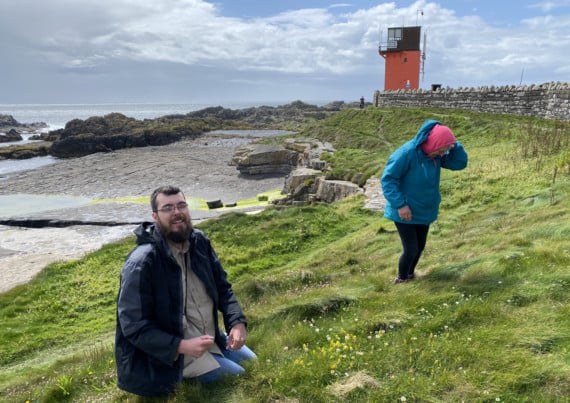
Amateur botanist Simon Smart was our guide for a wildflower walk around Scarlett, pointing out some of the flora beside the footpath and on the rocky foreshore.
It was the first of his Wildflowers of Man walks this year, Covid having forced the cancellation of planned events in spring.
A group of up to 20 set off from the car park, with Simon identifying the wayside plants and explaining their historical use in cooking or as natural remedies.


Alexanders, for example, were introduced to Britain as a pot herb by the Romans.
Quite how they ended up in the island then is a mystery, although their presence could be linked to the Medieval monastery at nearby Rushen Abbey.
We passed clumps of red valerian and common mallow with its striking pinky-purple blooms.
In the shallows of the flooded quarry, we found bogbean which has the fantastic Manx name of lubberlub.
Cushag’s honour as the island’s unofficial national flower was said to have been bestowed in jest by Governor Raglan, said Simon.
A mass of little pink blooms was identified as greater sea spurrey, which like the abundant thrift is a ’hyperaccumulator’ that can tolerate high levels of toxic heavy metals.
To the side of the path, we found the dainty yellow flower of creeping cinquefoil, used in times past, explained our guide, as a love potion.
In contrast, extracts from the roots of the white water lily we had seen in the flooded quarry are known as anaphrodisiacs, used by the monks of Rushen Abbey to lower the libido.
Further up the path, behind a gate, we found rock samphire, whose succulent shoots are edible although not as tasty as the unrelated marsh samphire.
Nearby was another edible plant that looked far from appetising but with the pleasing name of frosted orache.
Frothy yellow flowers were easily identified as lady’s bedstraw, used variously in the past as a dye, for cheesemaking and to stuff mattresses. It’s also a natural flea repellant.
Yarrow has been used for centuries as a first aid plant and it takes is Latin name from the Achilles of Greek mythology who used to treat the battle wounds of his soldiers.
A rolled-up yarrow leaf pushed up your nostrils could reputedly cure nosebleeds.
The plant was also said to have magical powers, helping fairies to fly.
Our guide pointed out kidney vetch and thyme and the little pink flowers of sea milkwort.
Cleavers, the well-known sticky weed, can be used as coffee substitute, explained Simon.
’But cook it first or otherwise it will stick in your throat!’ he said.
Back by the car park, Simon demonstrated how giant bindweed gets its popular name ’granny pop out of bed’ - squeezing in just the right place will send the flower spinning off its stem.
But he saved a real killer to the end - deadly poison hemlock.
With its umbrellas of white flowers and purple spotted stem, it may looked harmless but is anything but.
Its most famous victim was the philosopher Socrates who drank an infusion of hemlock when he was sentenced to death for corrupting the minds of young men.
There is no cure for hemlock poisoning which paralyses the respiratory tract.
While uprooting wildflowers is illegal, foraging is not - but our stroll around Scarlett showed you need to be very careful what you pick.
* You can find more details about the island’s flora at www.manxwildflowers.com or on the Wildflowers of the Isle of Man Facebook page.
Simon has also published a book on some of the best wildflower walks around the island.
Comments
This article has no comments yet. Be the first to leave a comment.