
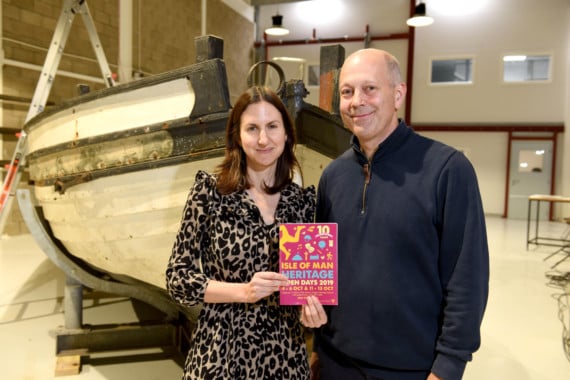
It’s a unique survivor - and focus of the most ambitious conservation project that Manx National Heritage has ever launched.
But as reporter Adrian Darbyshire found out, there are a lot of hurdles to overcome before the Peggy can come home to Castletown.
According to MNH conservator Chris Weeks, it is impossible to over-estimate the importance of the Peggy in the annals of nautical history.
She is the world’s oldest schooner and one of the oldest complete wooden sailing boats - the island’s answer to the Mary Rose.




But unlike the Mary Rose, she was never water-logged and retains her timbers and old paint, albeit covered by layers of oil paint applied in more recent times.
She has been housed in a purpose-built humidity-controlled warehouse on the Isle of Man Business Park since January 2015.
She moved here following a complex operation, many months in the planning, to remove her from her cellar in Castletown Nautical Museum on a specially designed cradle.
But Manx National Heritage conservator Chris Weeks said that the difficulty of that operation pales into insignificance to the work that lies ahead in finding Peggy a new home.
The idea is to house her, cosmetically restored complete with masts and rigging, in a purpose-built facility located in the old courtyard behind the Nautical Museum.
Chris said: ’We think the goal is a noble one but it’s not going to easy.’
Peggy was built in Castletown in 1789 for the wealthy banker and maverick inventor George Quayle for use as a pleasure craft.
She was clinker-built and you can still make out the marks left by an adze - a specialist axe - used to shape her timbers.
There is no other boat of that age built in that way surviving anywhere in the world.
Her survival is indeed remarkable. She was discovered in 1935 in a walled-up cellar, lying on her side. She had lain there forgotten since George Quayle’s death in 1835, with the tide running through her twice a day.
Some repairs were carried out by local craftsmen before the museum opened in 1951 but apart from some painting she has remained pretty much untouched ever since.
With many of her iron nails rusted through from old age and salt water, her timbers are effectively held together by paint.
But the dank cellar where she was kept for so long had at least retarded the fungal decay of her timbers which are mostly original.
Since 2015, she had been slowly drying out in the warehouse where humidity is strictly controlled to 65 to 75%.
Nevertheless, the drying out process has inevitably caused cracks to appear in the wood. And plans to replace the iron nails with wooden pegs, and strip the paintwork have also had to be shelved.
Having taken core samples, Chris believes there is a real danger the timbers could split apart and a third of the fabric of the boat could be lost. ’It would be a complete massacre and I don’t think it would be proportionate to the risk,’ he said.
Instead, the idea now is for a cosmetic restoration and for the boat to go on public display complete with its original masts, and rigging.
The proposed facility, still currently in the concept stage, would need to be at least 30ft high to accommodate Peggy’s mast and will have to hermetically sealed to prevent further decay, and it will need a sump to stop the yard flooding with the tide.
Chris said it will be at least another five years before a facility is built for her in Castletown - there will be consultation and architectural feasibility to go through before a planning application can be considered.
It is, he said, the most ambitious project MNH has ever attempted.
The new centre will include restoration of Peggy’s dock which was excavated as part of the project to extricate her from the cellar.
And it could perhaps also allow the public to see the secret cannonball-activated bank vault that George Quayle designed in Bridge House next door. Chris estimates the facility could cost £5m.
So far, just £30,000 of taxpayers’ money has been spent on the Peggy project. The cost of moving her from the Castletown into her purpose-bought current home has been paid out charitable funds.
But Chris believes money is not the problem. ’The problem is practical, intellectual and emotional. I know the money will follow,’ he said.
Comments
This article has no comments yet. Be the first to leave a comment.