
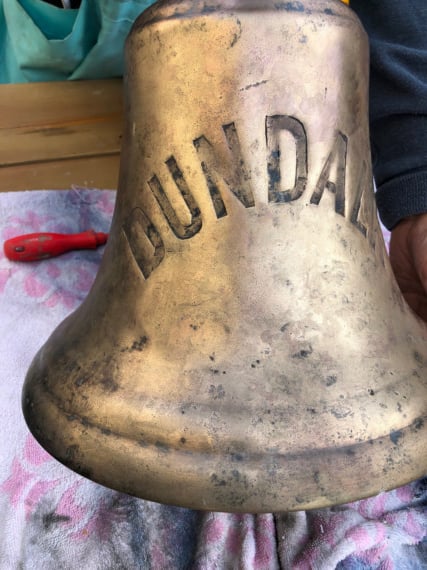
The bell of a ship sunk by U-boats during the First World War has been retrieved from the Manx seabed and will be returned to her home town at Dundalk.
SS Dundalk made weekly sailings between Ireland and the UK throughout the war years.
The crew knew the risks they took and in December 1917 she was the target of an attack by a German submarine.
That assault lasted about an hour and a half but the captain adopted a zigzag course and evaded the submarine. The captain and crew were commended for their bravery.
-(1).jpeg?width=209&height=140&crop=209:145,smart&quality=75)
.jpg?width=209&height=140&crop=209:145,smart&quality=75)
.png?width=209&height=140&crop=209:145,smart&quality=75)
.jpg?width=209&height=140&crop=209:145,smart&quality=75)
She was attacked again at 11pm on October 14, 1918, by two German U-boats, UB123 and UB90, during her return trip from Liverpool to Ireland.
After she was torpedoed she sank in less than four minutes and the explosion destroyed the lifeboats.
Twenty-one people were lost in the sinking and 12 survived in two small life rafts.
Most of those on board were local to the Dundalk area and the tragedy is still remembered by relatives of those who perished.
The 101st anniversary was commemorated last year in Dundalk at a memorial erected in 2018.
Dundalk dive club also visited the wreck last year.
Divers identified the wreck had items that could be recovered, so a team from Discover Diving in Port St Mary launched a recovery operation.
It was an audacious decision as the wreck, three miles south of the island, lies 60m down.
’It was deep, dark and scary,’ said Michelle Haywood, who dived with Steve Cowley and Anne Corkill.
’It was technically demanding and well beyond recreational diving limits.
’The team used rebreathers and breathed gas mixes including helium.
’The wreck sits upright, with the torpedo damage clearly visible around the boiler and engine room.’
The team visited the wreck three times and recovered a small porthole, the bell and a china wash basin.
SS Dundalk is not officially a war grave, but wrecks always provoke a sense of reverence said Michelle. ’Every wreck feels eerie, no one built a ship expecting it to end up at the bottom of the sea and there’s a trauma of the war wreck,’ she said.
The items will be sent on loan to their rightful home is at Dundalk’s County Museum.
Marie Agnew, secretary of the SS Dundalk Committee was thrilled by the recovery of the bell. She said: ’We were overjoyed, very emotional. Many of the SS Dundalk committee members are relatives of the crew of the SS Dundalk are delighted with the news describing it as "like closure" and "a home coming".’
Comments
This article has no comments yet. Be the first to leave a comment.