

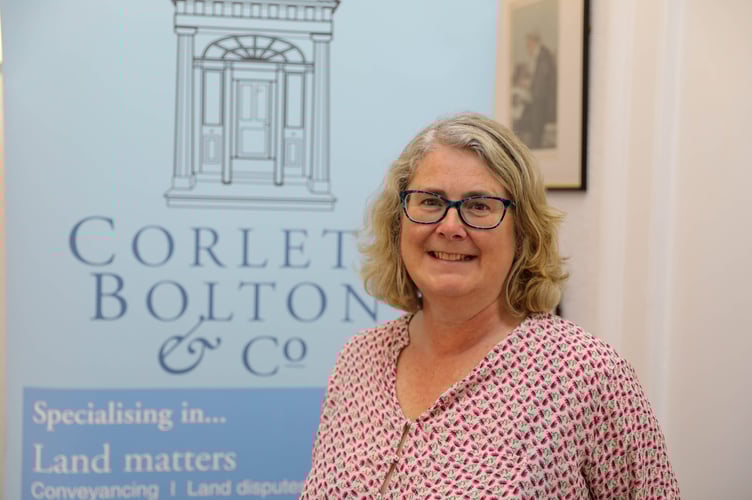
Never mind the high-profile litigation or the corporate work that some law firms chase, advocate Sally Bolton has built her legal practice, Corlett Bolton, around the everyday matters that affect us all.
She is known as the go-to person for family law in the island, and says: ‘There are always going to be people getting divorced, or having to do wills; there are always children needing assistance and we also do a lot of mental health-related work.’
Sally qualified in 1990 and, since then, she says: ‘The court practice and the legislation is a bit less confrontational. Most of the family practitioners will work with each other and a lot of us have done mediation training, so we do try to reach an agreement, even if the parties don’t want to.
‘Now, the things that you actually have hearings on are either housing, money or children.’




When it comes to the latter, Sally is also experienced in international family law and has been the advocate appointed by the Attorney General’s chambers to handle cases where children have been removed without permission from another jurisdiction.
The jurisdictions she has dealt with have included Italy, Poland, Pakistan, Australia and the US. These cases are not common on the island but they are complex, involving more than one country’s legal system, and are often deeply distressing.
Sally says: ‘When you’ve got people in two jurisdictions you have the equivalent of court welfare officer or social worker in each jurisdiction. The role of the court welfare officer is to provide a report to the court but often these children might be traumatised, they could be absolutely terrified about going back, and there isn’t any structure for giving support to a child who has to go back, or a child who has to stay here.
‘For one case we had where a father wanted a child returned to another country, the court welfare officer was fantastic and went out of her way to arrange the contact, and for the child to see her father and her brothers, but she didn’t have to do that, there is no provision for it and there’s no provision in international law for contact arrangements.
‘So it’s very difficult to give the child any support. I’ve had to pick up children myself and take them from one parent to see another.’
These cases are meant to be dealt with on a strict timetable but a child brought here can still have months without contact with the ‘left behind’ parent, as they are officially known. The child can get established in a new school and make friends and that can make it hard for them to be uprooted six months or more down the line.
‘And the court [here] has only very narrow discretion to allow the child to stay here because under international law the child has to go back to the country of origin, for the country of origin to make the decision.’
‘It’s a very complex area and, unfortunately for the child, its welfare is not always the most important criteria in those cases.’
It’s the reverse with relocation cases within British Isles, where the welfare of the child is the most important concern. And another change Sally has seen since she started practising is a shift away from the old idea that a child should always remain with its mother.
She says: ‘There is less of a presumption of that now because the focus is much more on the welfare of the child: that is always of paramount importance so there isn’t such an assumption that the mother is going to be the best person to be looking after a child.’
These cases, and many other aspects of family law, are what Sally characterises as ‘the emotional end of things’, and she deals with it in her own calm and careful way.
She says: ‘My thing with family work is always to look for how you’re going to get out of this. You’ve got to get a settlement that you can both live with for the rest of your life, especially if you’ve got children.
‘If both of you don’t like the settlement, that’s great, but if one of you really does, then it shows the other person is going to harbour resentment.
‘So it’s to get rid of that resentment that is the aim of a family lawyer, I think, to reach a settlement that doesn’t cause resentment to the detriment of the rest of the family.’
Her practice’s focus on family, rather than corporate, law has also led to a decision to provide their services on a more local basis, opening offices in Port St Mary and Peel, again an unusual move when most legal practices prefer to have a presence solely in Douglas.
Sally says: ‘It was basically our strategy, to concentrate on local business.
‘We’d always had a strong private client local business and we’ve worked with a lot of local business owners in a private capacity: that can be their, estates, divorces things like that.’
Sally’s fellow director, Nadine Roberts, works from their Port St Mary office and the acquisition of Gelling Johnson Farrant has seen Liz Parkes joining the practice’s Peel office, where she specialises in estate planning.
But Sally and the other Douglas-based advocate in the practice will also travel to the local office to see clients.
She says: ‘Being local helps clients because what we’ve found is that a lot of people don’t like coming into Douglas, particularly elderly clients because of the parking.
‘And, because we have a centralised computer system in the cloud, it means we’re able to work from all of these offices.’
Sally would be the first to say that what she has built her practice around is not the glamorous side of the law and as she says, her team are ‘not afraid of dealing with areas of higher emotion’.
But the services they offer cover issues that are likely to affect all of us at one time or another in our lives and maybe that is the blueprint for a successful legal practice.
Comments
This article has no comments yet. Be the first to leave a comment.